Icona che richiama un banner d'attenzione

FOR GROUPS AND SCHOOL PARTIES ARRIVING BY BUS: Please be advised that, due to ongoing works in the village, bus access may be difficult.
We therefore recommend parking in Via Cerretana and continuing on foot.

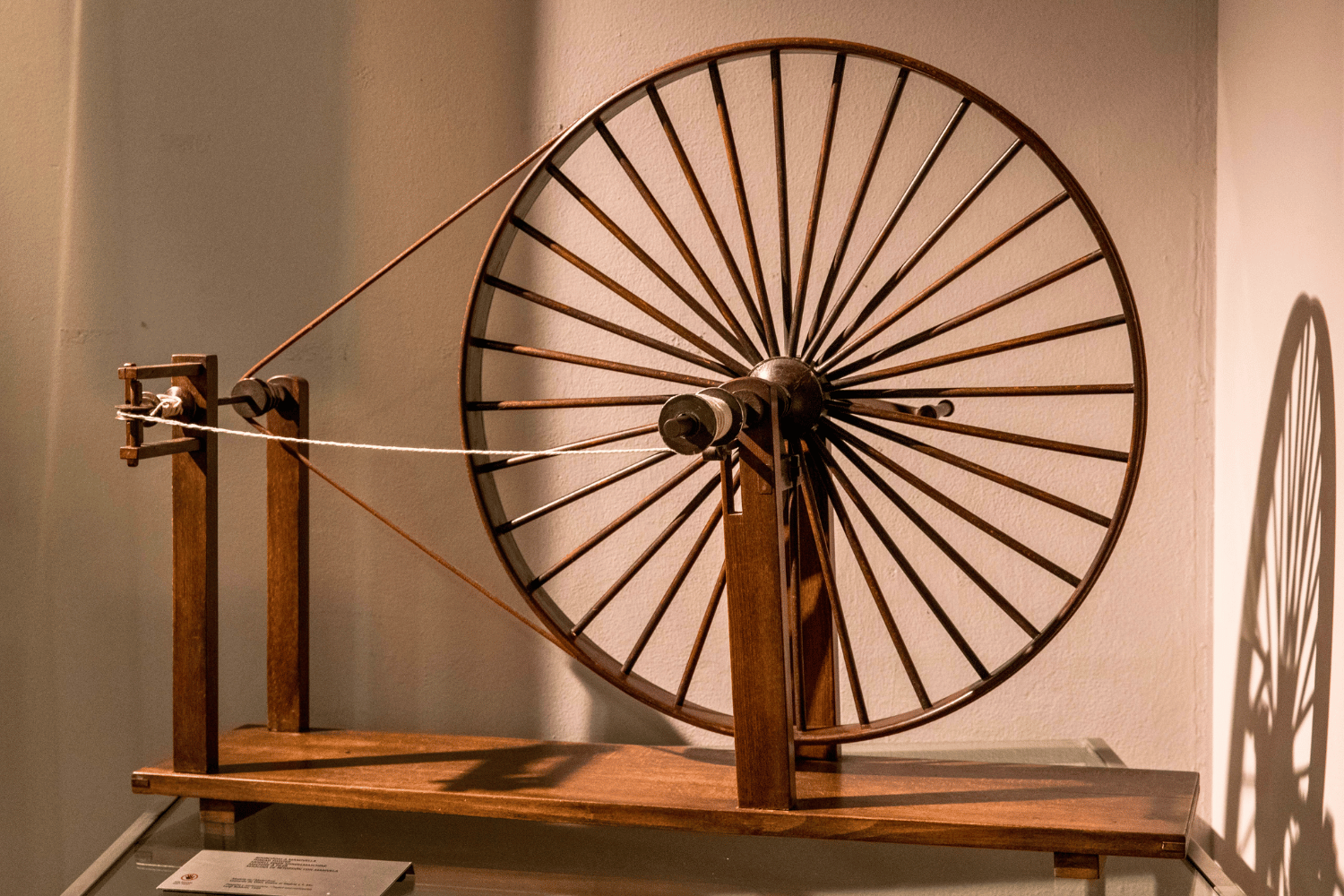
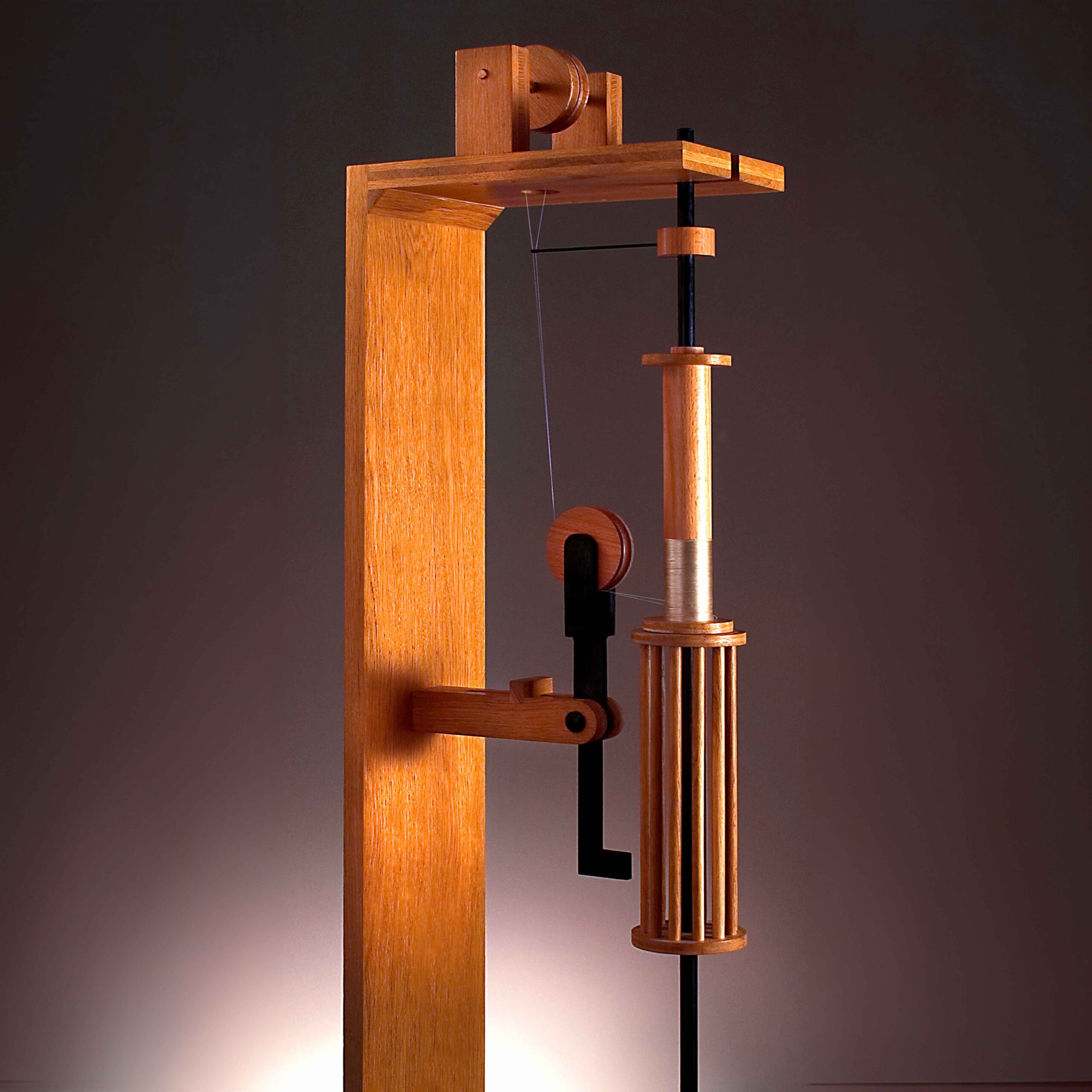
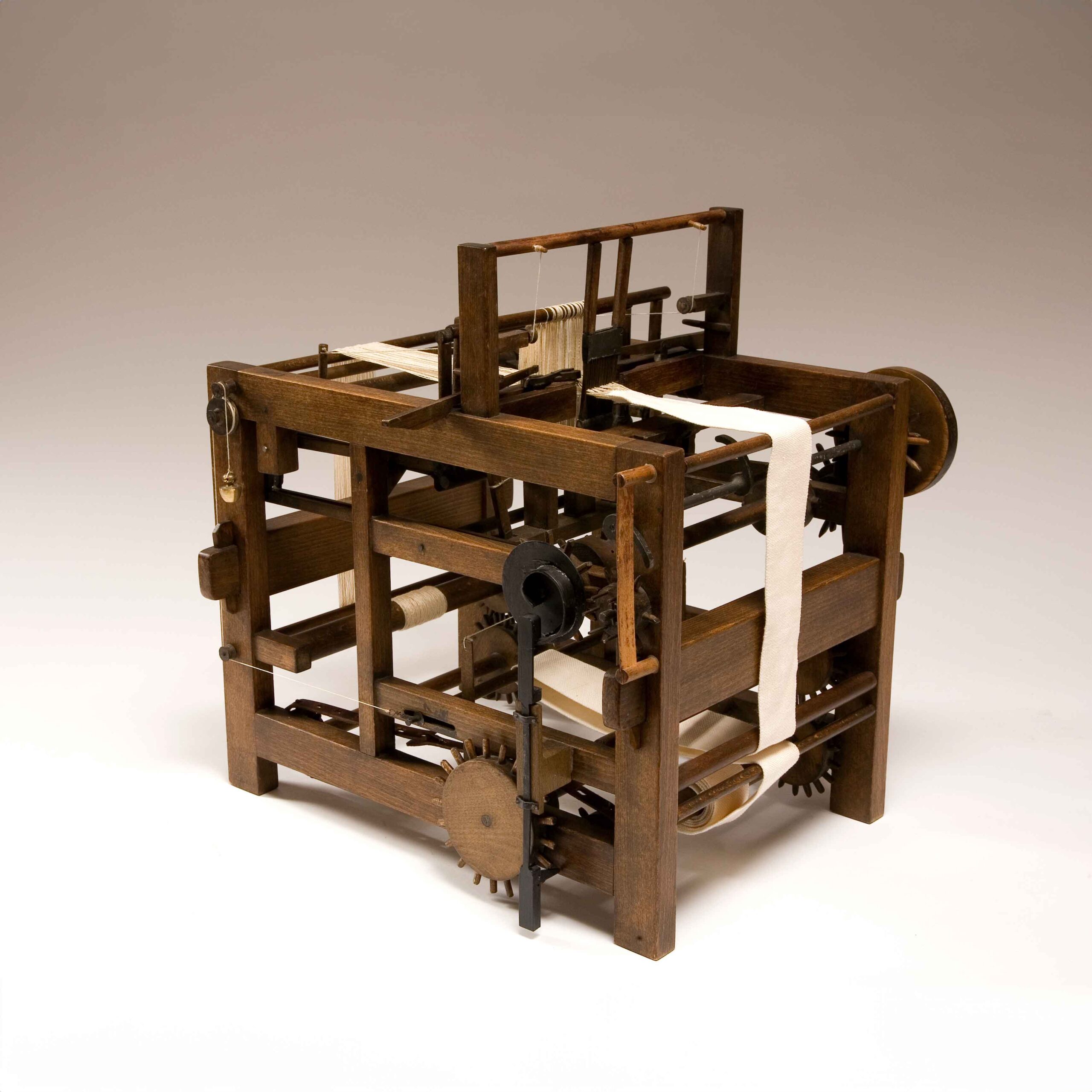
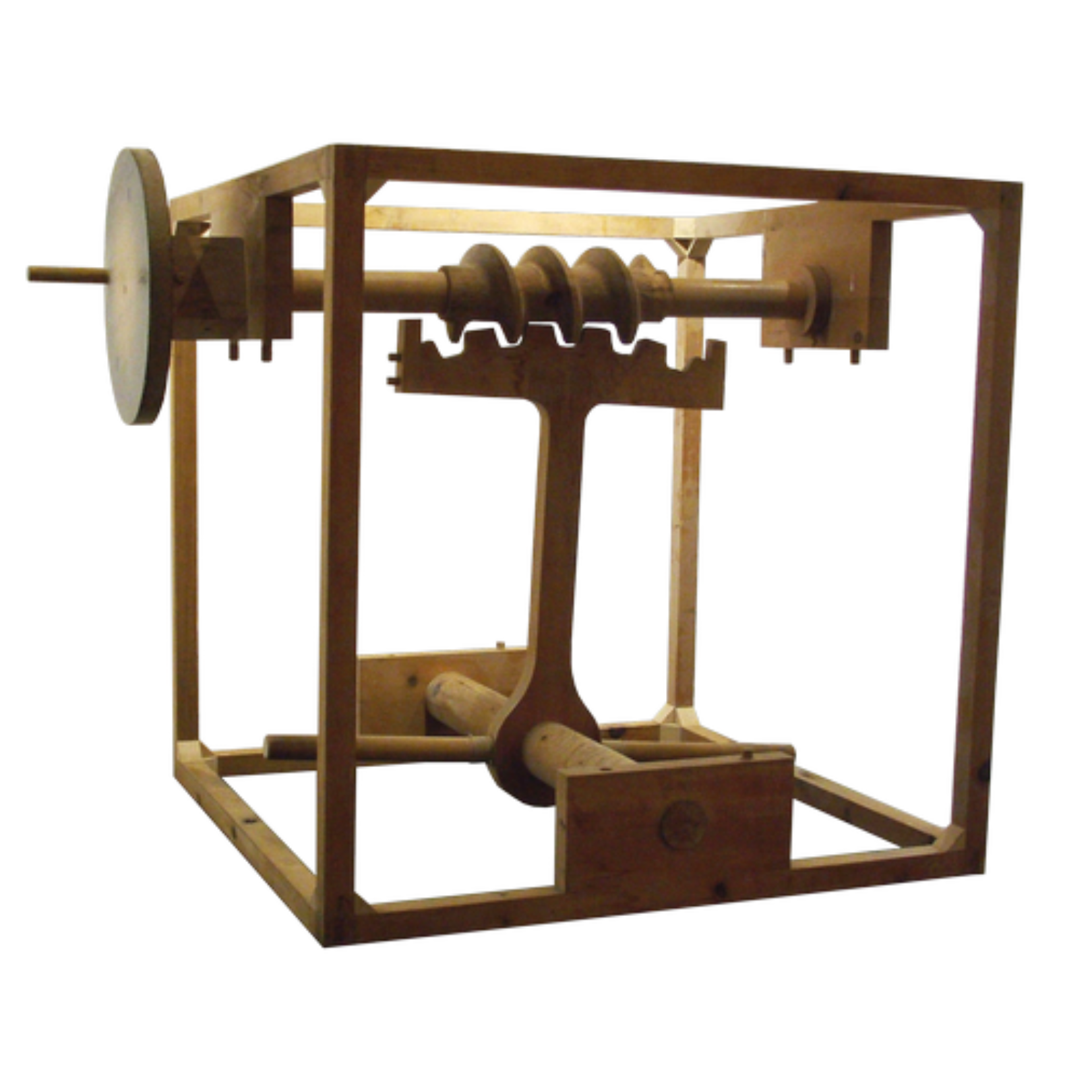
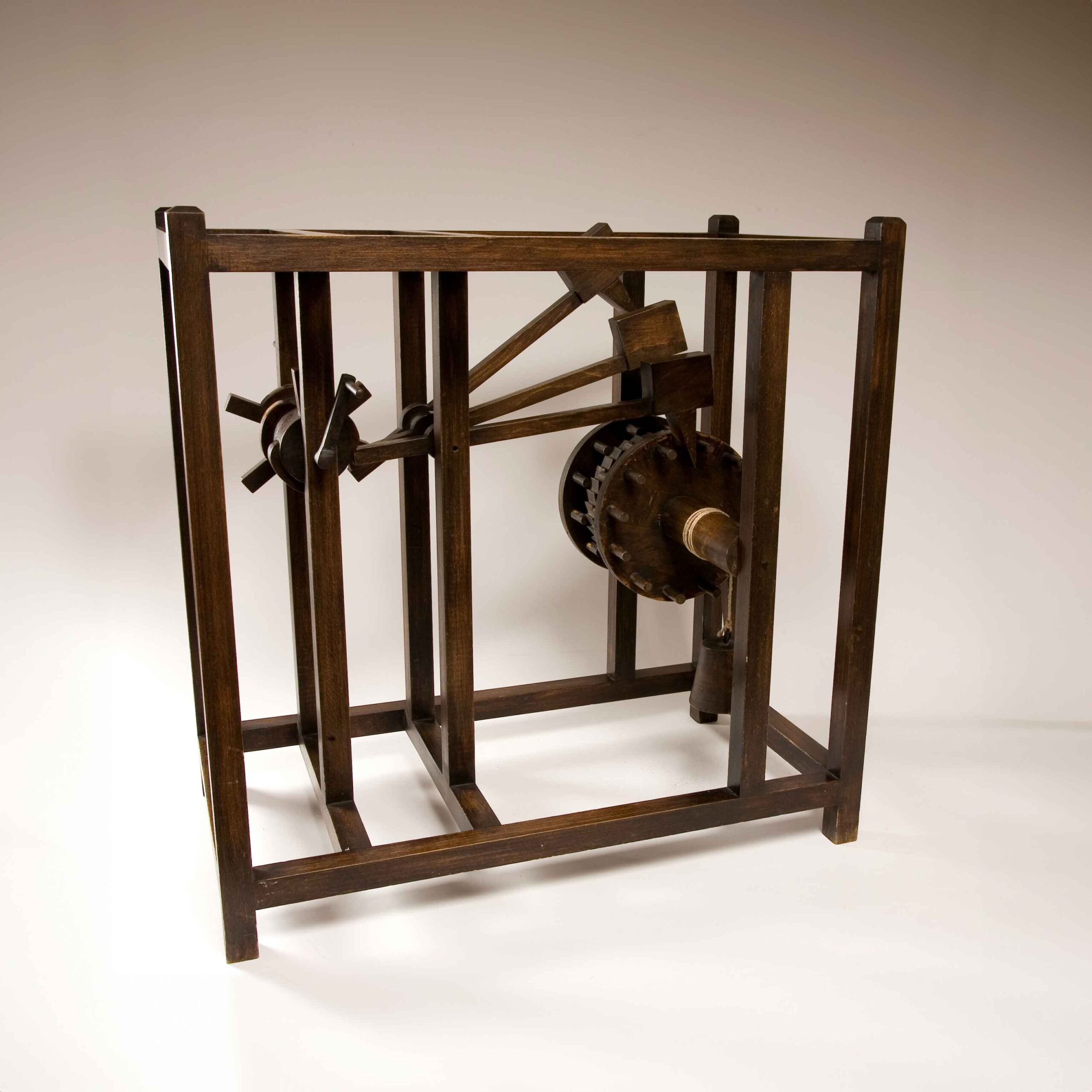
Crank-operated thread-twisting machine

Luigi Boldetti

1969

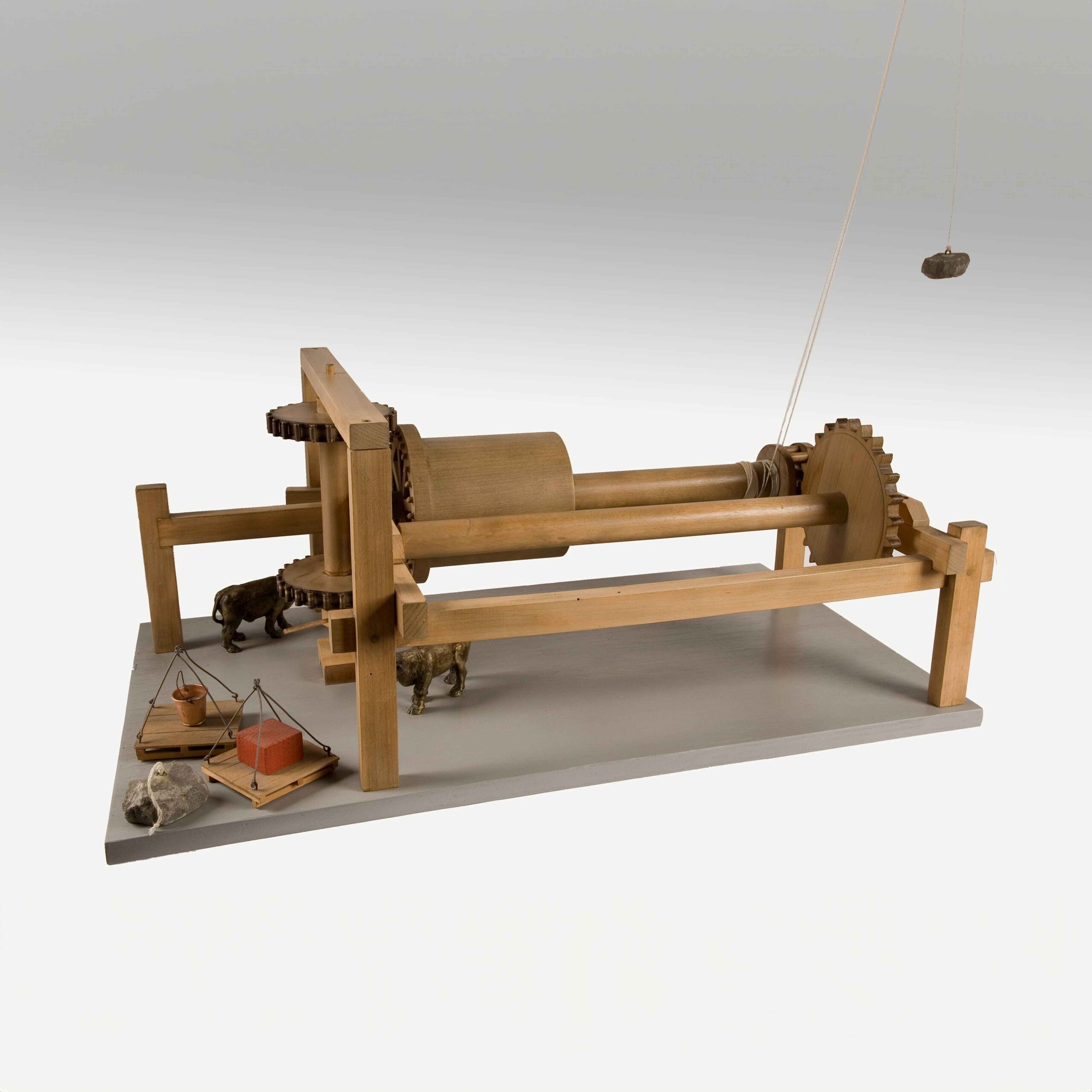
This machine was designed by Leonardo to automate the operation of twisting thread. This is the phase coming after the doubling of the thread, where the textile fibers are twisted to give more resistance to the thread.

The innovative device, probably conceived for work at home, was to function without the spinner’s having to feed the machine by hand, and without accumulation of thread on the bobbin. The large wheel, driven by the crank, is connected by a belt to a shaft on which the reel of doubled thread is fixed. When this thread passes through another small wheel, it is twisted and then wraps around the larger bobbin.
To provide a uniform distribution of the spun thread, the bobbin also performs a back-and-forth movement owing to an ingenious system for transforming the rotary motion of the principal wheel into alternating motion.

Technical informations

Type of exhibit
Model
Collection
Material
Partially turned carved wood, iron, wool thread, and leather
Measures
Width: 74.5 cm, Length: 100 cm, Depth: 55 cm
Storage location
Relationship with the original work
Source: Leonardo da Vinci, Madrid Codex I, f. 65 v
Inventory number
Object Record No.: 00000029
Location
Museo Leonardiano, Palazzina Uzielli, first floor

Last update: 22 September 2025, 09:03
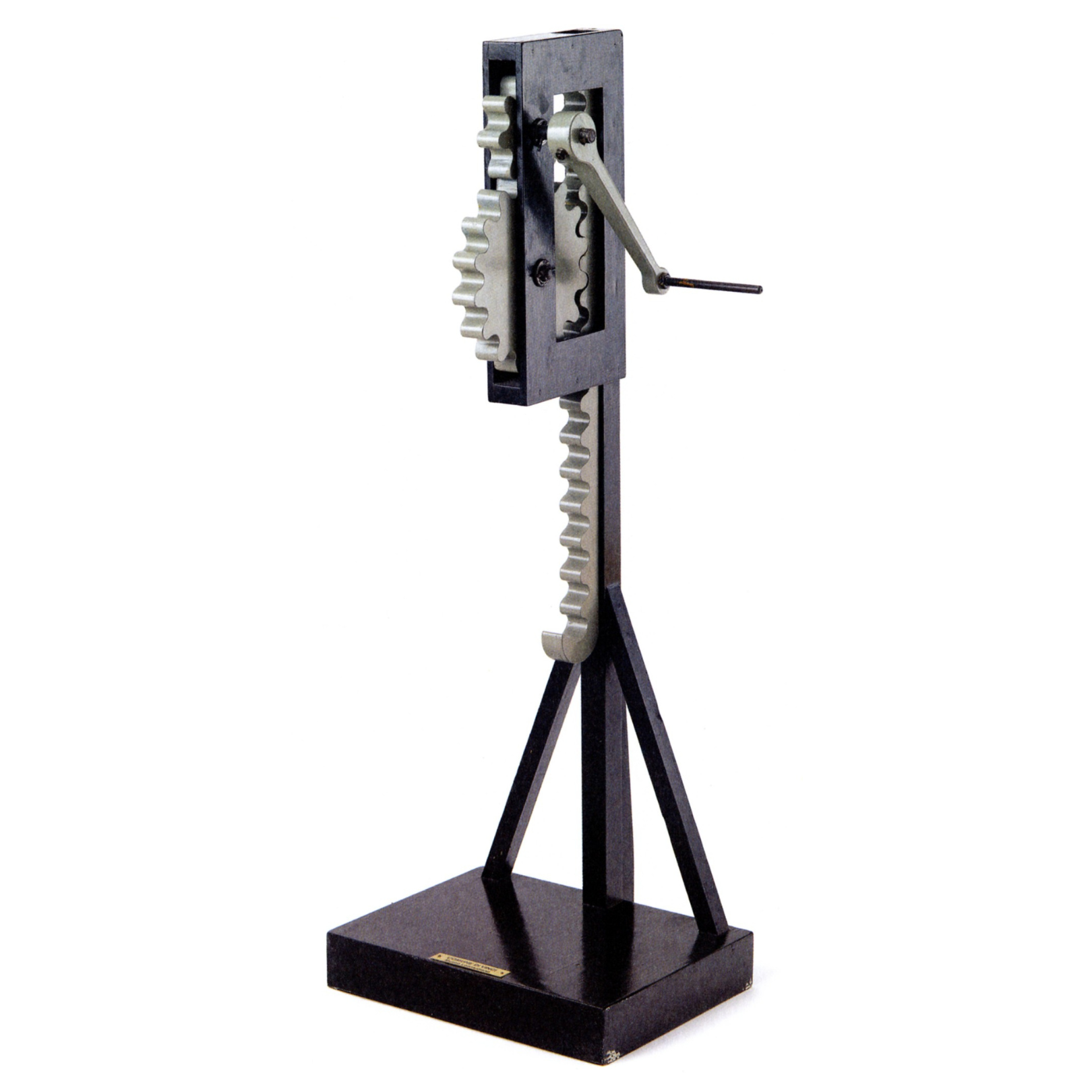
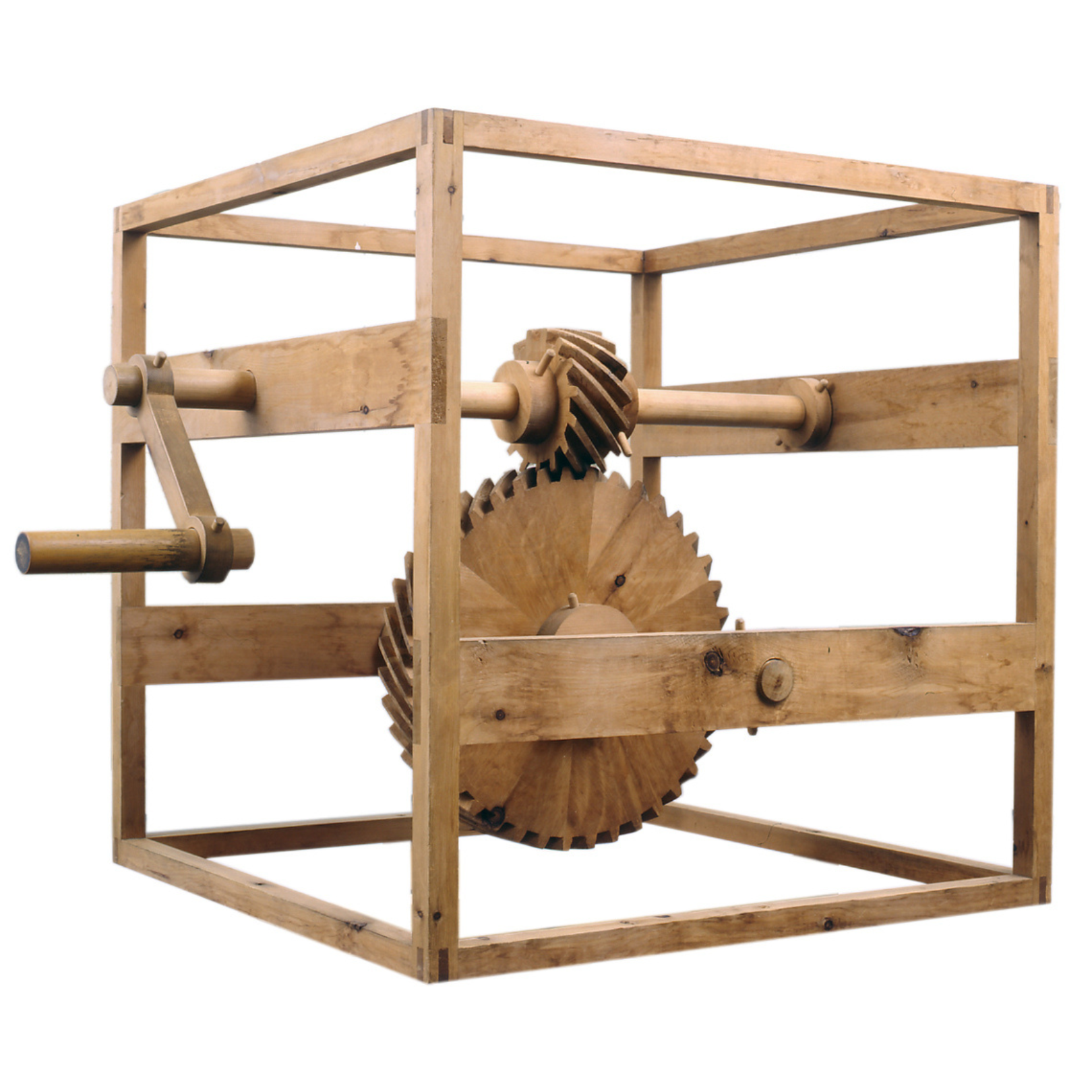
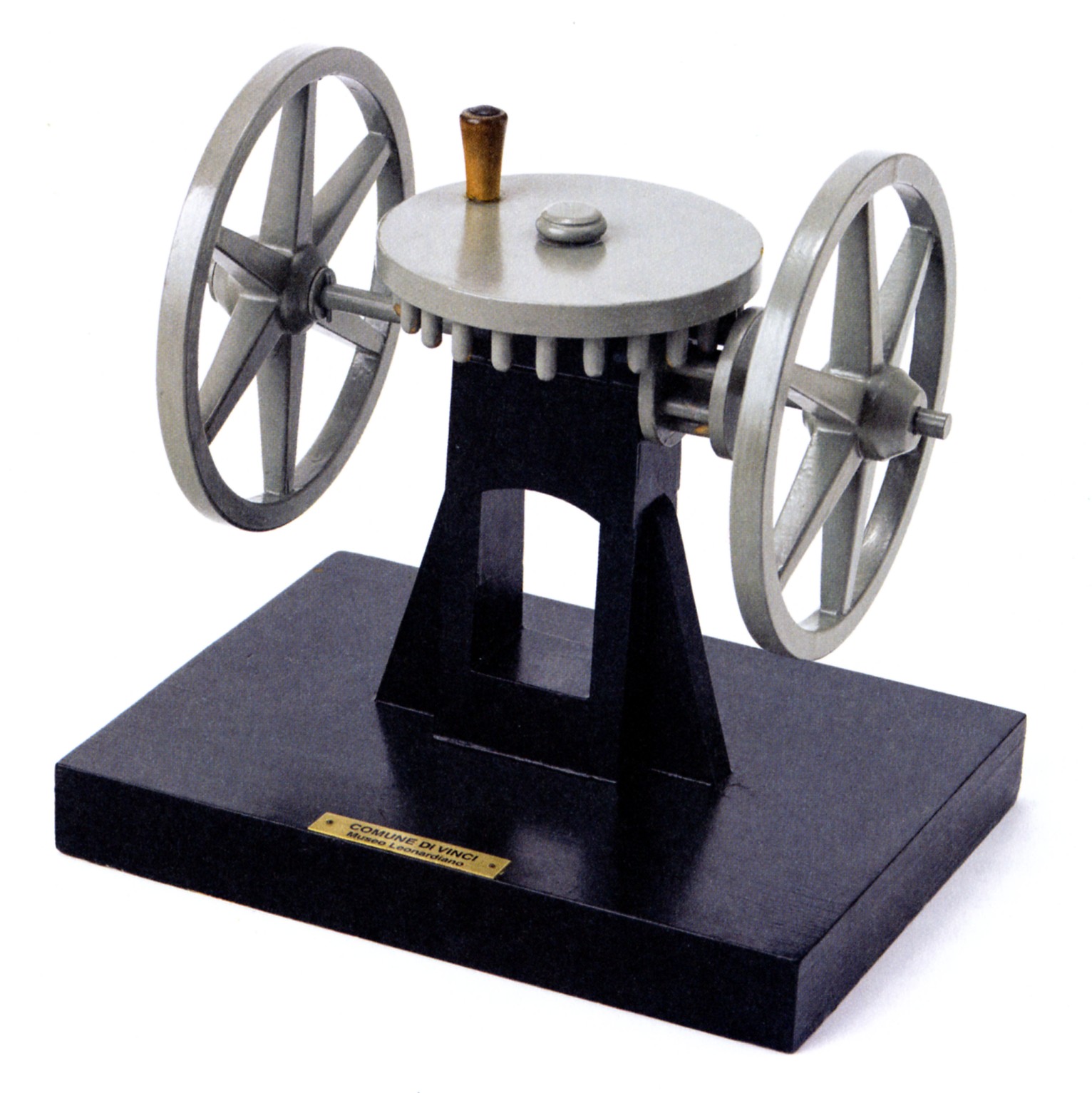
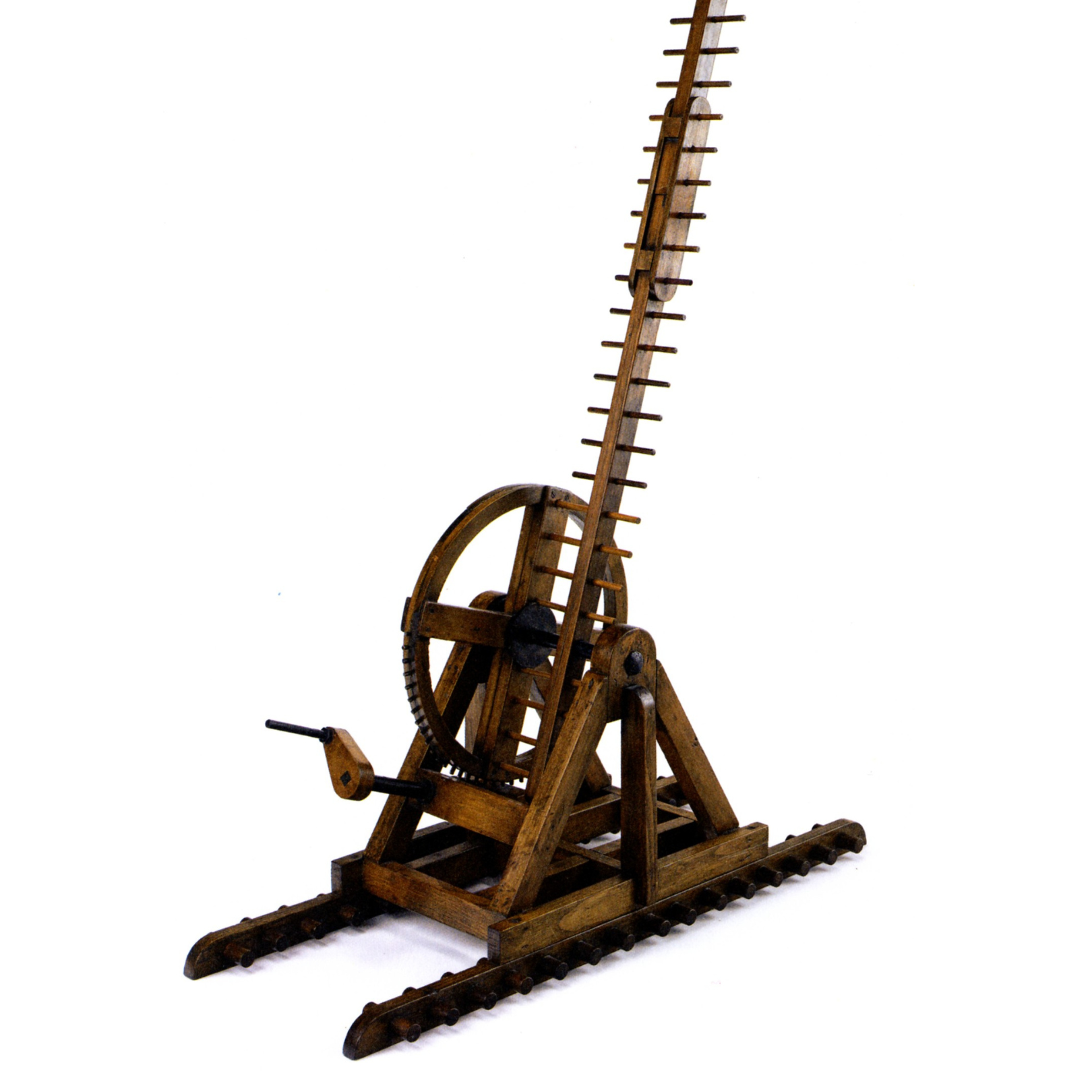
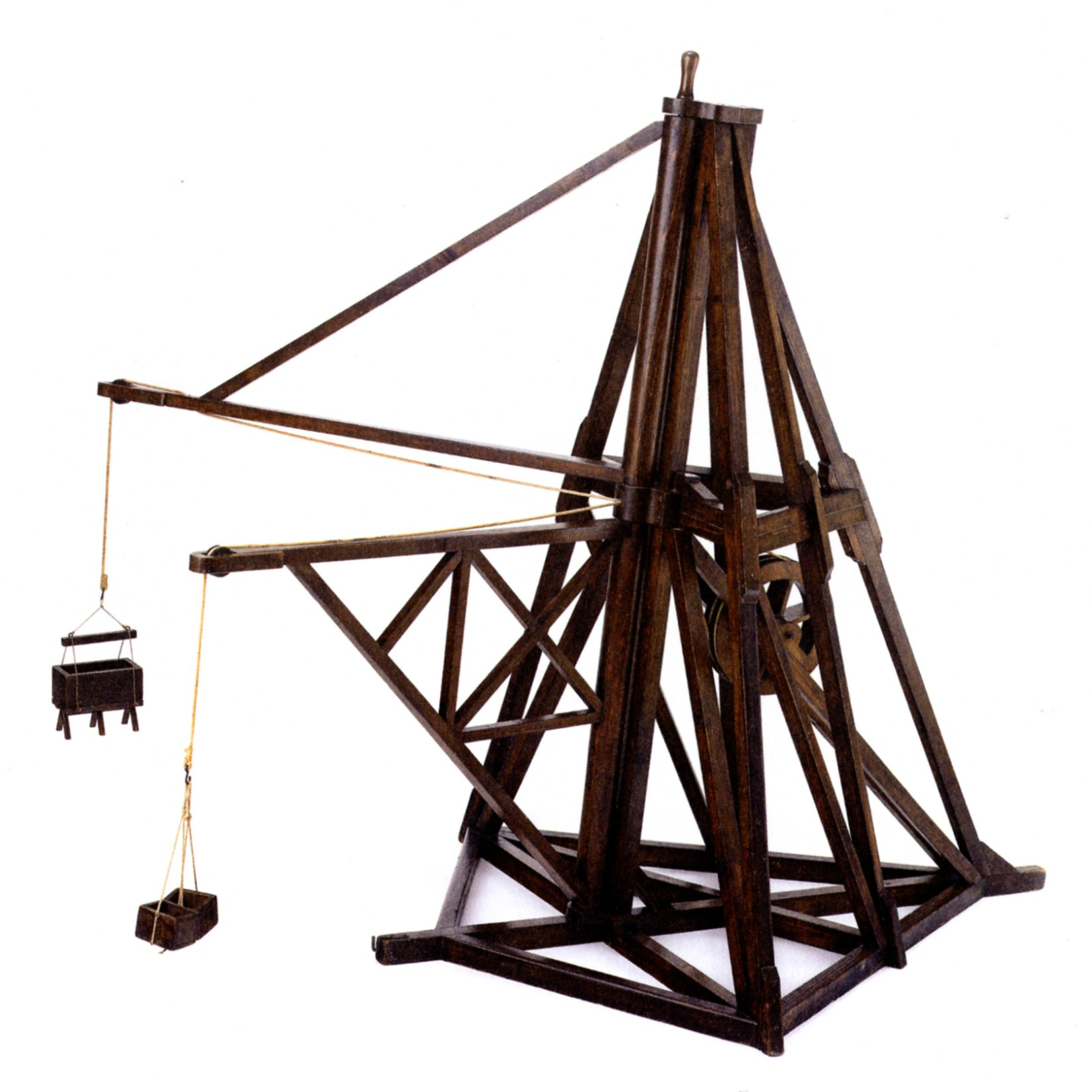
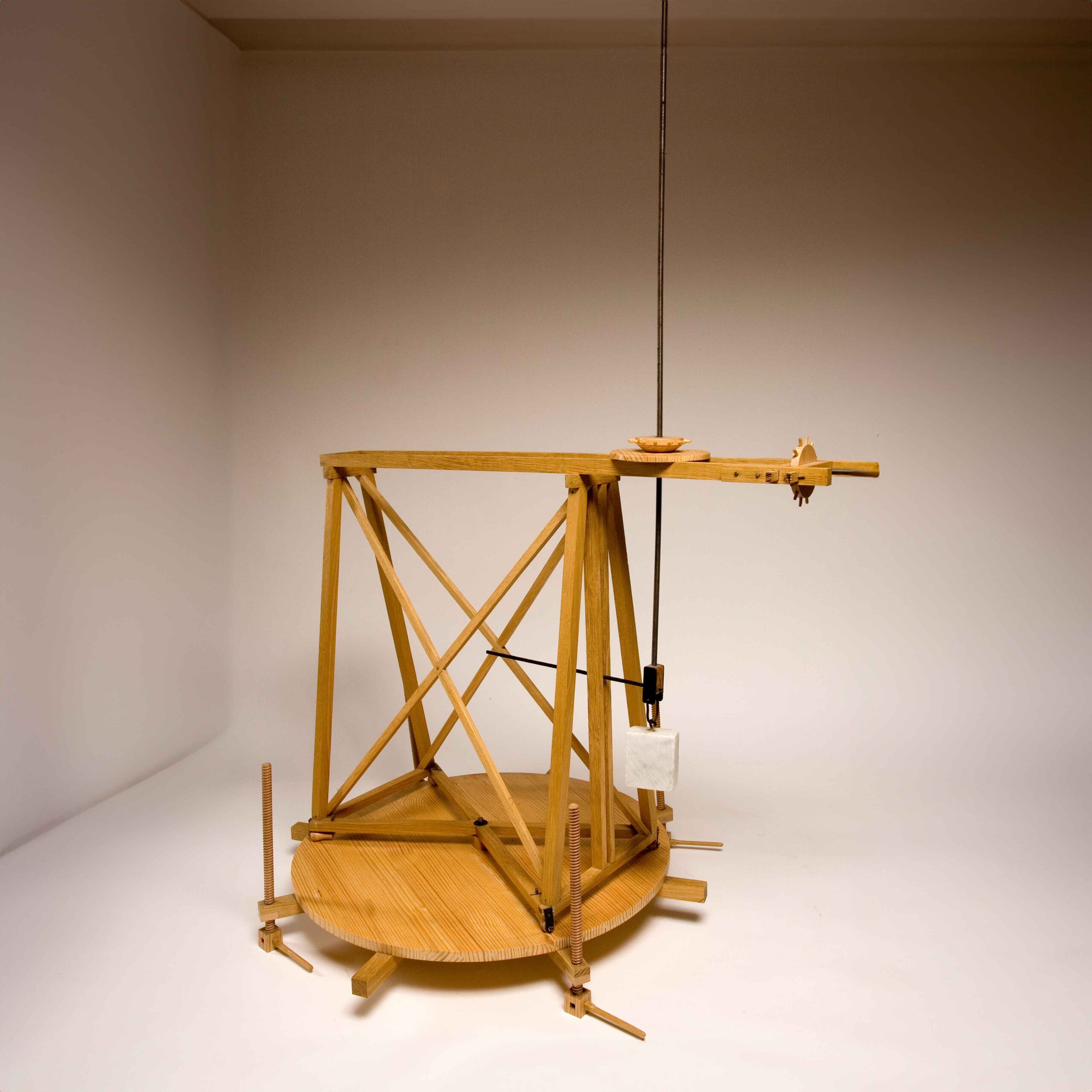
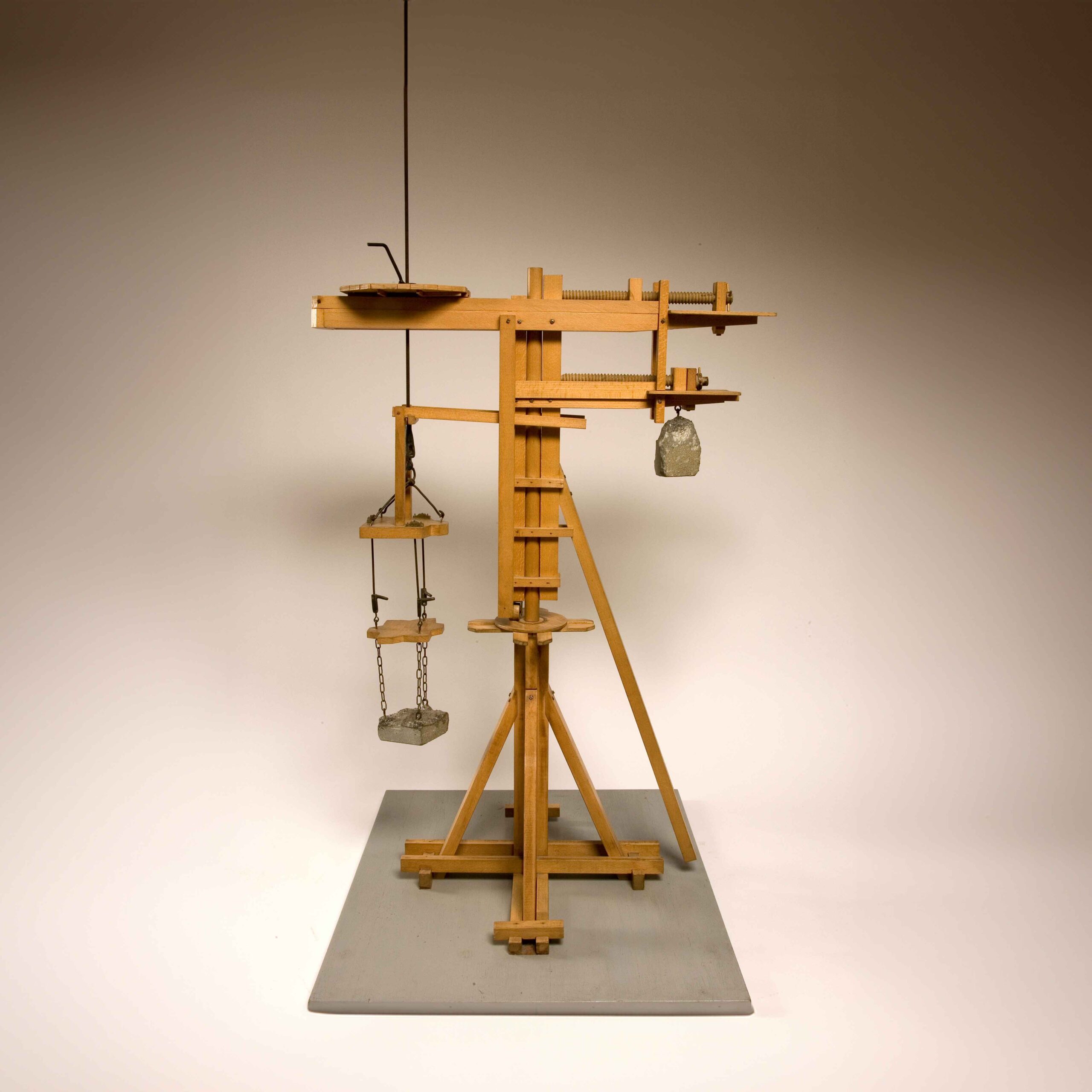
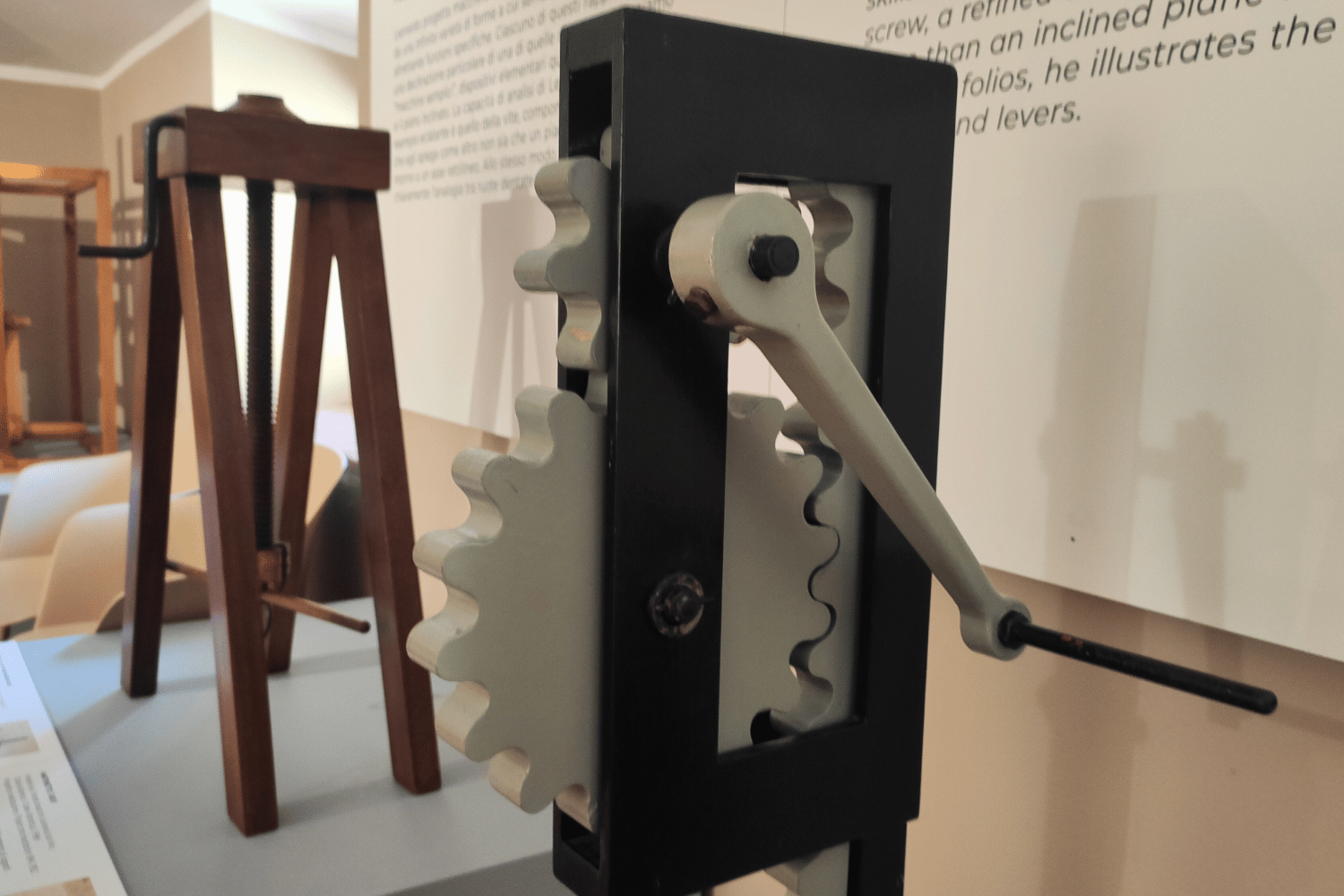
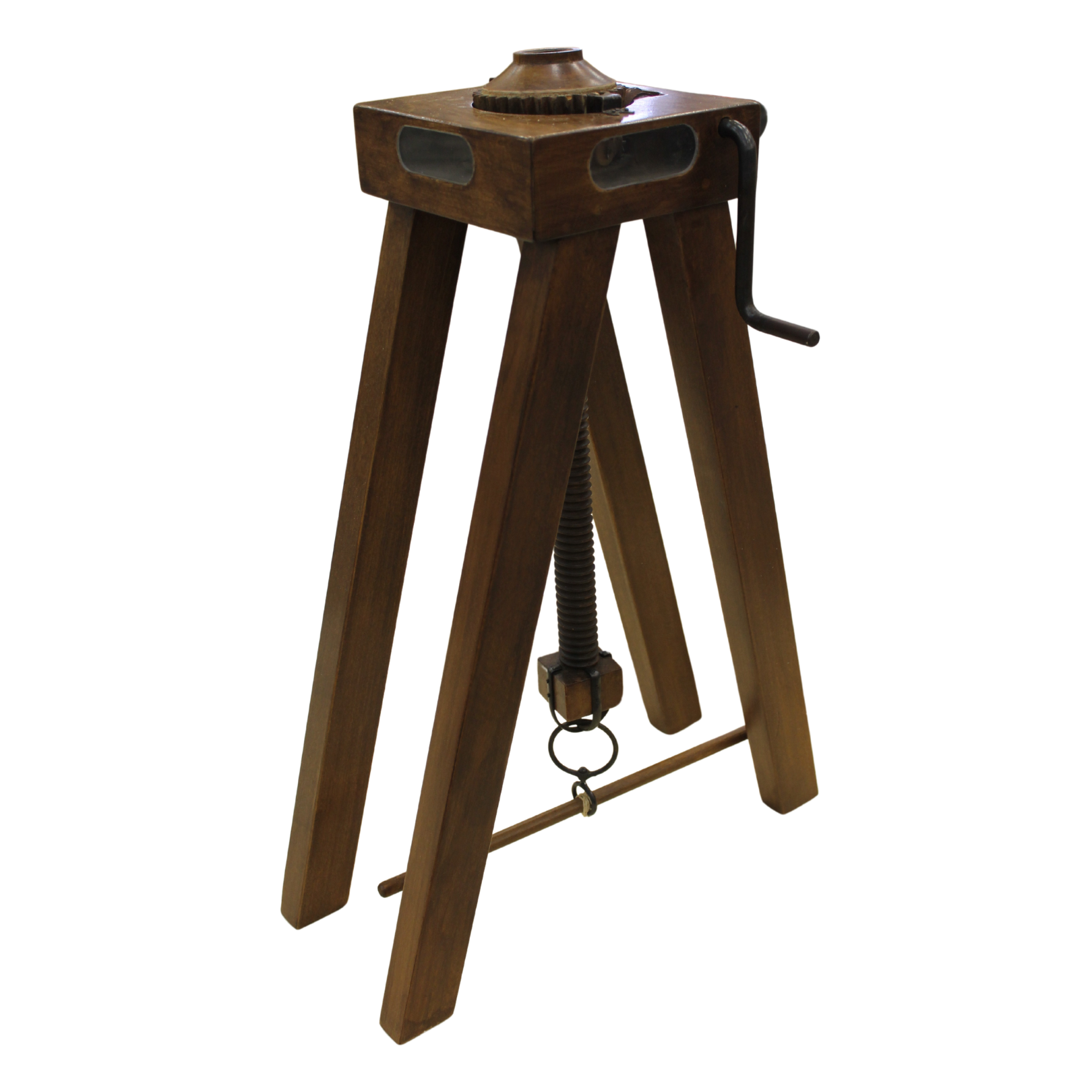
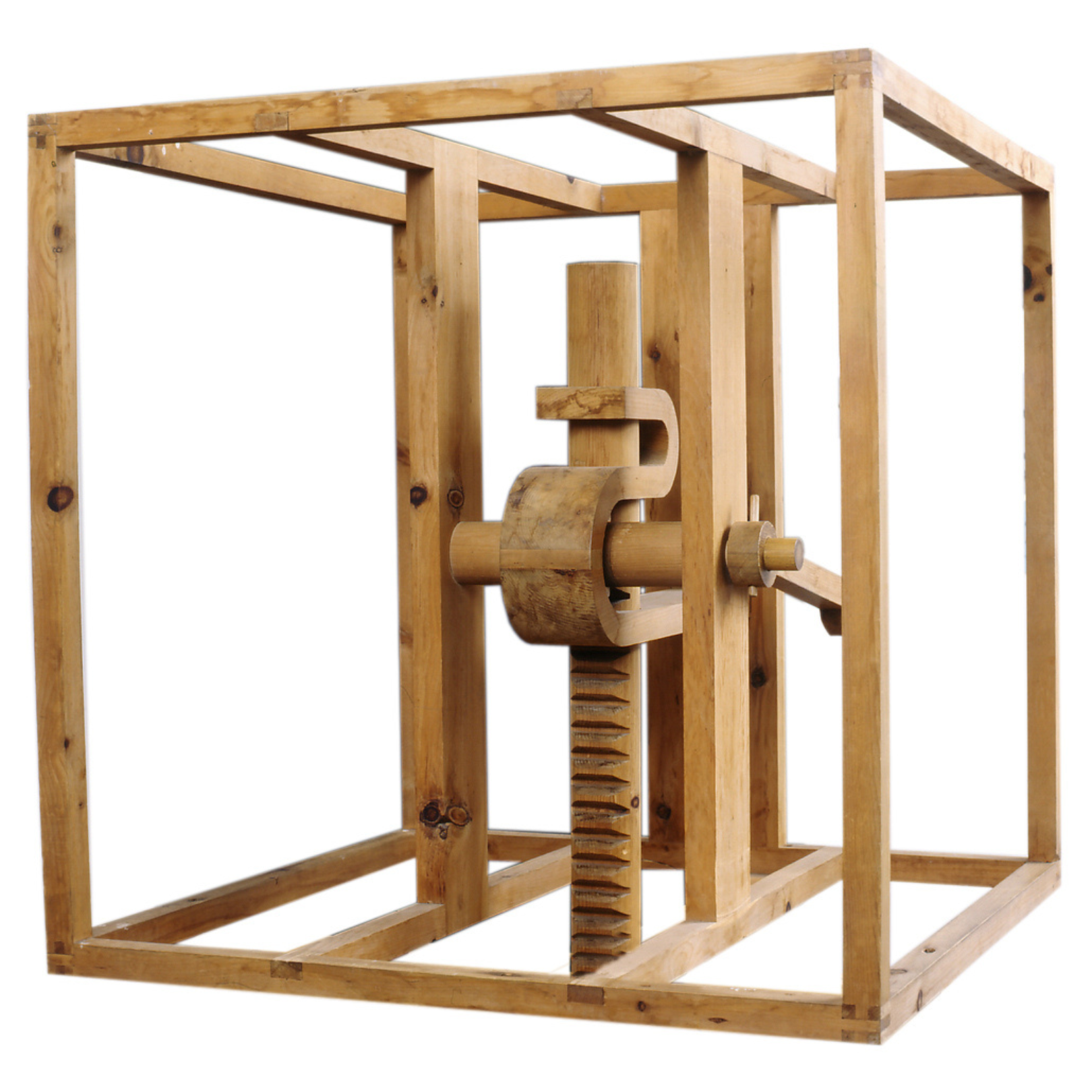
The model features a mechanism applicable to machines designed for lifting and lowering heavy loads, capable of converting rotary motion into linear motion.

By turning a crank, the toothed wheel engages with the vertical rack, causing it to move up or down. At one end of the rack, a hook is attached to secure the load.

This device resembles a jack, a tool commonly used to lift two-wheeled vehicles in order to replace a wheel.

Technical informations

Type of exhibit
Model
Collection
Material
Carved Swiss pine wood
Measures
Width: 75 cm, Length: 75 cm, Depth: 75 cm.
Storage location
Relationship with the original work
Source: Leonardo da Vinci, Codex Atlanticus, f. 998 r
Location
Museo Leonardiano, Palazzina Uzielli, second floor

Related exhibits

Last update: 24 June 2025, 10:52

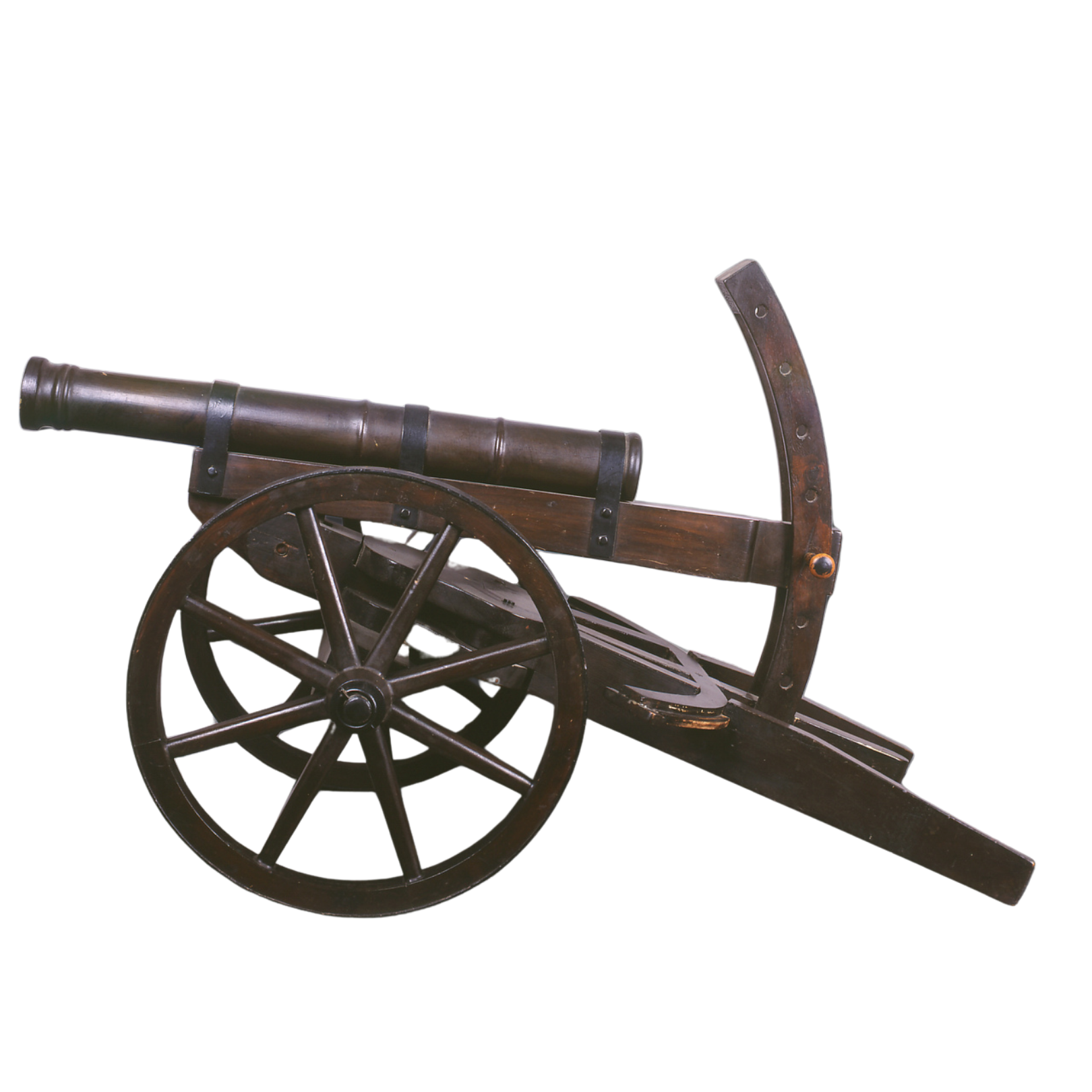
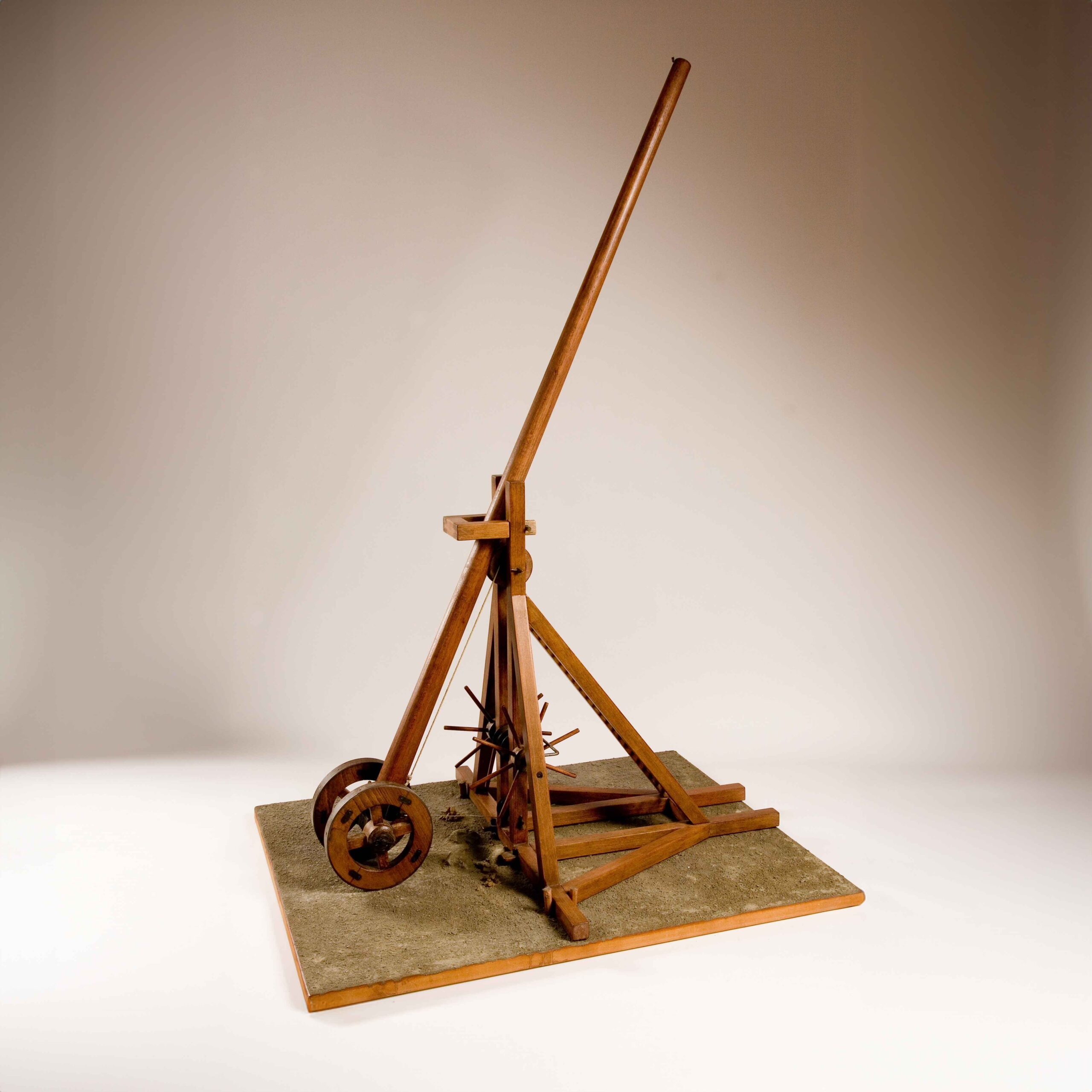
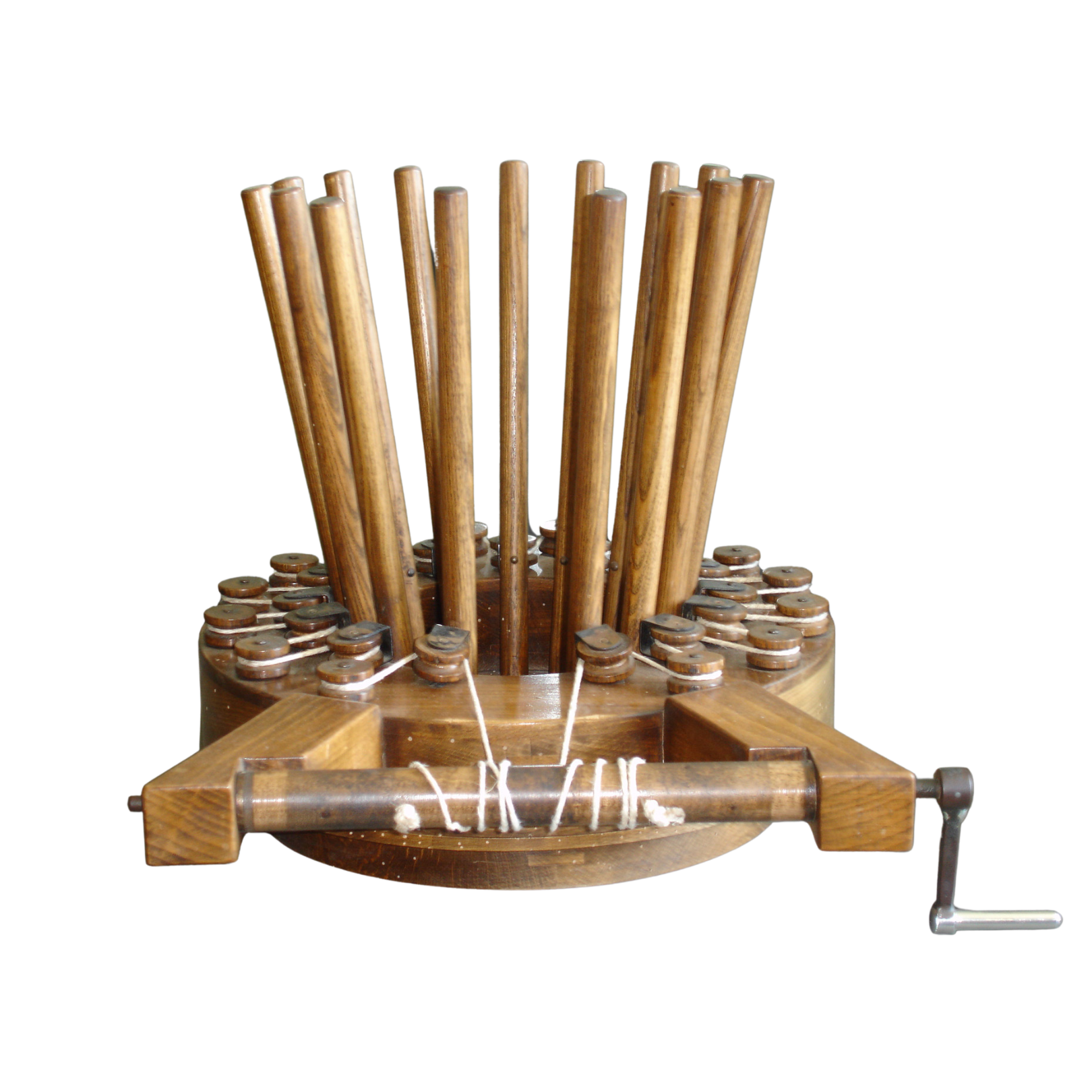
Multiple-shot, fan-array cannon

Made by
IBM Italia

1952

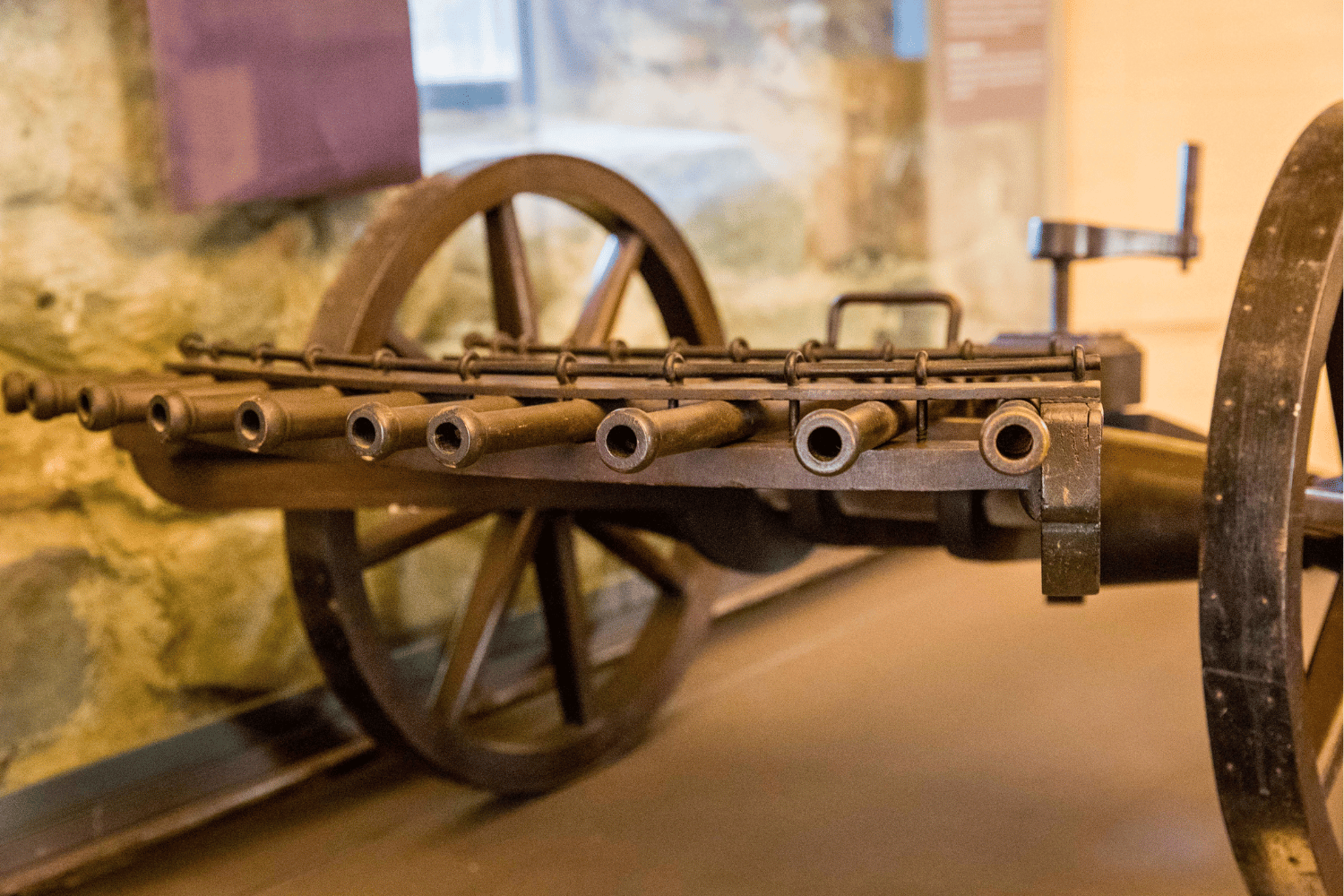
Leonardo worked on several designs for cannons capable of simultaneously shooting multiple projectiles. These weapons were decidedly avant-garde for their time, and likely to trigger the interest of potential commissioners.

This multiple-shot firearm has ten small-caliber guns mounted on a single gun carriage. Equipped with two wheels for easy movement about the battlefield, it can aim at multiple targets. The arrangement of the firearm barrels into fan array makes it possible to increase the firing volume, thereby reducing the effects of inaccuracy in shooting. The projectiles are loaded through a small hatch located at the center of the gun array. A crank is used to adjust the inclination of the instrument, making it possible to regulate the launch trajectory.

Technical informations

Type of exhibit
Model
Collection
Material
Turned wood and wrought iron
Measures
Width: 50 cm; Length: 146 cm; Depth: 81.5 cm.
Storage location
Relationship with the original work
Source: Leonardo da Vinci, Codex Atlanticus, f. 157 r
Inventory number
Record n. OA: 00000009
Location
Museo Leonardiano, Counts Guidi's castle, ground floor

Related exhibits

Last update: 10 November 2025, 12:40

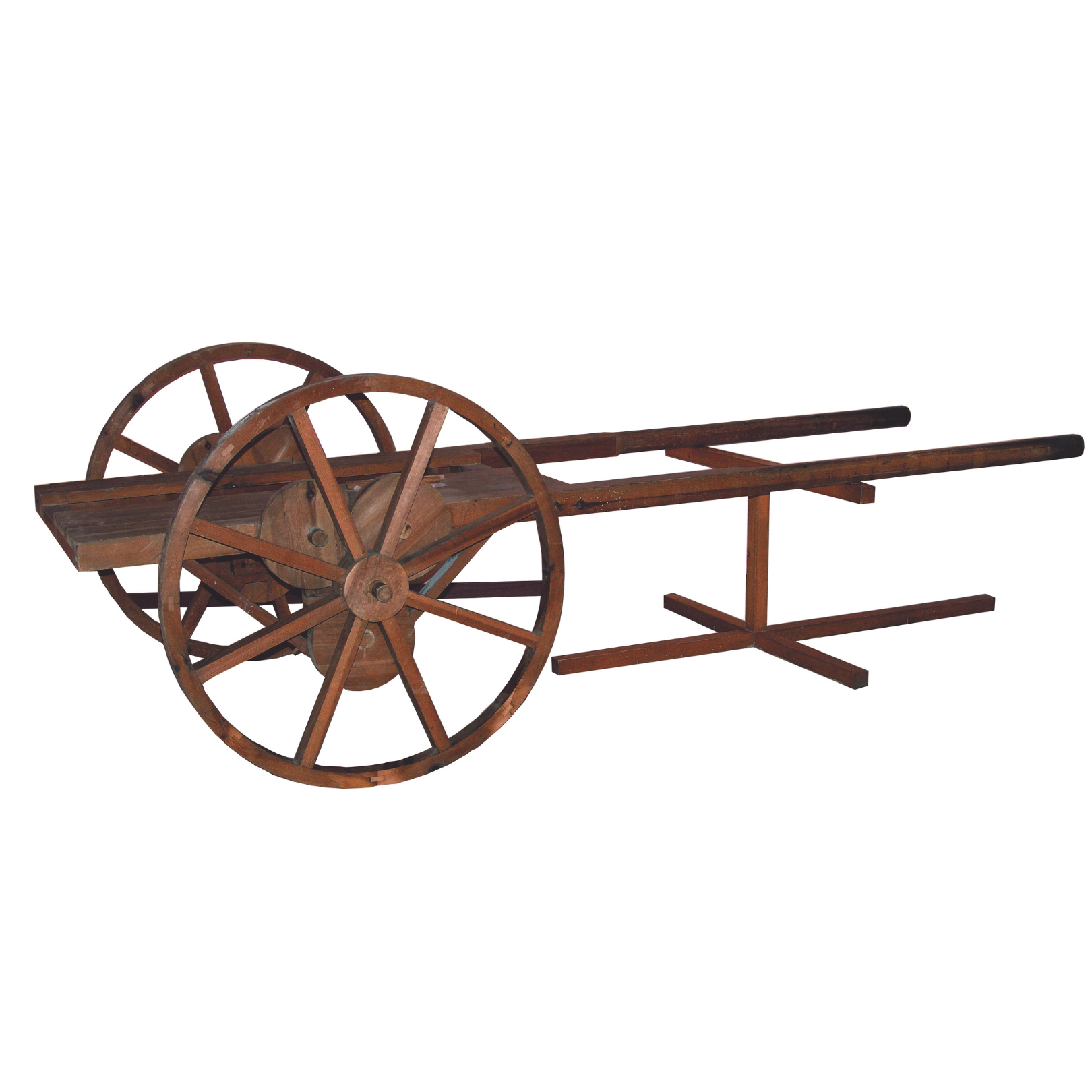
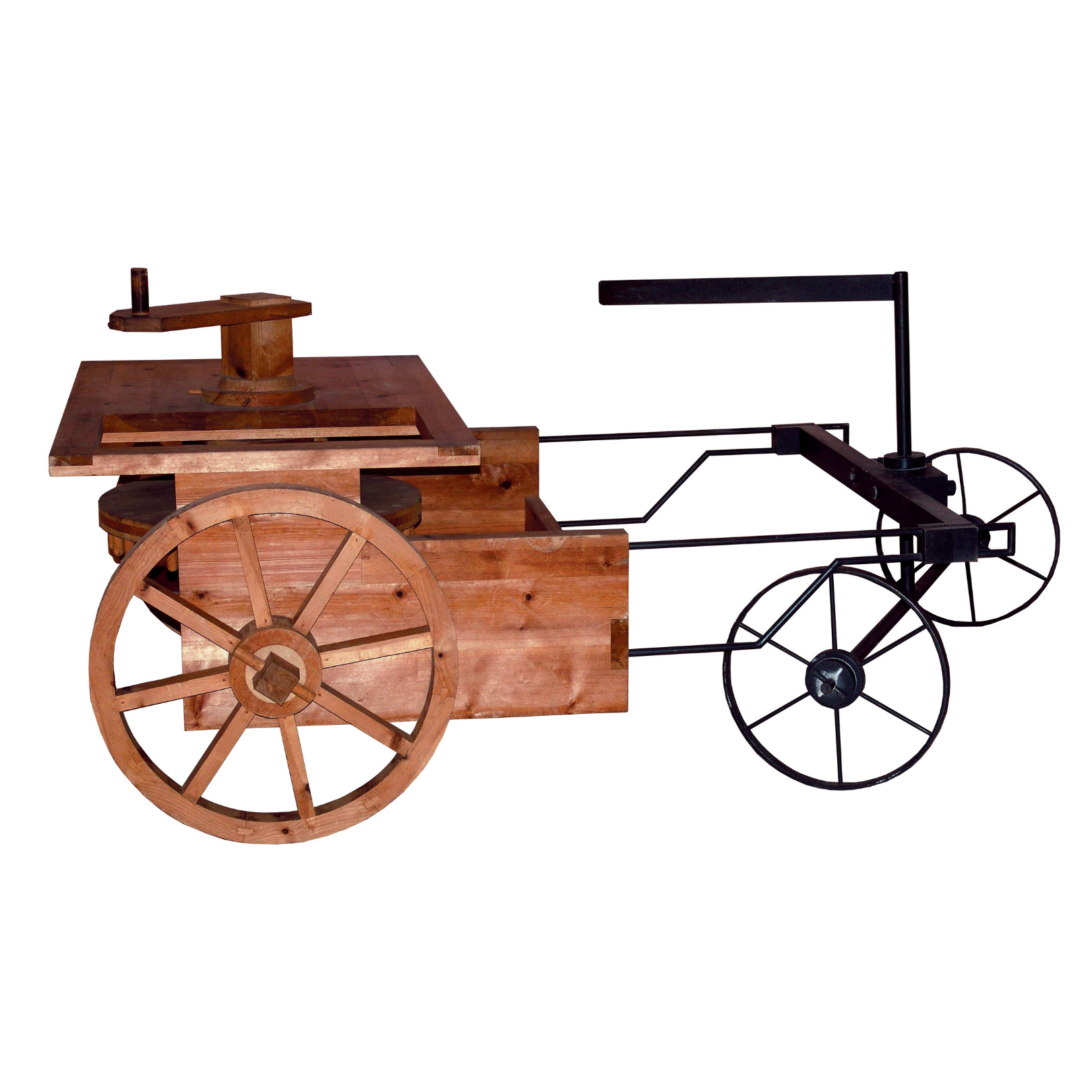
Odometer (distance-measuring device)

Made by
IBM Italia

1952

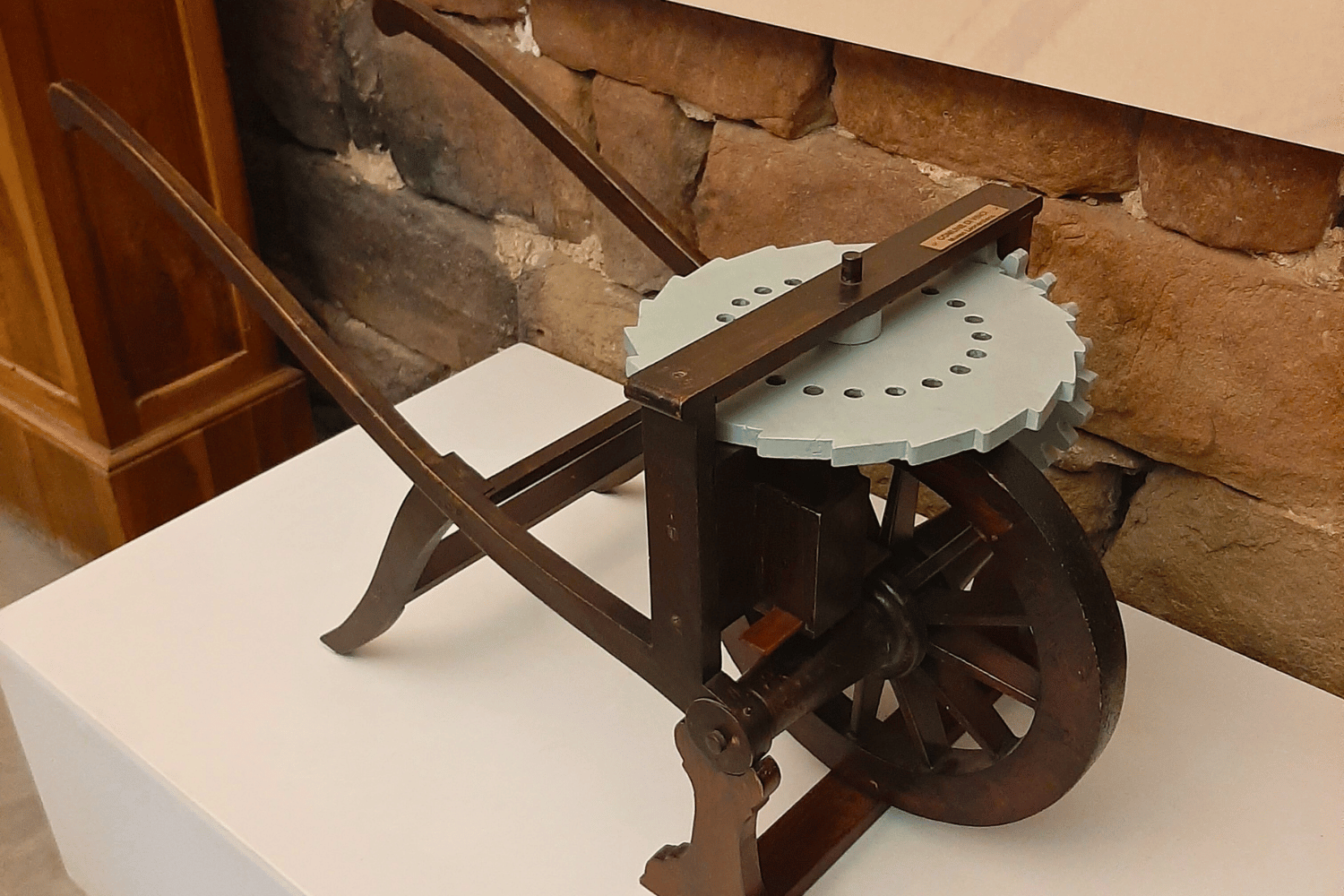
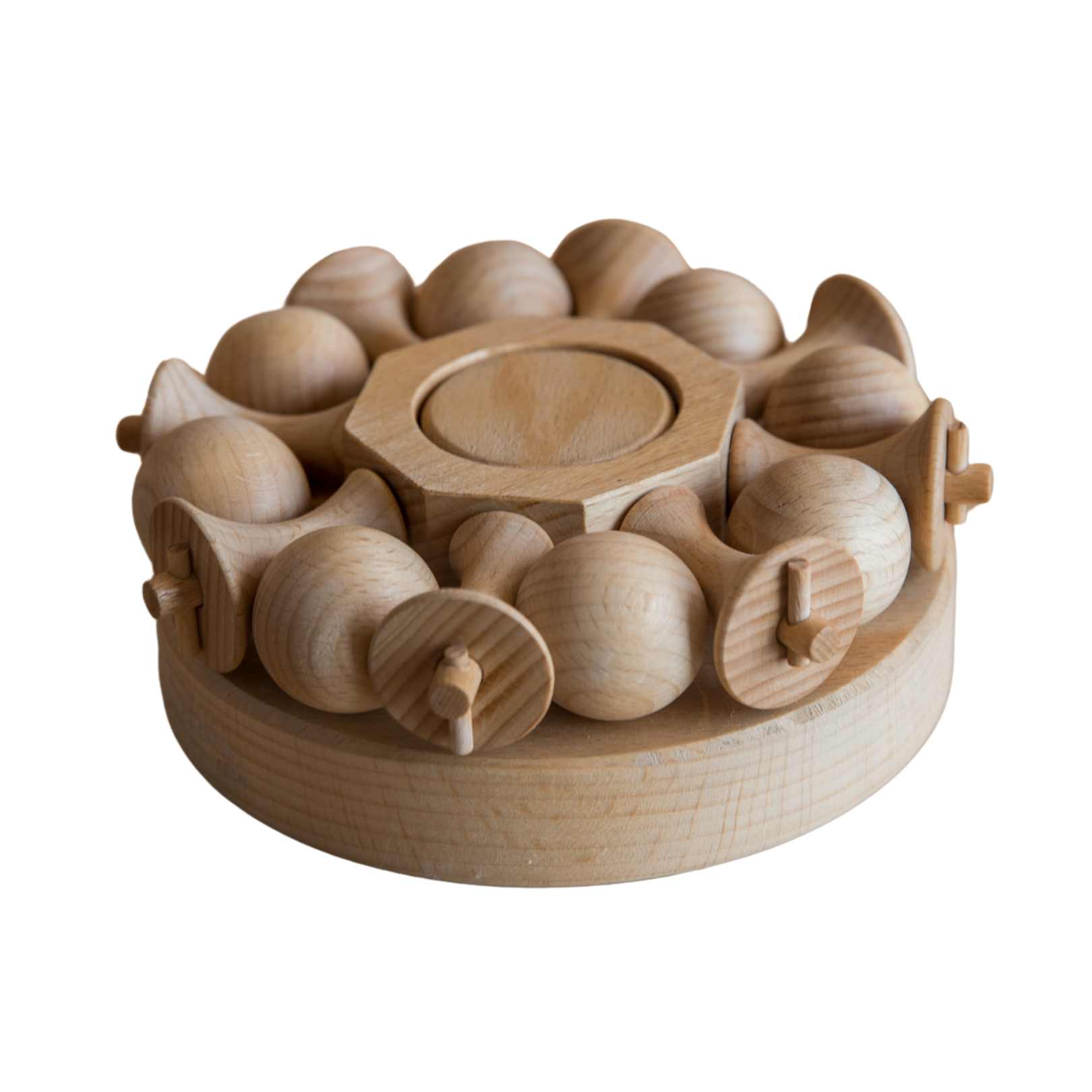
The model represents a device designed to measure distances with precision.
Following Vitruvius’ description in the De Architectura, Leonardo accurately illustrates its mechanical features, providing a well-structured graphical representation and analysing every single detail.

The machine has the shape of a wheelbarrow: its frame is supported by a central wheel resting on the ground. Each revolution of the wheel’s hub causes a vertical toothed wheel to move one notch forward; in turn, every full rotation of this vertical gear drives another large horizontal central wheel that functions as a counter.

Along the inner edge of the horizontal wheel are several holes, which are gradually filled with small stones or little metal or wooden spheres. At each movement of the wheel, one of these drops into a special container placed underneath.

By collecting and counting the stones or spheres, and knowing the circumference of the main wheel, it is then possible to calculate the distance travelled.

Technical informations

Type of exhibit
Model
Material
Wood, carved and varnished
Measures
Width: 52 cm; Length: 105 cm; Depth: 43 cm.
Storage location
Relationship with the original work
Source: Leonardo da Vinci, Codex Atlanticus, f. 1 r
Location
Museo Leonardiano, Counts Guidi's castle, ground floor

Related exhibits

Last update: 10 November 2025, 12:10

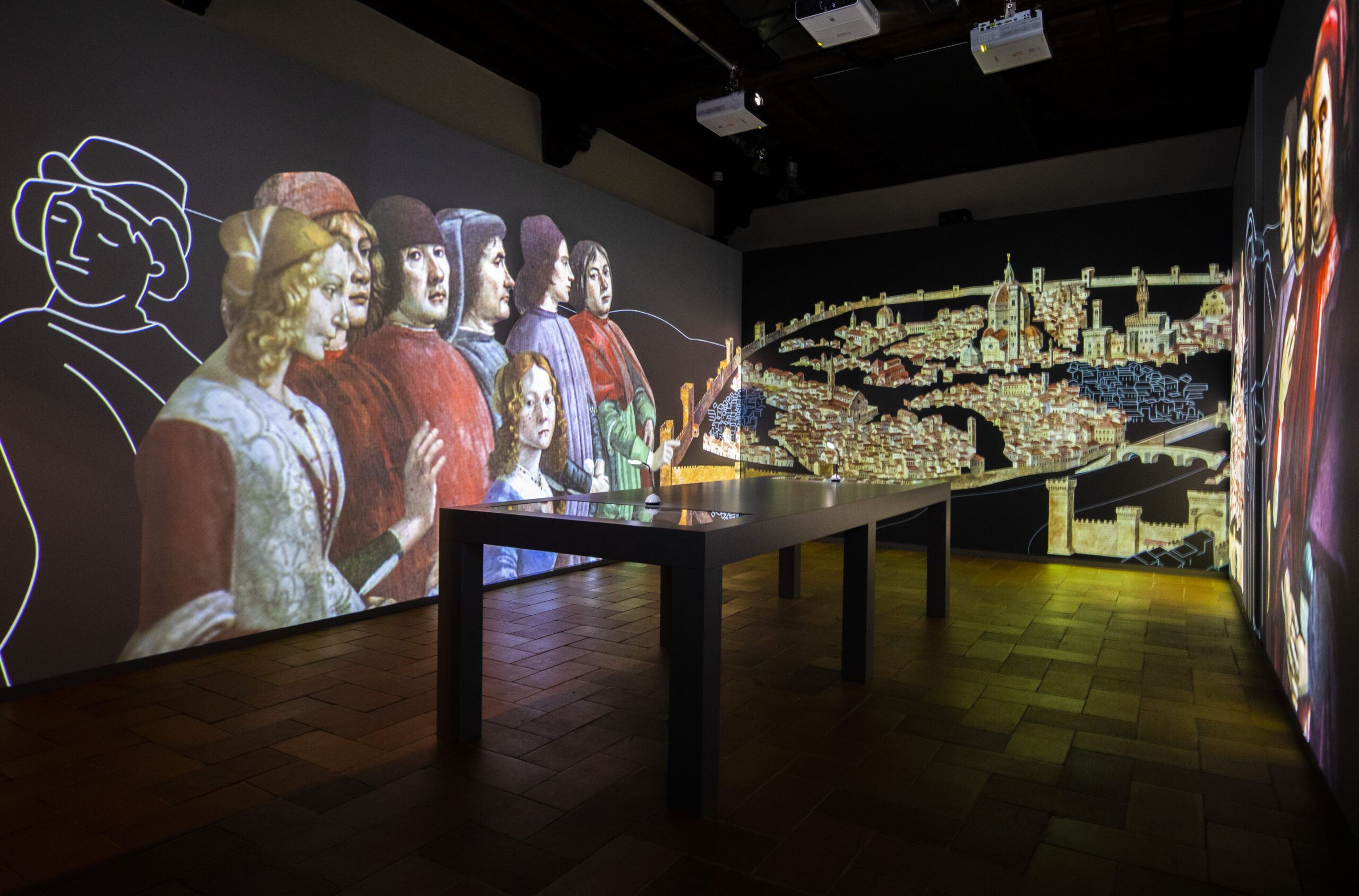
The film recounts Leonardo’s experience at the construction site of the Florence Cathedral dome, a milestone in the development of the Vinci Genius as an engineer and in the history of technology in general.

This remarkable endeavor took place within the context of 15th-century Florence, a city that proudly displayed its economic prosperity, supported by the so-called Arti, the guilds of Florentine trades, through culture, art, and architecture.

Technical informations

Type of exhibit
Video
Storage location
Location
Museo Leonardiano, Palazzina Uzielli, first floor

Related exhibits

Last update: 17 September 2025, 12:04

Ebbe nome Lionardo

Made by
MYBOSSWAS

2019

The narrative begins with the impressions of scholars and artists who, in the 19th century, came to Vinci in search of the origins of the genius. It traces the events surrounding Leonardo’s birth on April 15, 1452, as well as the lesser-known aspects of his childhood. It outlines his relationships with his family of origin and the circumstances of his arrival in Florence, offering a previously unseen reconstruction of a period of Leonardo’s life that remains little known.

The video installation is projected alternately in Italian and English.

Technical informations

Type of exhibit
Video
Collection
Storage location
Location
Museo Leonardiano, Counts Guidi's castle, first floor

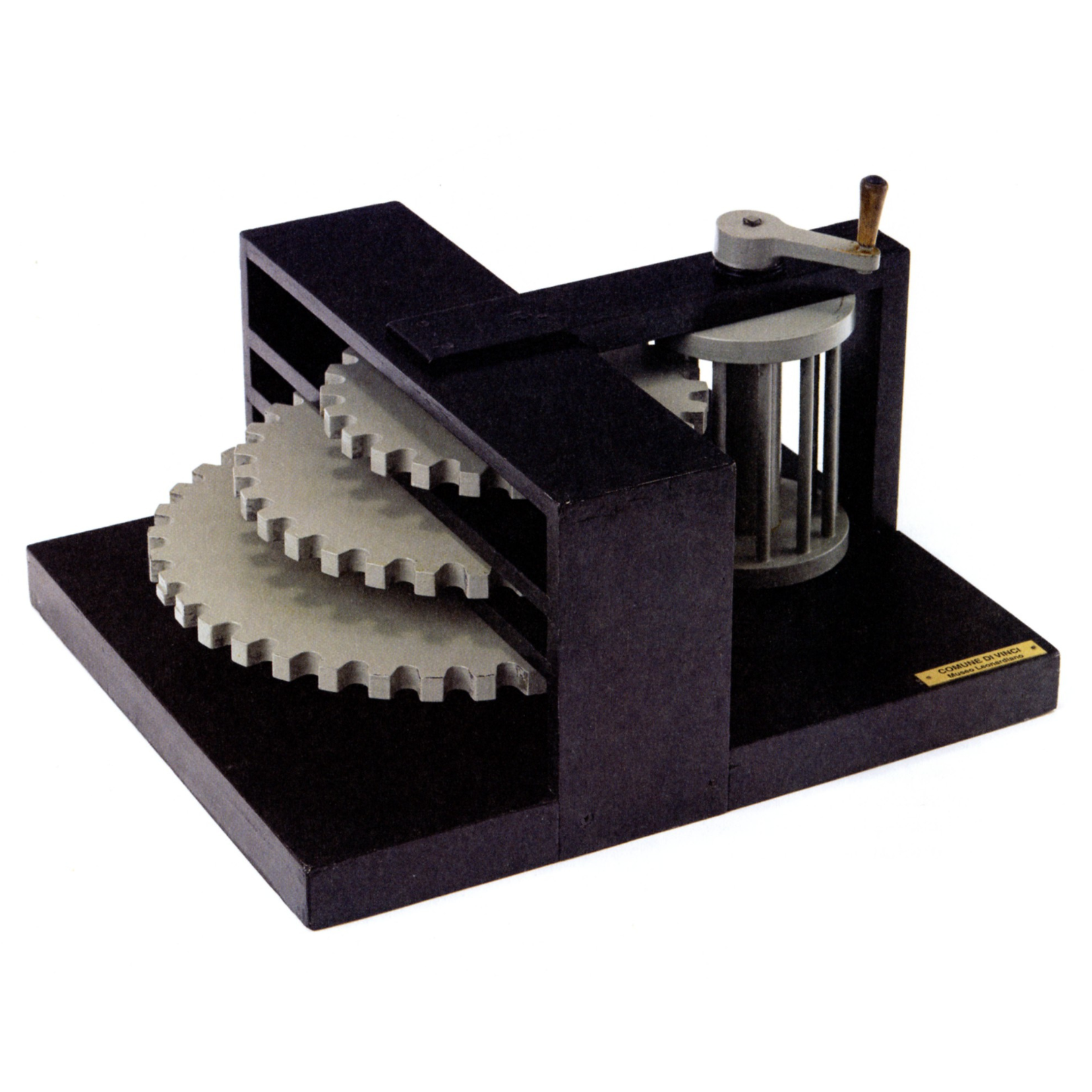
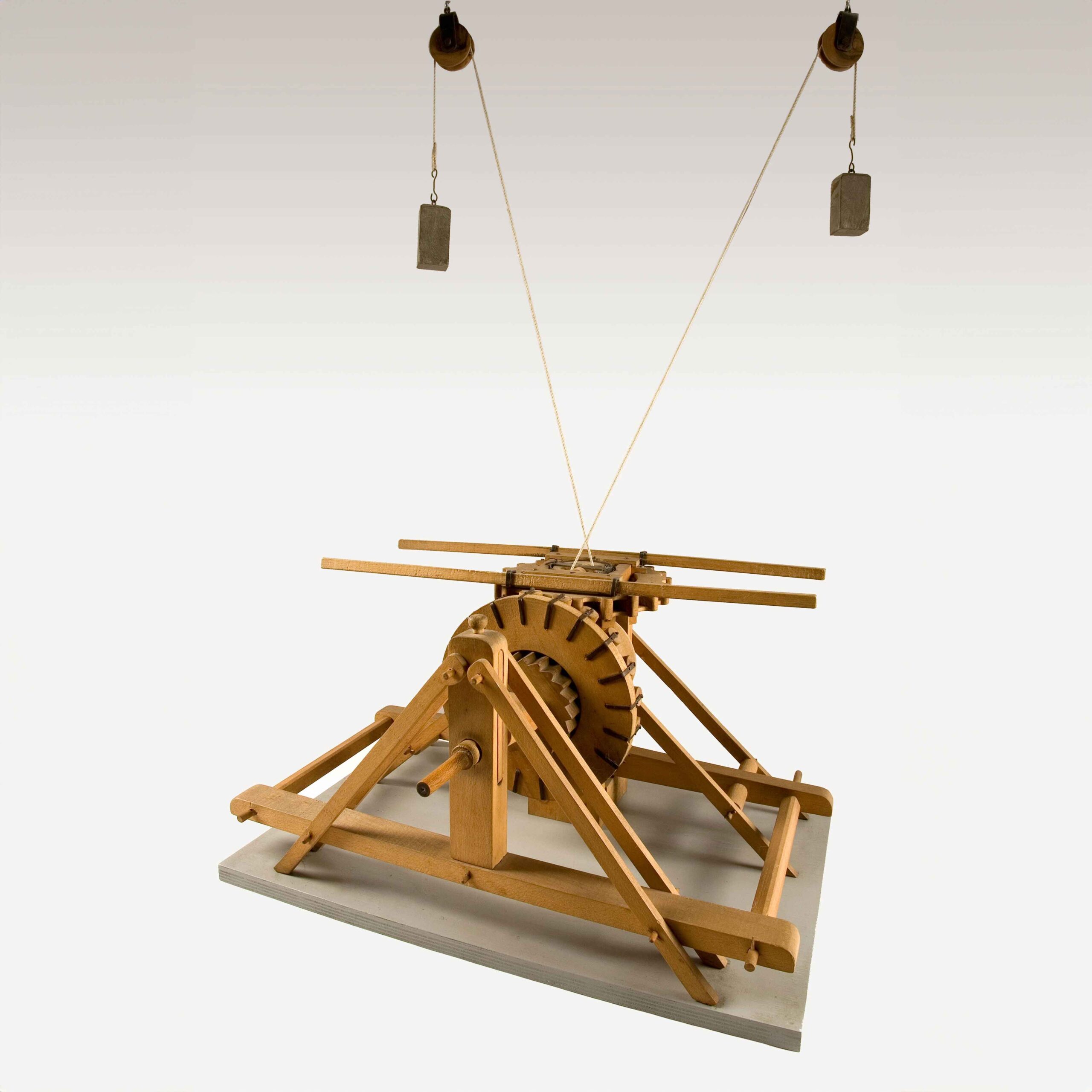
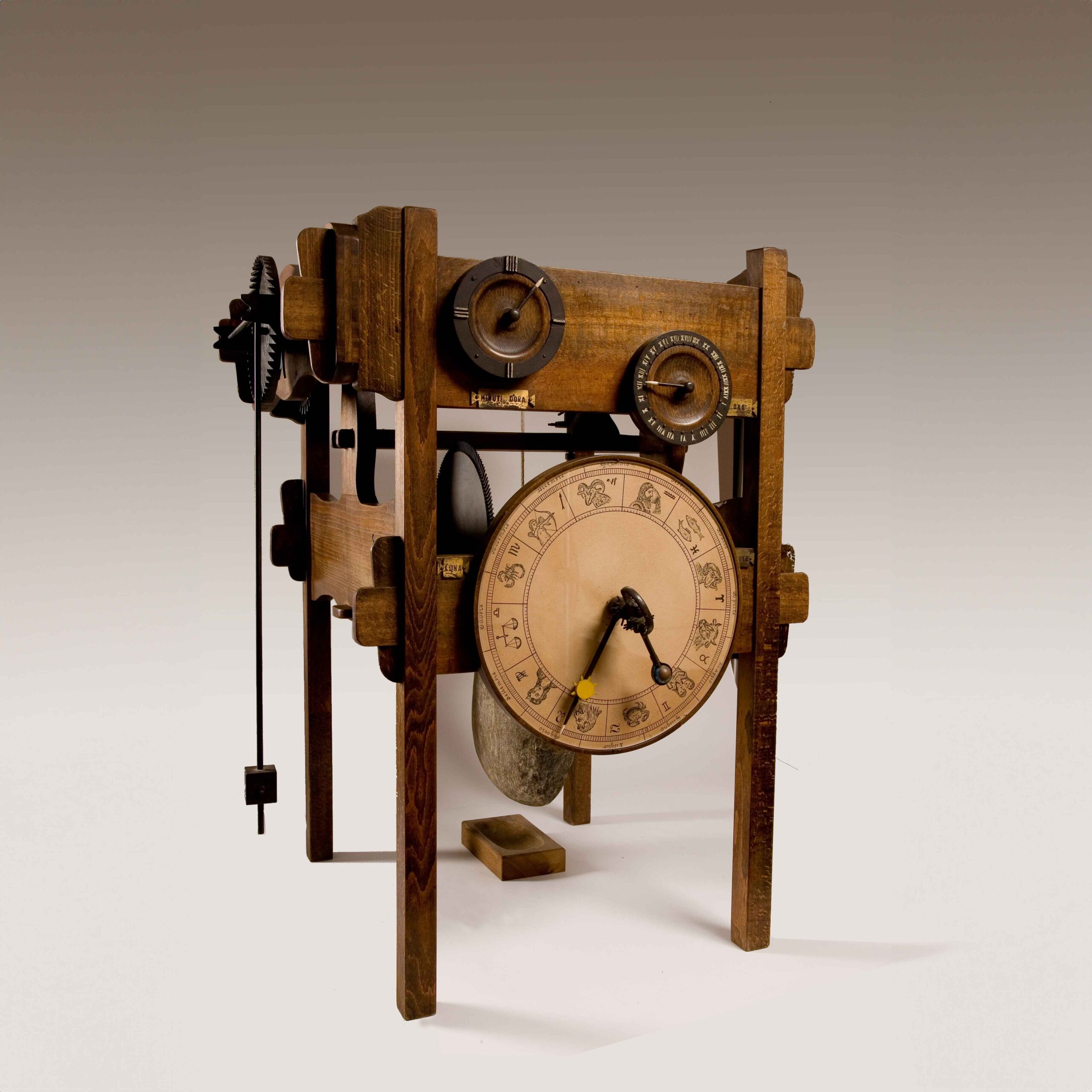
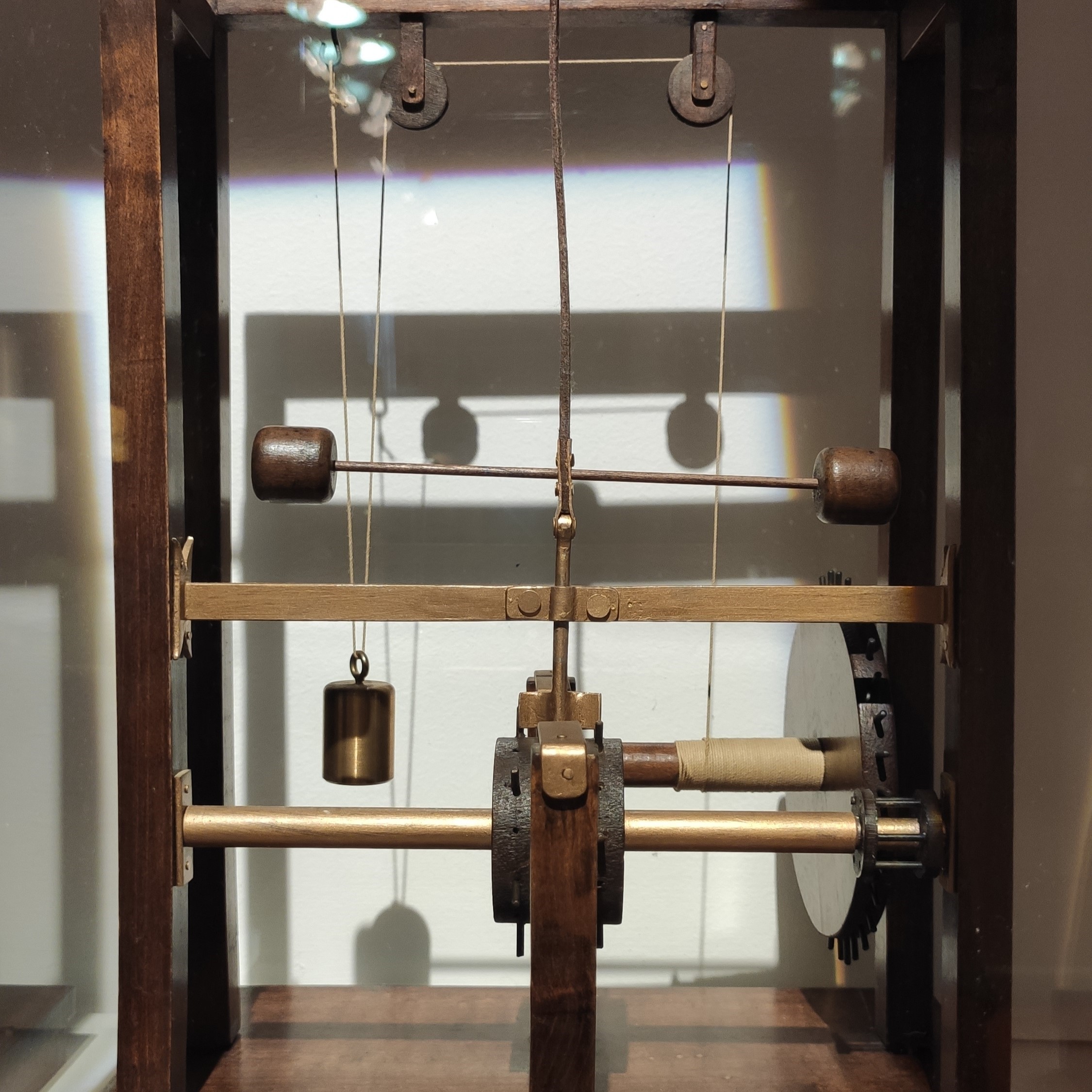
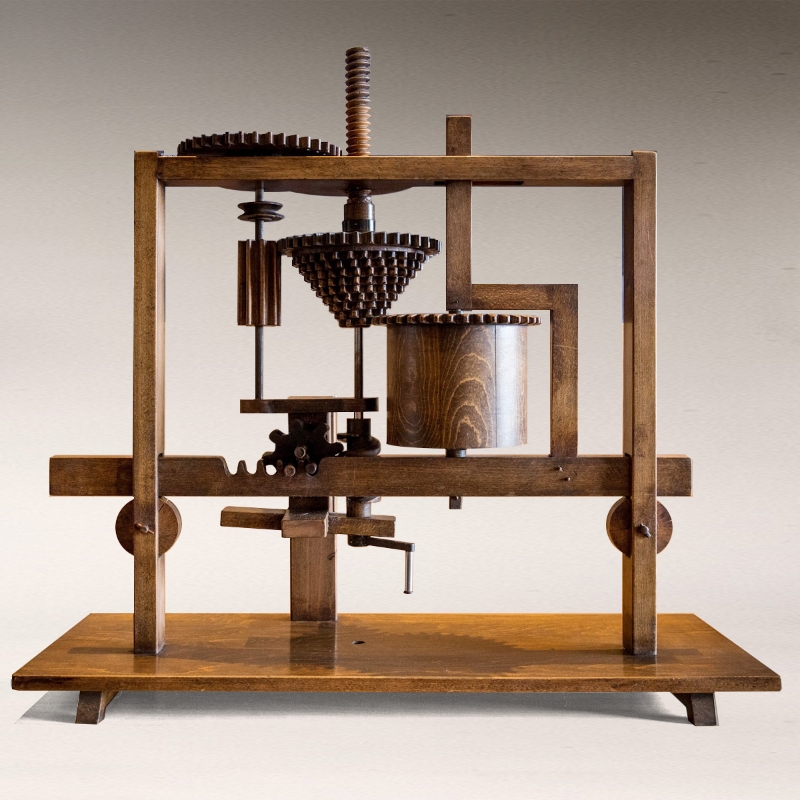
Clock mechanism

Made by
IBM Italia

1952

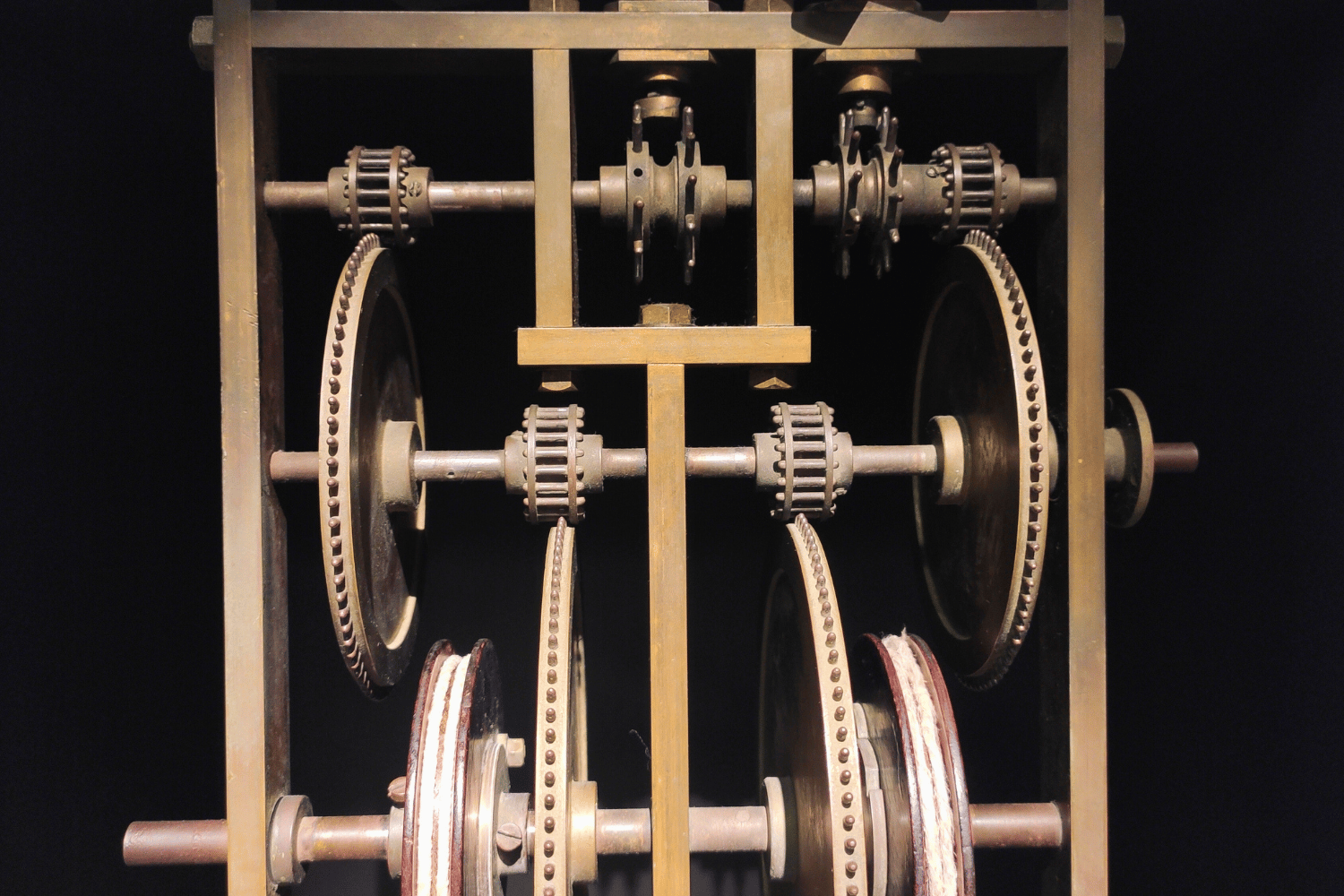
Leonardo devoted great interest to the study of mechanical clocks and their components, in search of a device capable of accurately scanning time. This model replicates the mechanism regulating the descending speed of the weight inside a clock, a device that Leonardo and his contemporaries called the tempo, literally, “time.” Today this device is referred to as the escapement.

The descending weights communicate movement to two identical orders of toothed wheels and pinions, which transmit their movement to the gears of the escapement situated in the upper part of the device. Here a movable rod balance wheel in the form of a sector of a circle alternately meshes with the teeth of the system of pegged wheels, allowing them to advance intermittently, to mark the passage of time. Leonardo also used the flywheel as a regulator: a rotating axle fitted with vanes in order to make use of air resistance.

Technical informations

Type of exhibit
Model
Collection
Material
Carved wood, cotton rope, iron, brass
Measures
Width: 110.5 cm, Length: 35.5 cm, Depth: 45 cm
Storage location
Relationship with the original work
Source: Leonardo da Vinci, Codex Atlanticus, f. 964 r
Inventory number
Object Record No.: 00000007
Location
Museo Leonardiano, Palazzina Uzielli, first floor

Related exhibits

Last update: 22 September 2025, 09:17

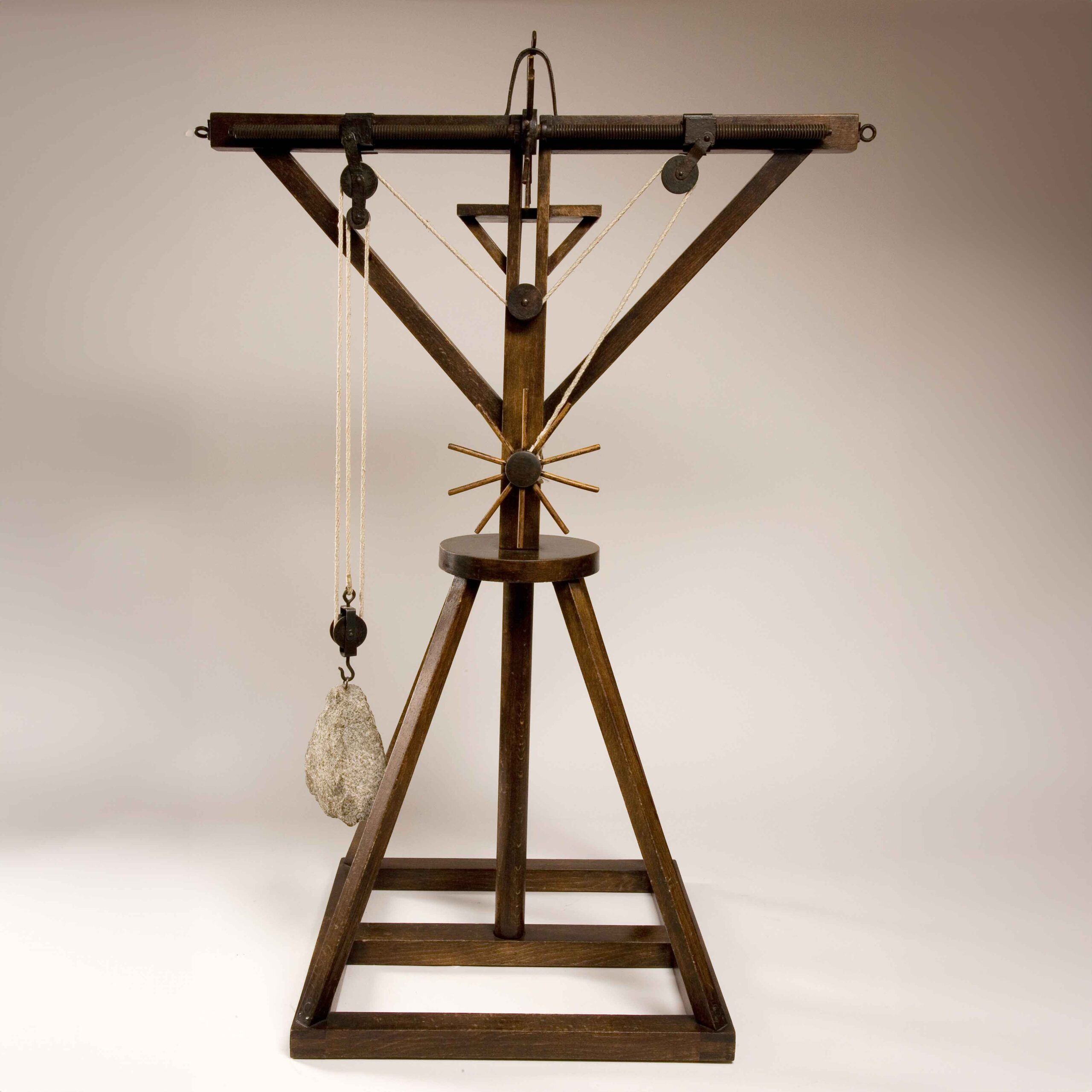
Jack

Made by
IBM Italia

1952

The model of this mechanism, inspired by a drawing from the Codex Atlanticus, consists of a gear wheel which, when operated by a crank inserted into a drum, engages a vertical rack, allowing it to move up or down.

By converting rotational motion into linear motion, this device greatly facilitates the lifting of a weight from the ground.

Technical informations

Type of exhibit
Model
Collection
Material
Painted carved wood
Measures
Width: 111 cm, Length: 40 cm, Depth: 33 cm
Storage location
Relationship with the original work
Source: Leonardo da Vinci, Codex Atlanticus, f. 998 r
Location
Museo Leonardiano, Palazzina Uzielli, second floor

Related exhibits

Last update: 22 September 2025, 09:37

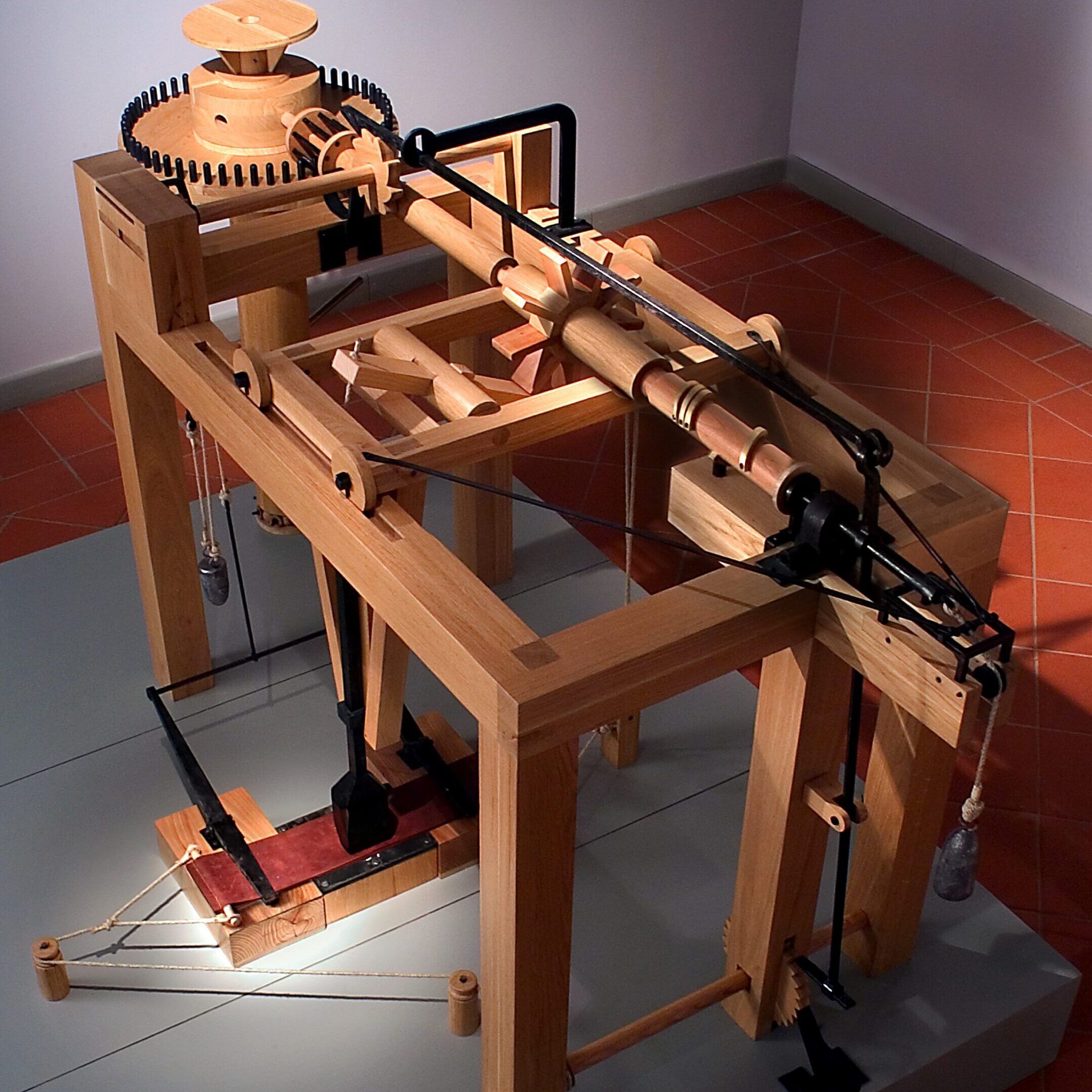
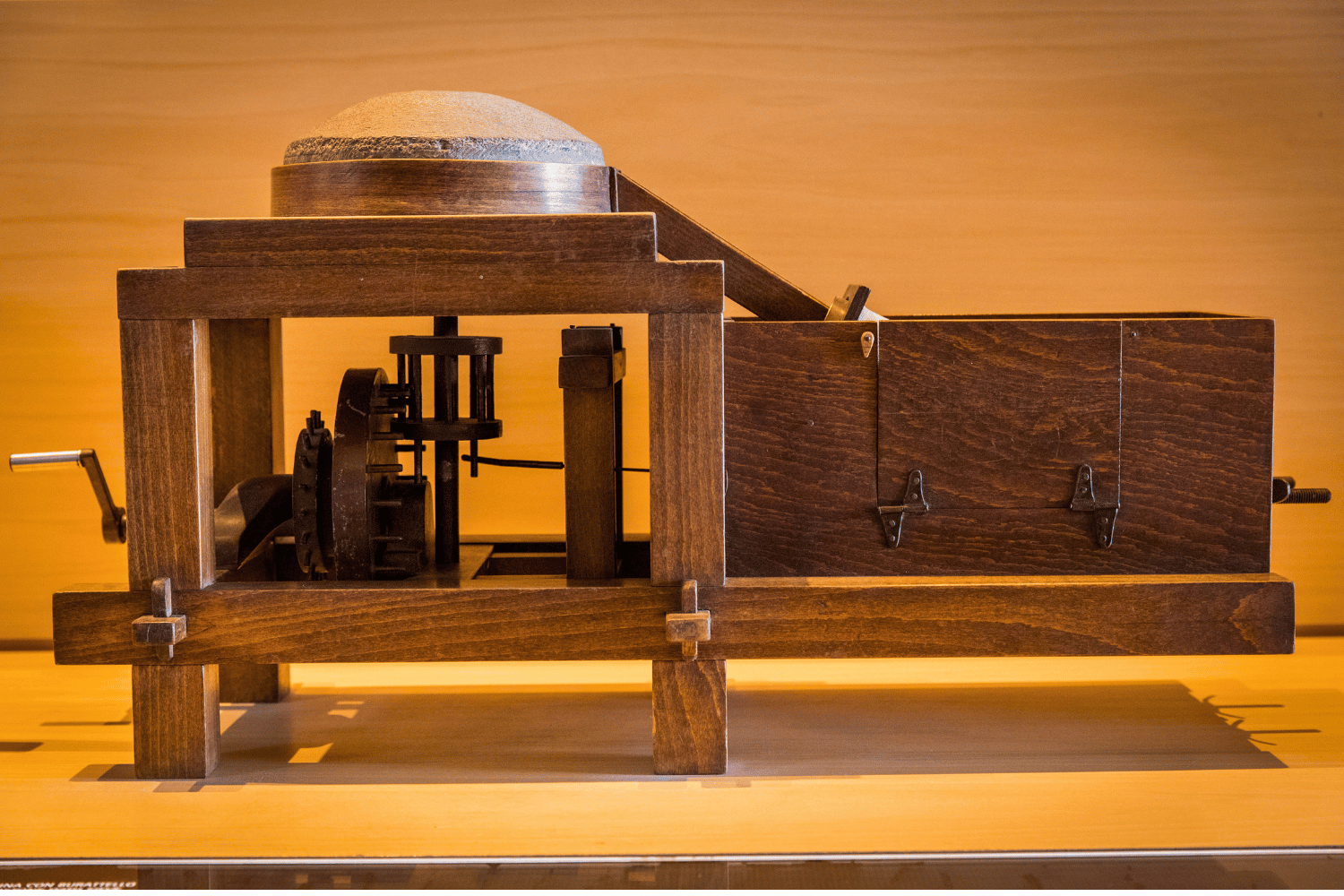
Mill with sifting sack

Luigi Boldetti

1972

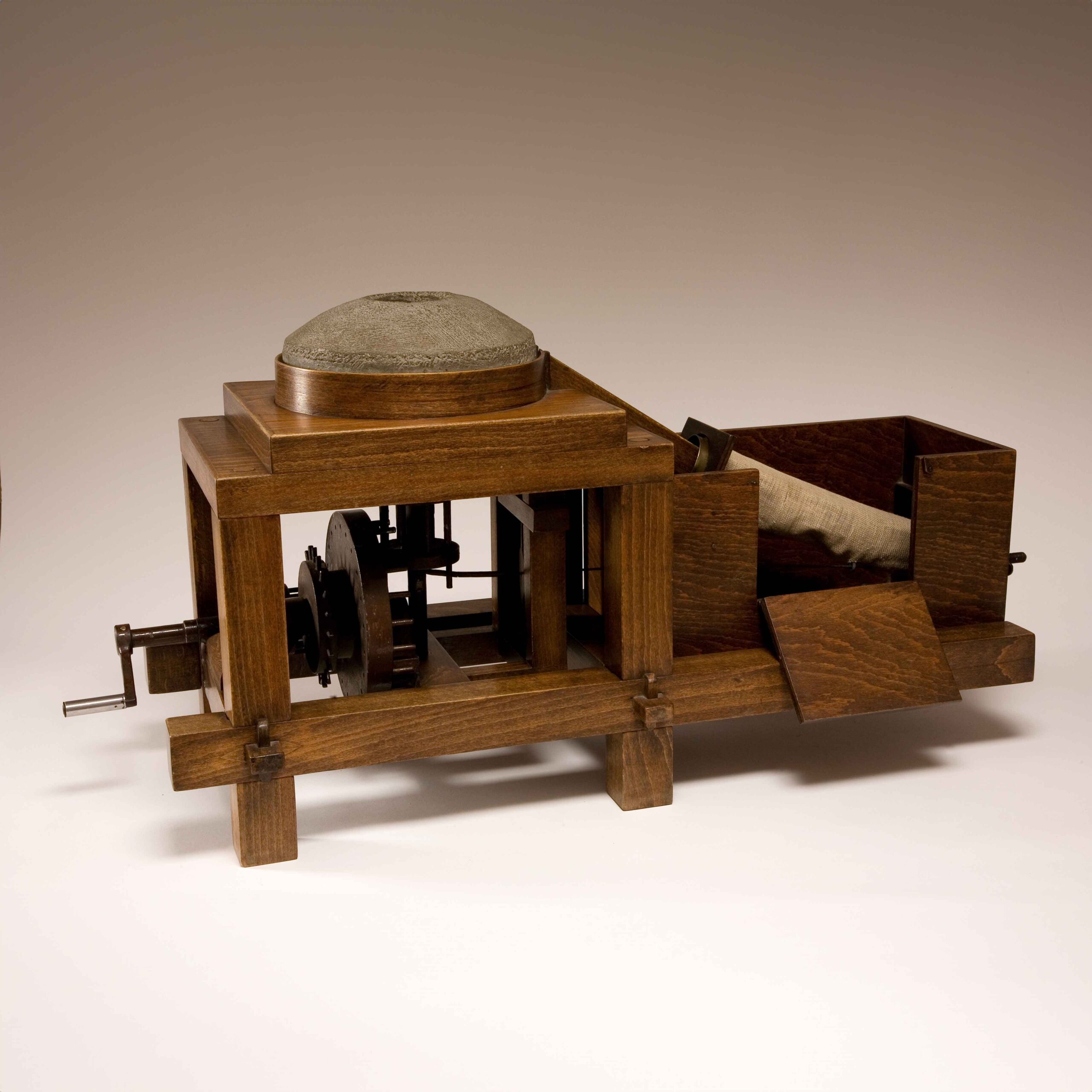
In order to optimize and improve the operations carried out by a traditional grinding mill, Leonardo conceived of a curious device that, in addition to grinding the grain, also separated the flour from the bran at the same time.

The machine houses a millstone at its upper part and, in its lower part, all the gears needed for its movement. A wooden box fitted with a small service hatch is used to collect the ground product. When a crank is moved, the entire mechanism comes to life: the wheat is fed into the mill, where it is ground; it then comes out from a side hole and descends through a sloping channel into a long narrow bag, called the burattello, a sort of meal sifting sack made of bolting cloth. The sifting sack is shaken by a long rod connected to the gears positioned under the millstone, causing the separation of the ground flour from the bran. The sifted flour can be made more refined by using a tighter weave of cloth for the sifting sack.

Technical informations

Type of exhibit
Model
Material
Carved wood, stone, iron, hemp canvas
Measures
Width: 41 cm; Length: 82 cm; Depth: 32 cm.
Storage location
Relationship with the original work
Source: Leonardo da Vinci, Madrid Codex I, f. 22 r
Inventory number
Record n. OA: 00000021
Location
Museo Leonardiano, Counts Guidi's castle, ground floor

Related exhibits

Last update: 11 November 2025, 11:34

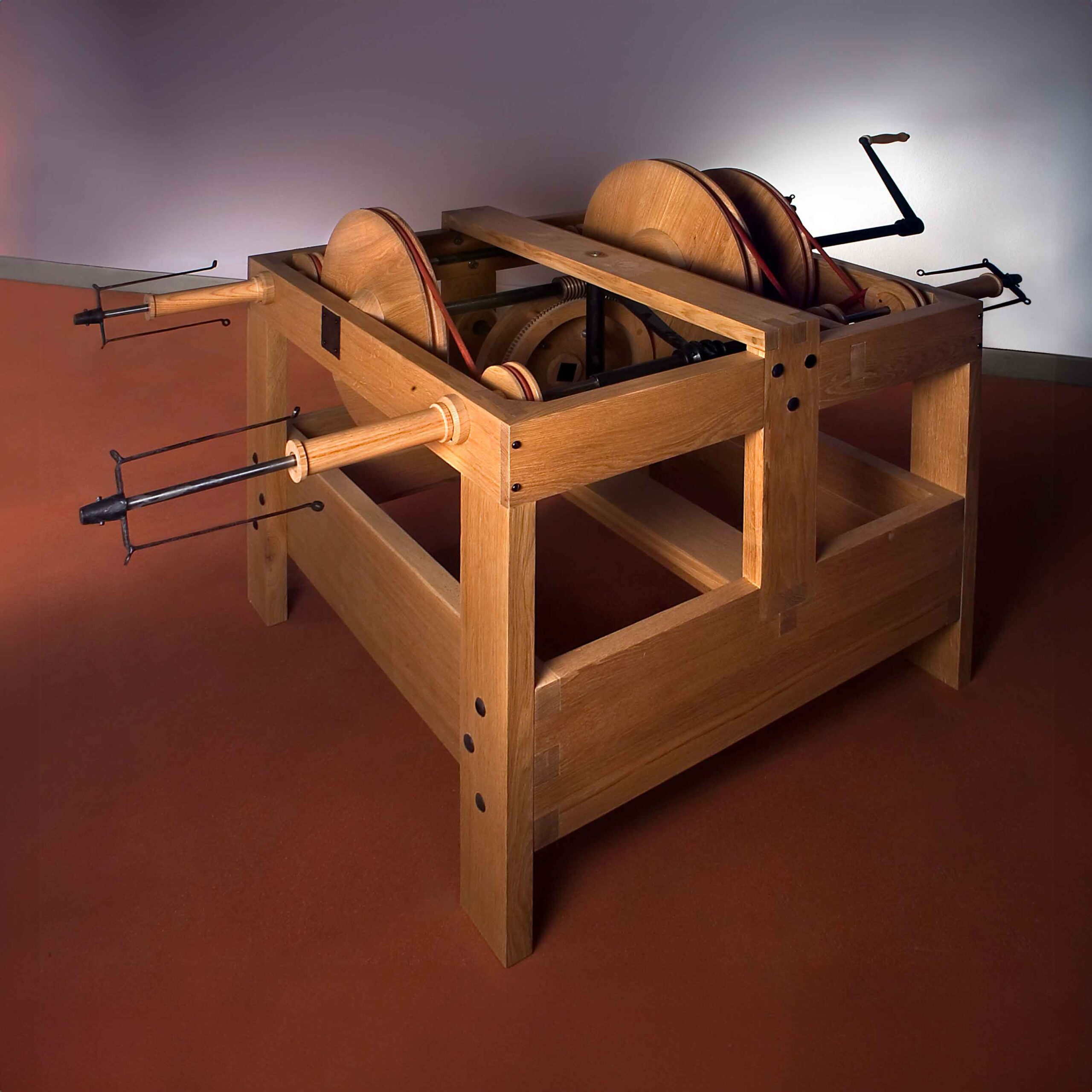
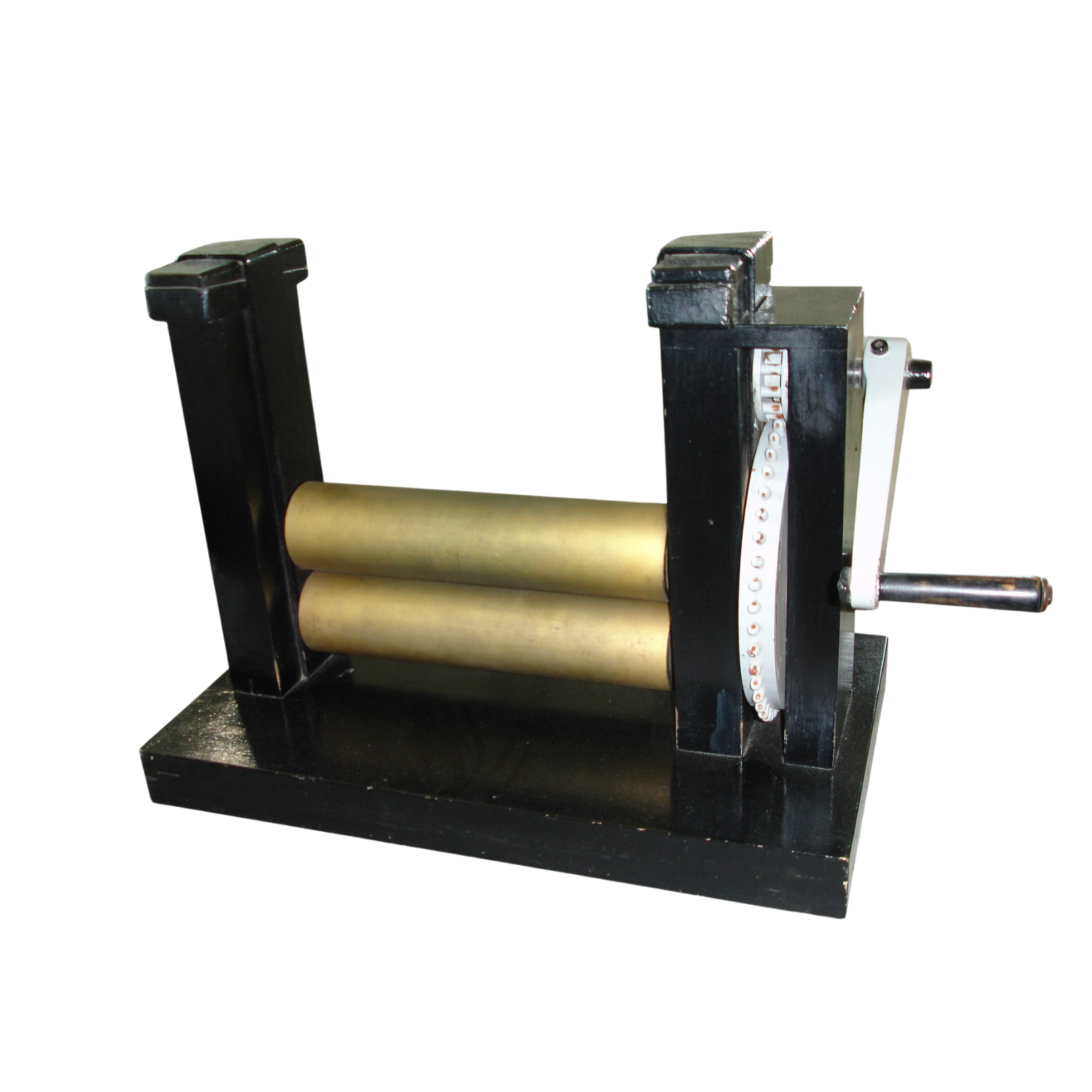
Rolling mill

Made by
IBM Italia

1952

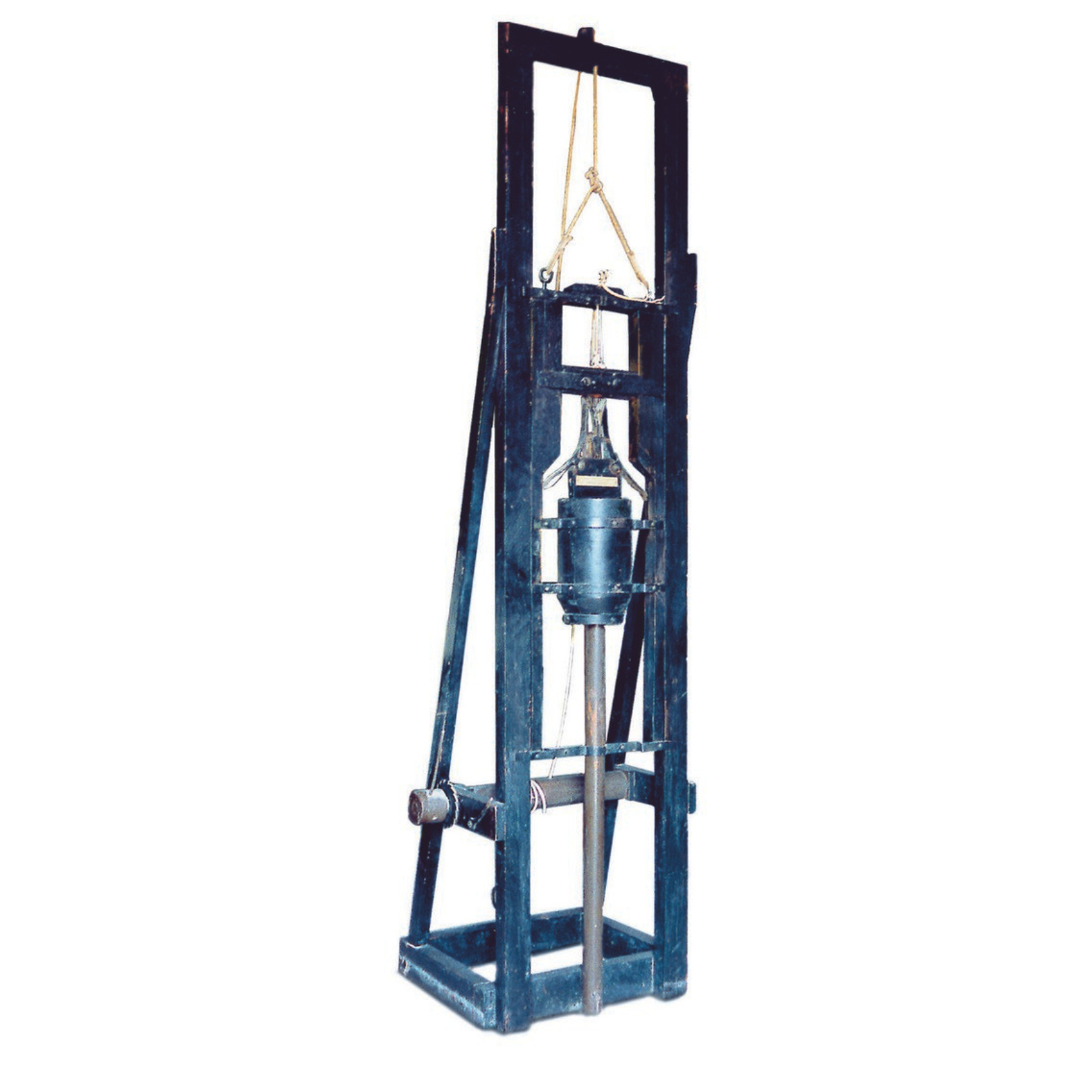
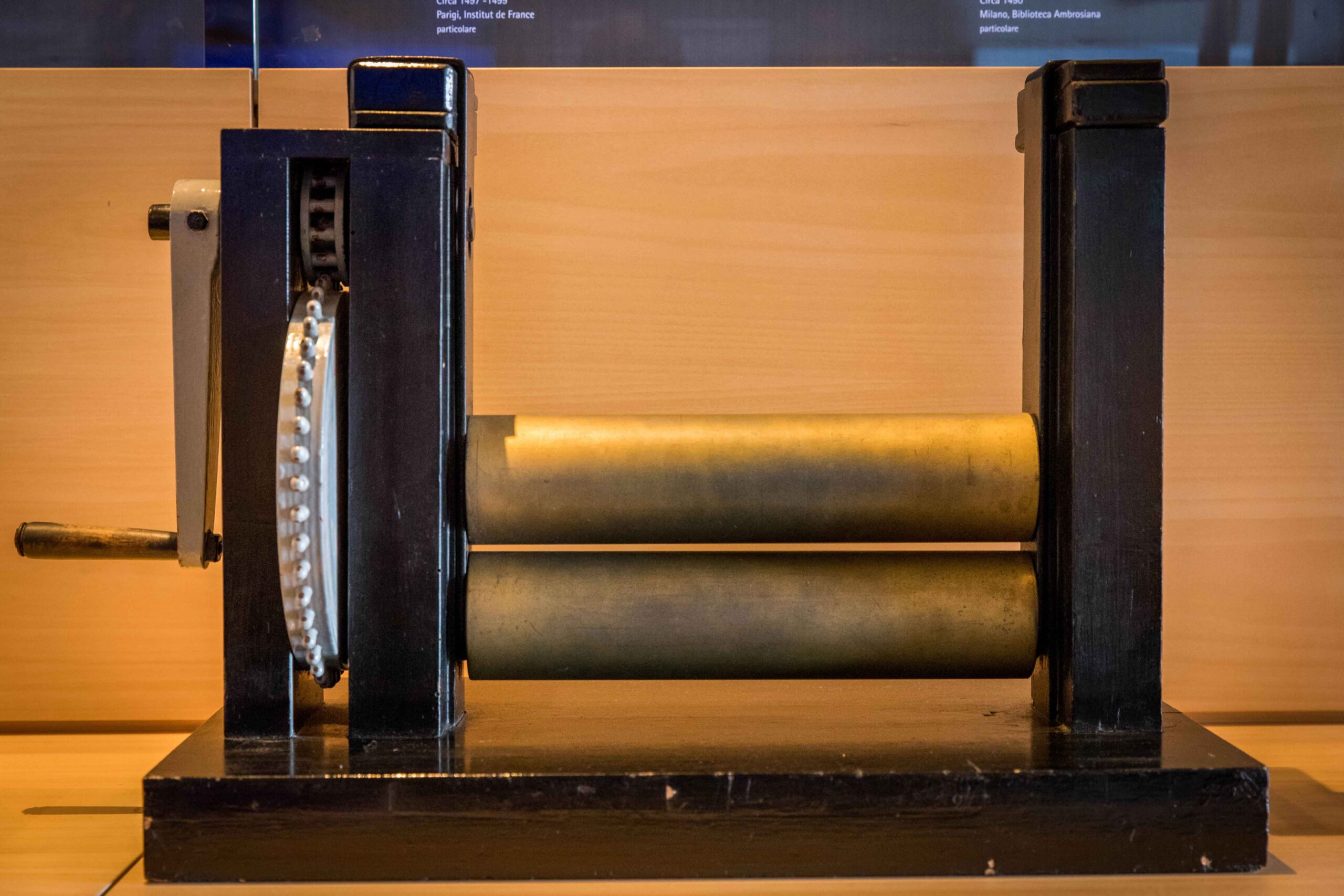
Among Leonardo’s inventions we find a rolling mill capable of rolling out tin into uniformly thin plates.

The instrument consists of a pair of cylindrical rollers, positioned one above the other, which progressively press upon the product to be processed. The turning of a crank moves the gears to set the upper cylinder in motion. The lower one, supported by two brackets, can be lowered or raised, depending on the thickness desired for the metal sheet to be thinned.
Leonardo suggests making the cylinders out of “material for bells,” namely, bronze, so that they will not deform during use.

Technical informations

Type of exhibit
Model
Material
Carved wood, metal, enameled iron
Measures
Width: 46 cm; Length: 70 cm; Depth: 35 cm.
Storage location
Relationship with the original work
Source: Leonardo da Vinci, Manuscript I (France), f. 48 v
Inventory number
Record n. OA: 00000018
Location
Museo Leonardiano, Counts Guidi's castle, ground floor

Related exhibits

Last update: 11 November 2025, 11:50

How clear is the information on this page?

Thank you, your feedback will help us improve the service!

What were your favorite aspects?1/2

Dove hai incontrato le maggiori difficoltà?1/2

Do you want to add more details?2/2

Enter a maximum of 200 characters

This website is protected by reCAPTCHA. Google Privacy Policy and Terms of Use di applies.