Icona che richiama un banner d'attenzione

FOR GROUPS AND SCHOOL PARTIES ARRIVING BY BUS: Please be advised that, due to ongoing works in the village, bus access may be difficult.
We therefore recommend parking in Via Cerretana and continuing on foot.

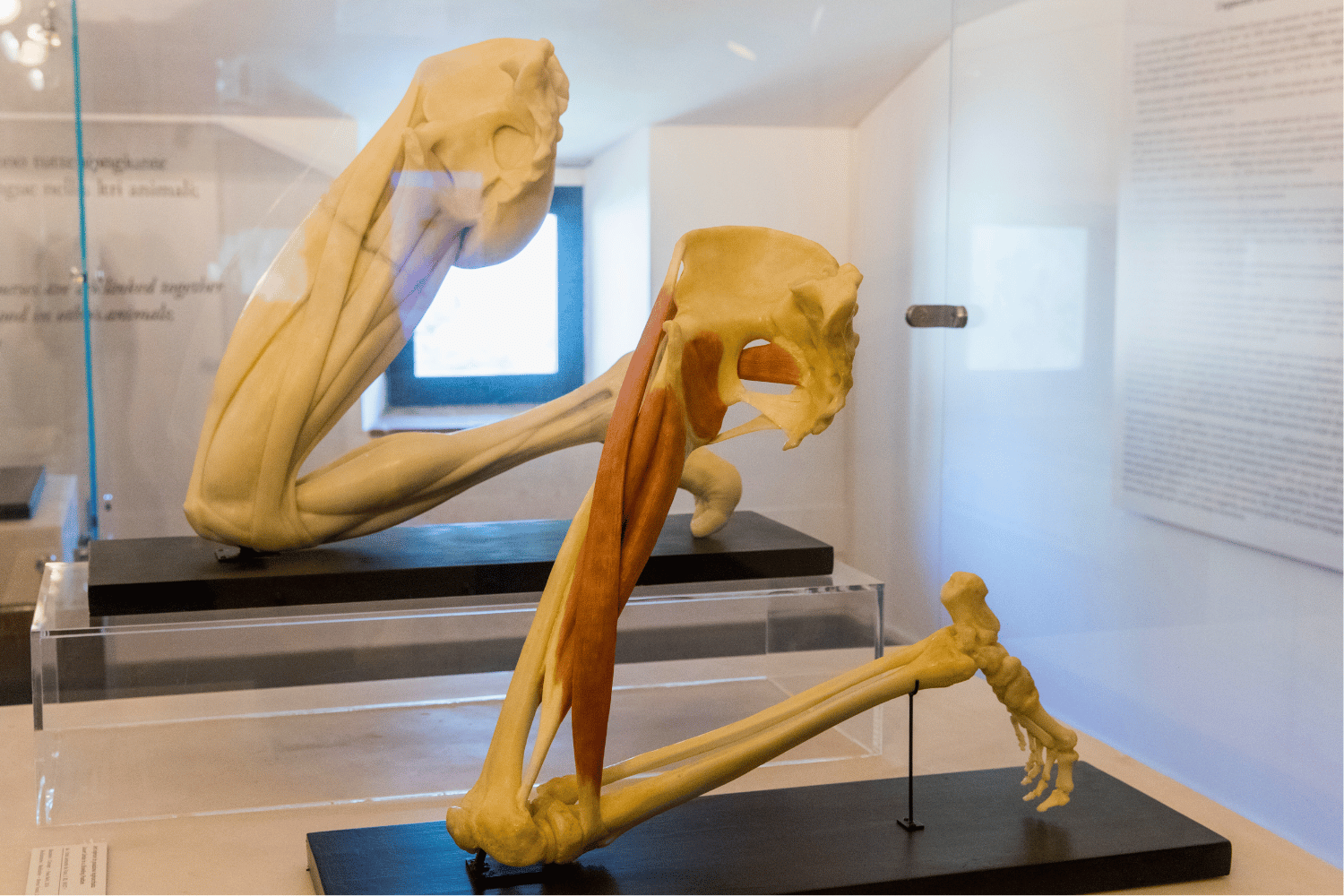
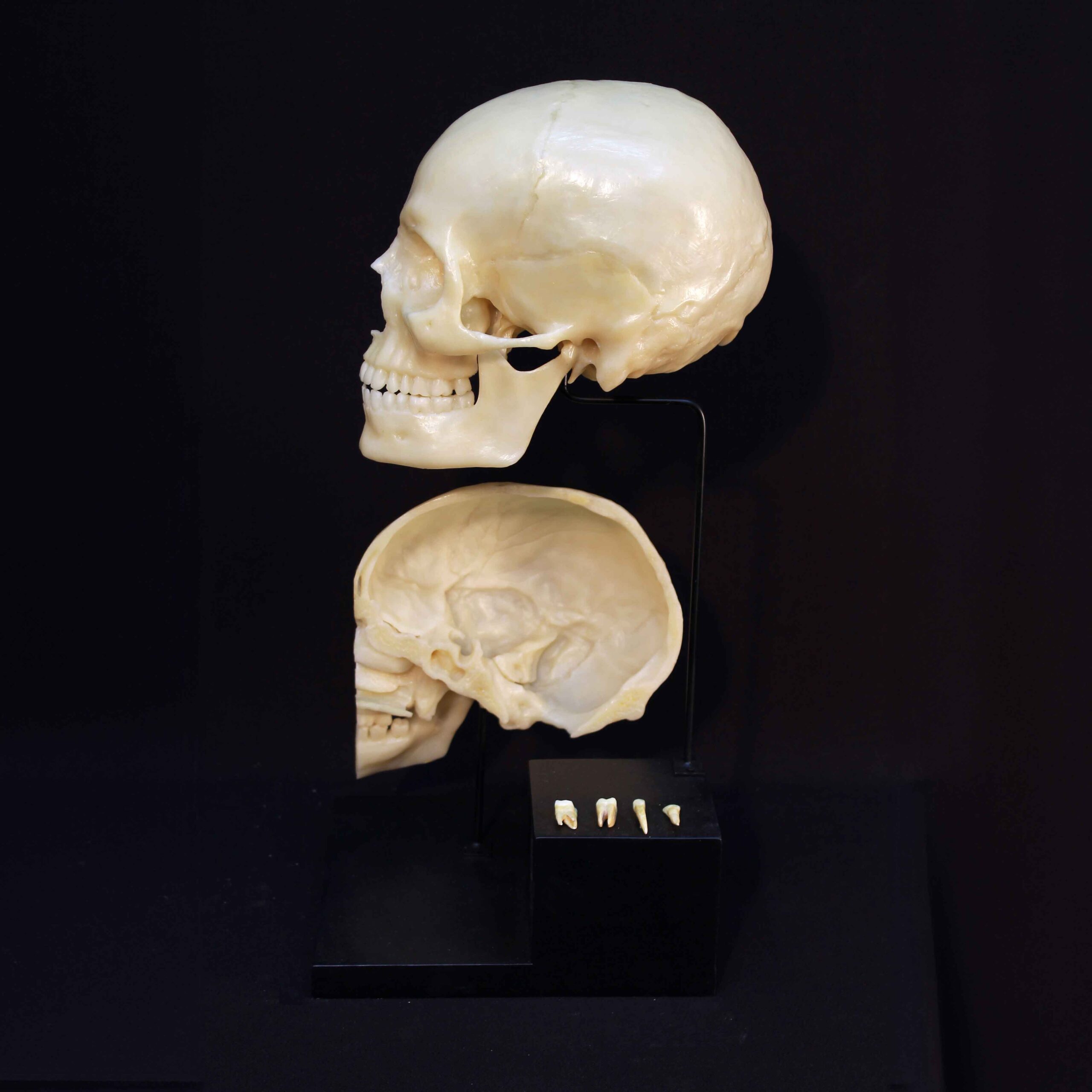
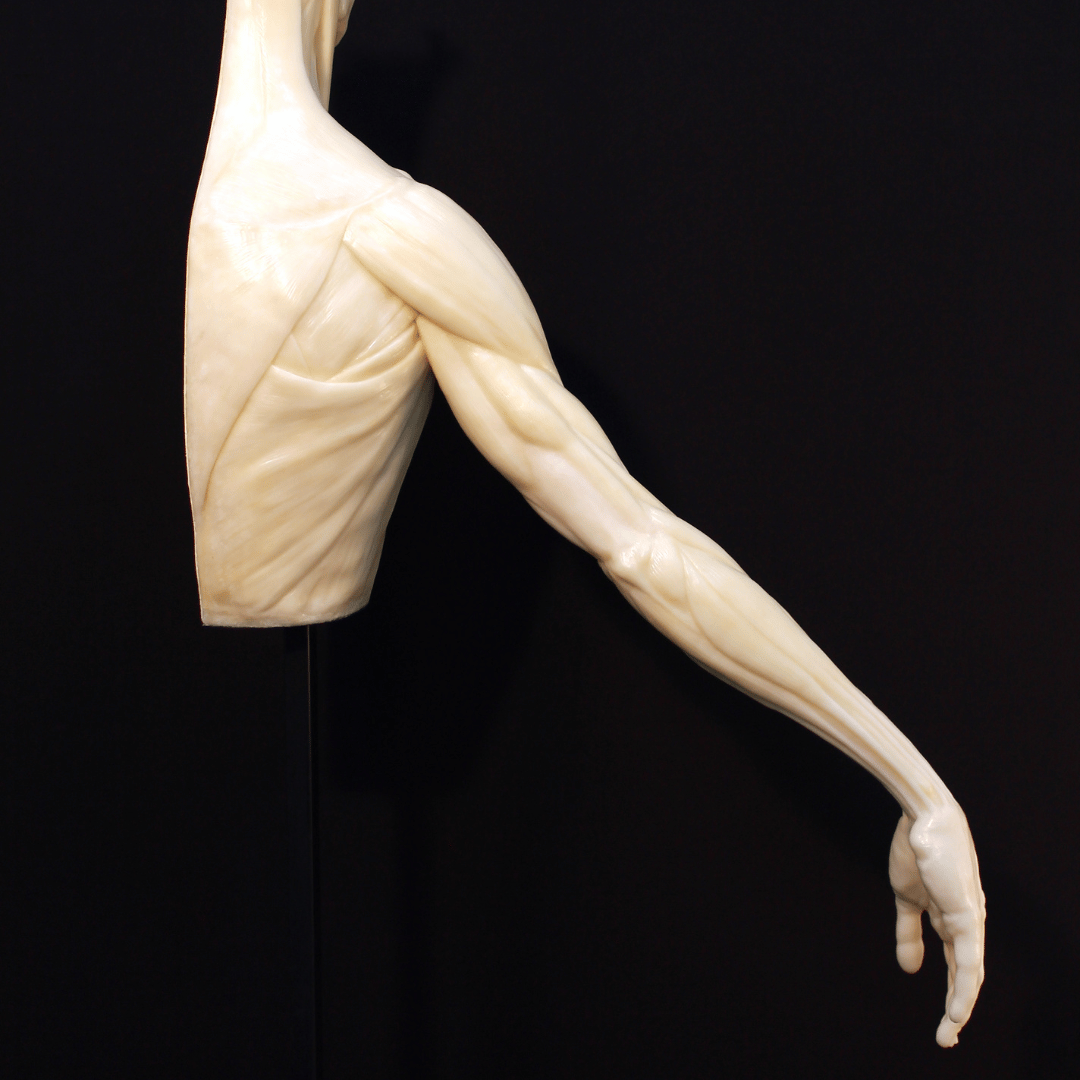
Lower limbs in kneeling position

Paola Salvi, Made by
Moreno Vezzoli

2016

Leonardo analyzed the lower limbs for their power, in view of their possible propulsive energy for operating his machines. The two wax models in the display case represent the lower right limb in kneeling position, that is, with the knee and the tip of the foot resting on the ground. Just as in Leonardo’s drawing, which you can view on the longest wall of the room, the two sculptures highlight two different levels of dissection: one shows the conformation of the surface musculature, while the other depicts the bones and deeper connections between muscles.

Leonardo was interested in the muscles that produce flexions: of the leg, on the thigh; of the foot, on the leg; and of the tip of the foot, on the metatarsal section. In particular, he analyzed the rotary action of the sartorius, an elongated, ribbon-like muscle that joins the hip bone to the upper end of the tibia. In order to represent the muscles, often the artist made use of a particular artifice: these transform into taut cords stretched between one bone intersection and another, thus explaining the application of the lines of force during contraction.

Technical informations

Type of exhibit
Model
Collection
Material
Wax sculpture
Storage location
Relationship with the original work
Source: Leonardo da Vinci, Windsor Collection, f. RL19037 r
Location
Museo Leonardiano, Palazzina Uzielli, second floor

Last update: 14 October 2025, 10:52
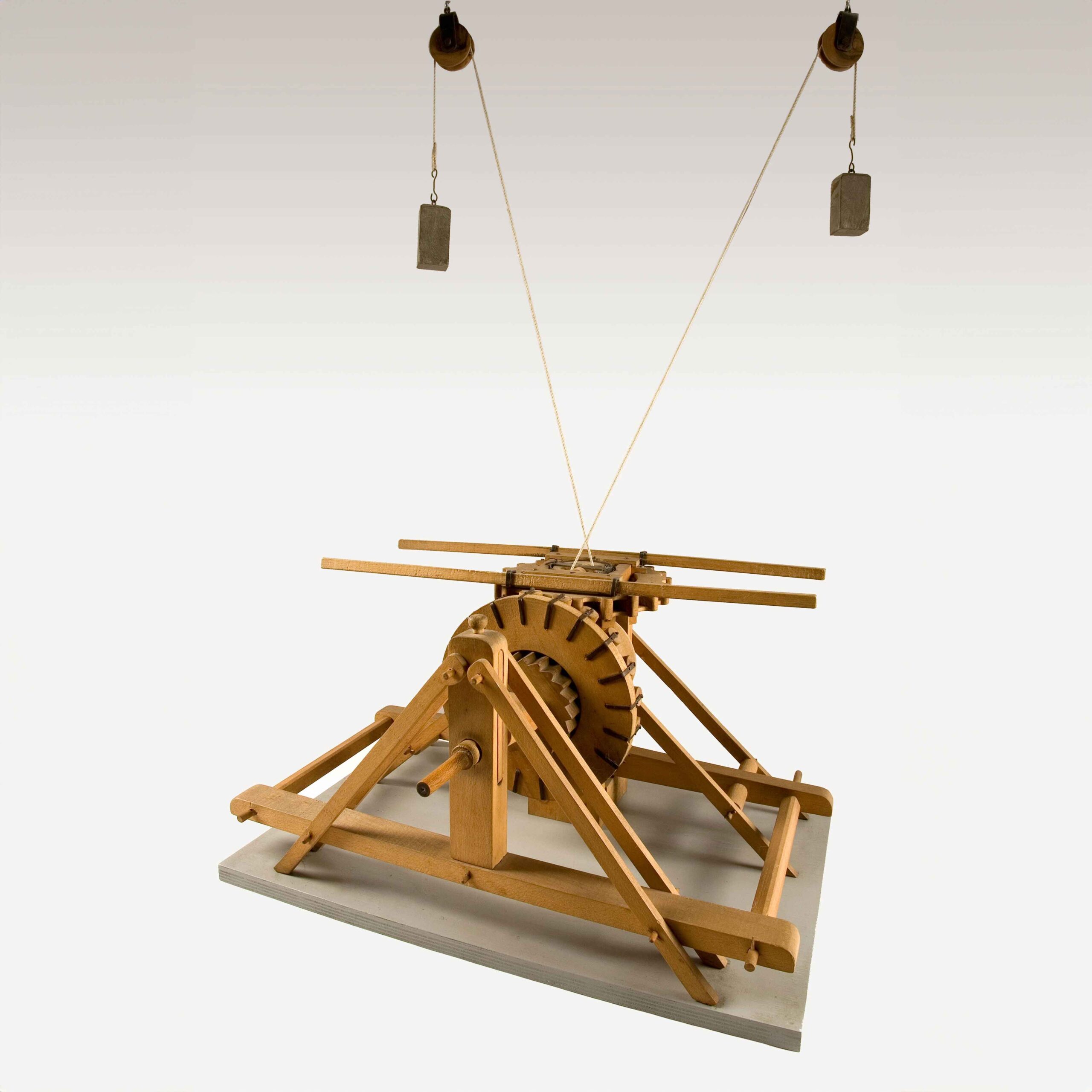
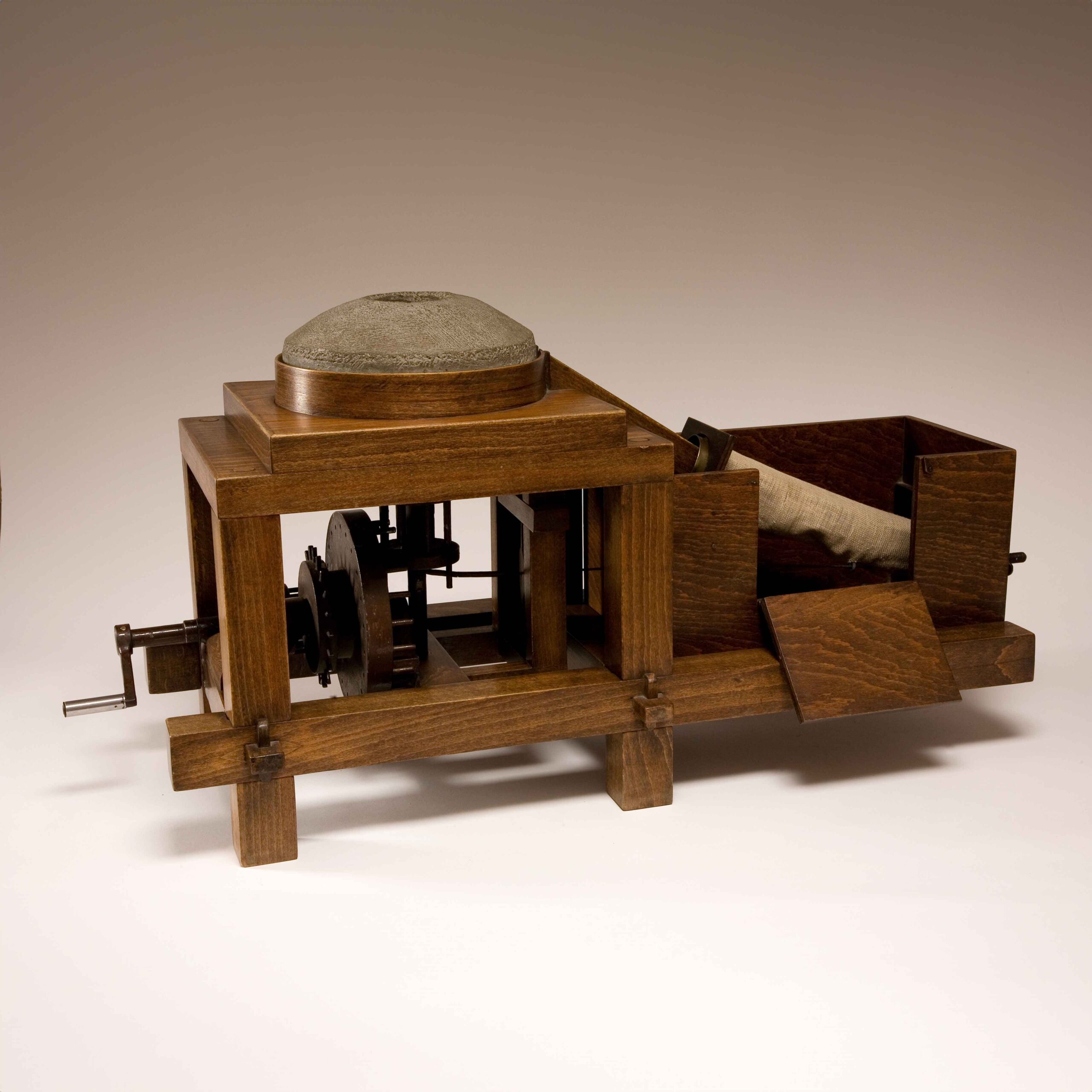
Lightweight winch

Ladislao Reti, Federico Antonello, Nino Terreni

1964

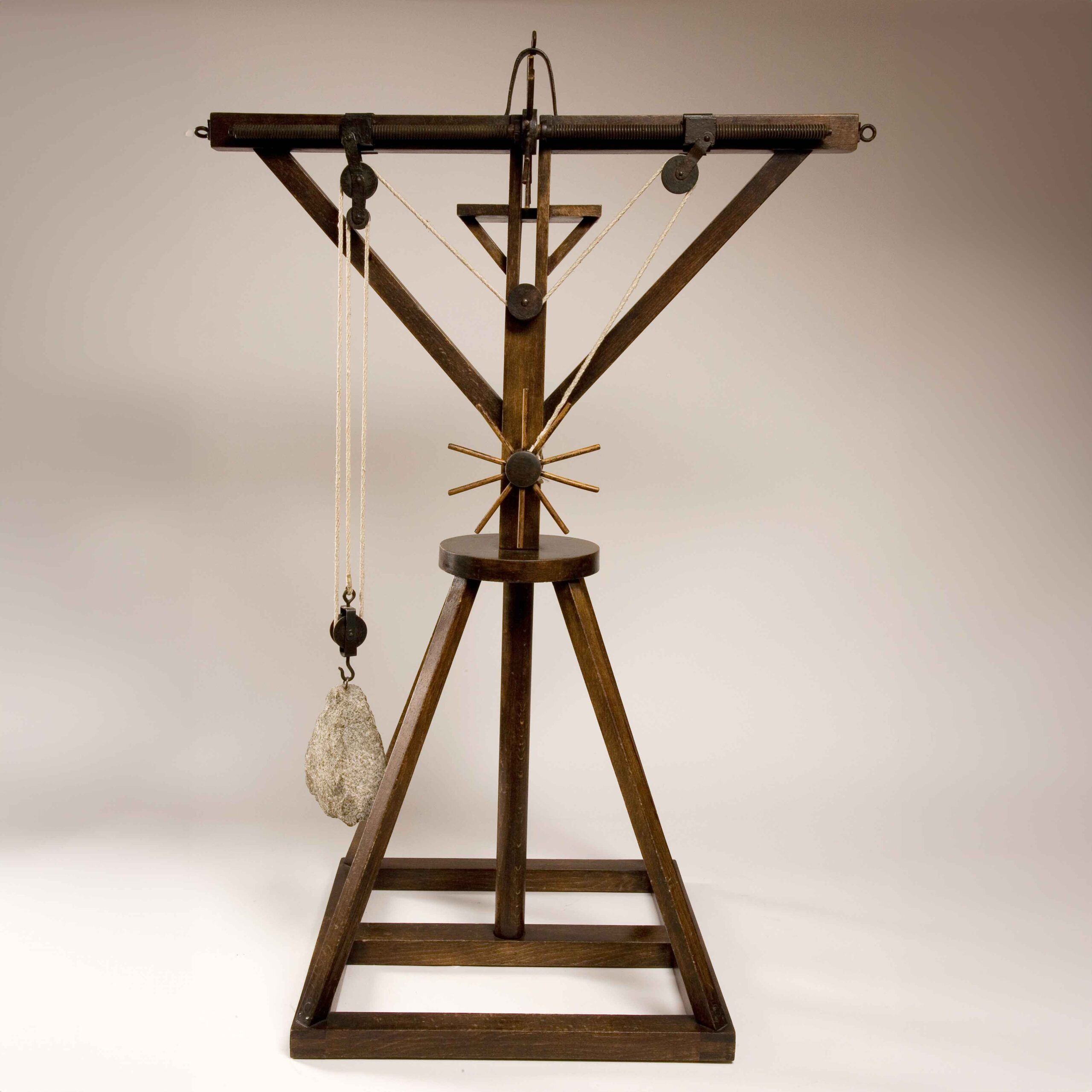
Conceived by Brunelleschi for the construction works for the Florence Cathedral dome, the lightweight winch was utilized for hoisting modest loads. It could lift a 1200 kg weight at a speed of 3 meters per second. The machine is powered by four men who, by moving the two horizontal rods, turn a large toothed wheel meshing with a vertical wheel equipped with innovative friction-reducing cylindrical bearings. The lifting ropes wrap around the central drum, one supporting the load, the other supporting the counterweight. Thanks to the pulley fitted into the horizontal wheel, the lifting ropes can run upward without obstructing the movement of the bars.

Technical informations

Type of exhibit
Model
Material
Carved wood, iron, cotton ropes, stone
Measures
Width: 101 cm, Length: 72 cm, Depth: 43.5 cm
Storage location
Relationship with the original work
Source: Leonardo da Vinci, Codex Atlanticus, f. 105v
Inventory number
N° scheda OA: 00000028
Location
Museo Leonardiano, Palazzina Uzielli, first floor

Related exhibits

Last update: 17 September 2025, 12:11

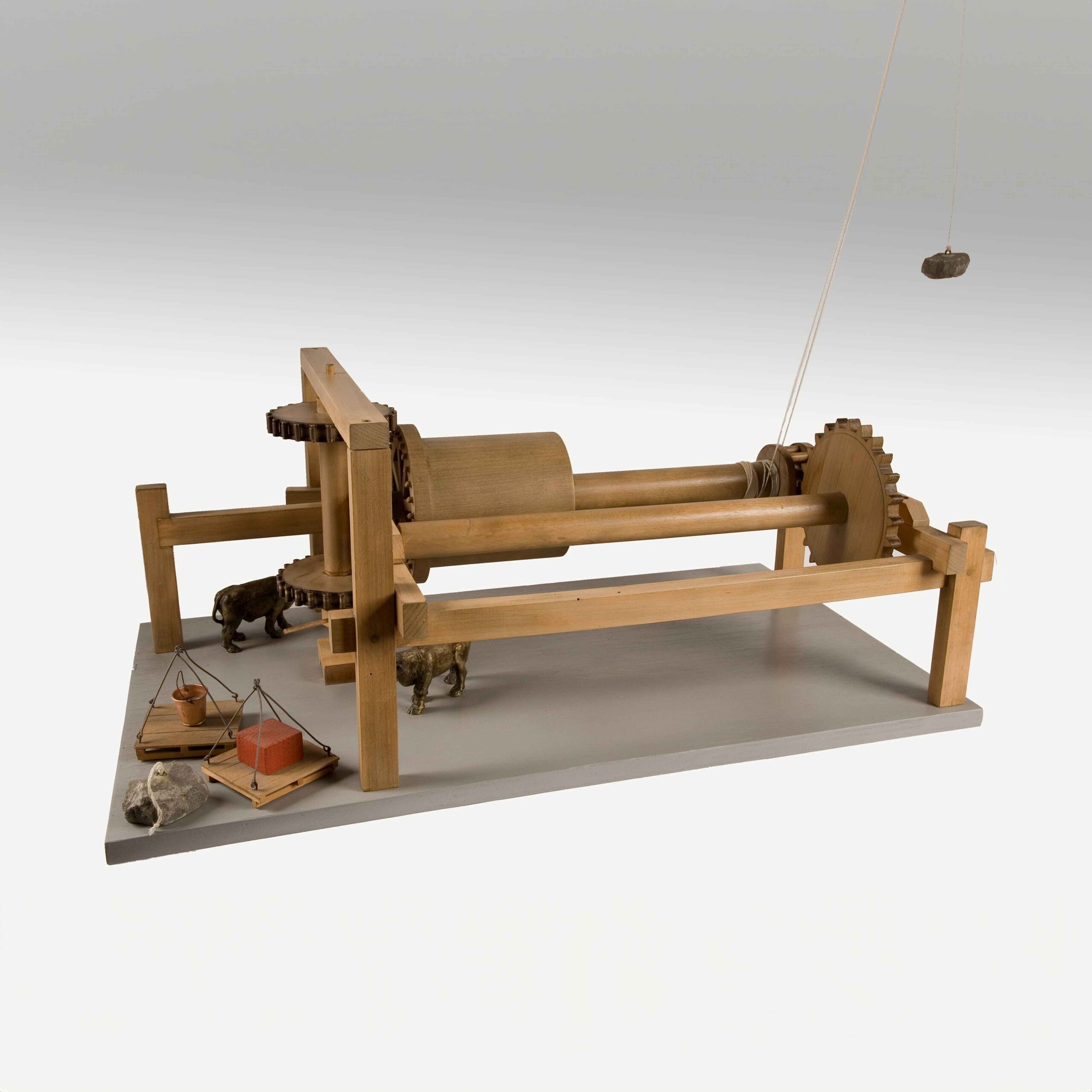
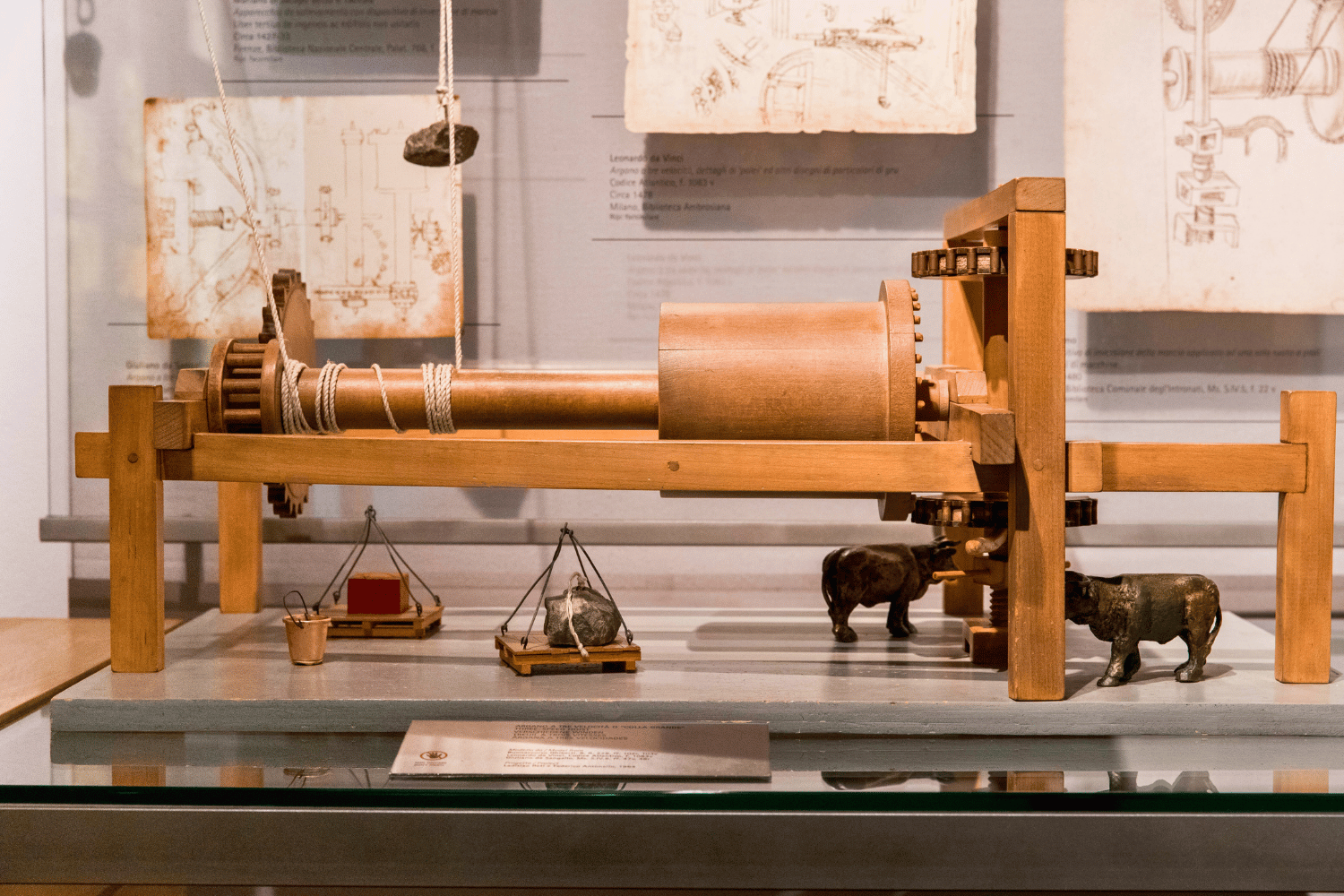
Three-speed winch

Ladislao Reti, Nino Terreni, Federico Antonello

1964

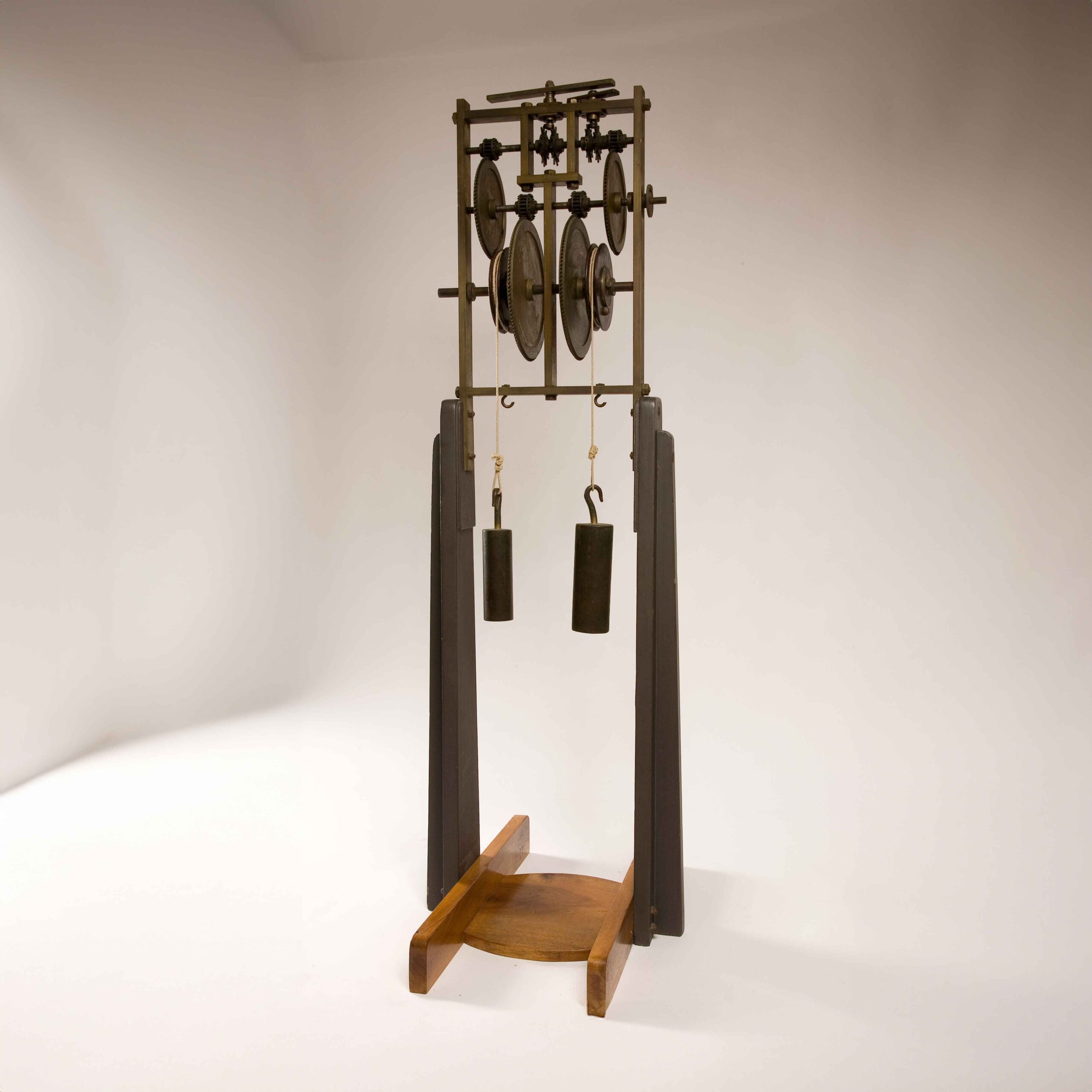
Designed by Filippo Brunelleschi around 1420, this winch was used in the construction works for the dome of the Florence Cathedral, for hoisting and lowering very heavy loads.

The machine is composed of a wooden structure anchored to the ground. It is powered by a pair of oxen turning in a circle, actuating a moving shaft with an endless screw device connected to two horizontal wheels. By means of the gears connected to the endless screw, it was possible to change the direction of the winch’s rotation, thus causing the load to rise or lower, without having to detach the oxen from the yoke. Another feature of the machine is the presence of three drums, or cylindrical axes, on which the cords for raising or lowering the loads wrap and unwrap. Each has a different diameter, allowing the winch to work with different forces and at different speeds depending on the load to be handled.

Technical informations

Type of exhibit
Model
Material
Carved and turned wood, cotton cords, brass, stone, and copper
Measures
Width: 96 cm, Length: 86.5 cm, Depth: 57.7 cm.
Storage location
Relationship with the original work
Source: Leonardo da Vinci, Codex Atlanticus, f. 1083 v
Inventory number
Record no. OA: 00000027
Location
Museo Leonardiano, Palazzina Uzielli, first floor

Related exhibits

Last update: 19 June 2025, 12:05

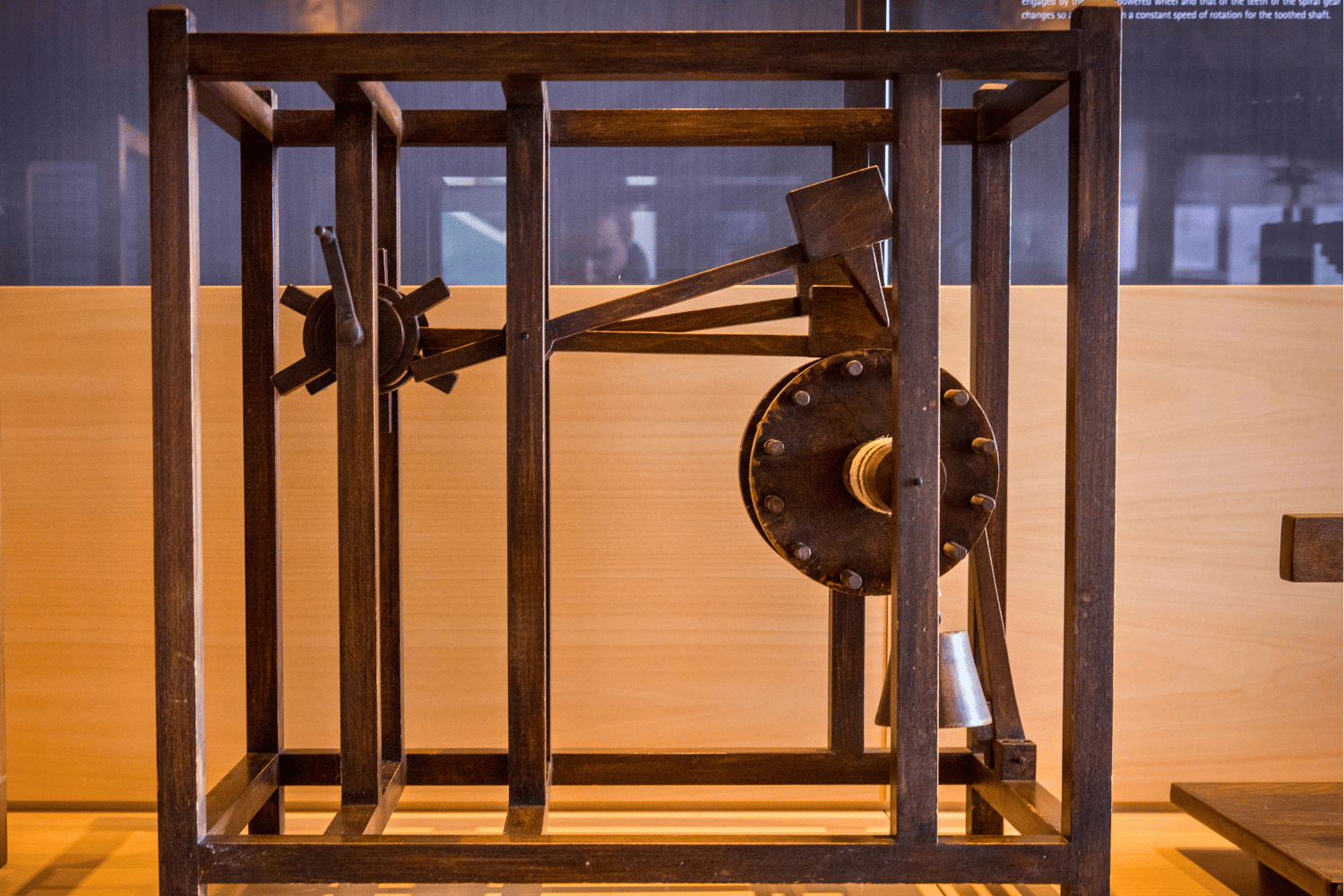
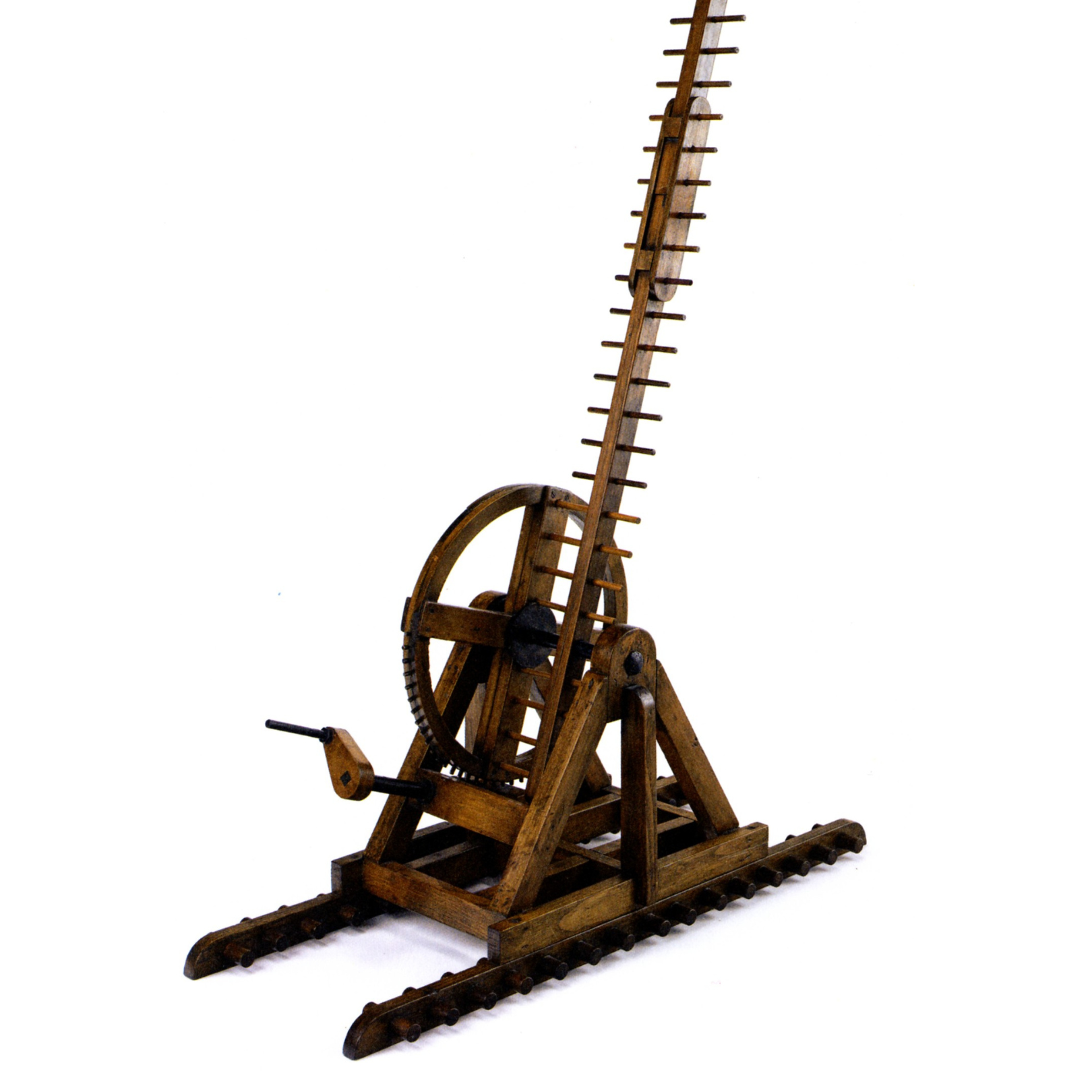
Hammer winch

Luigi Boldetti

1968

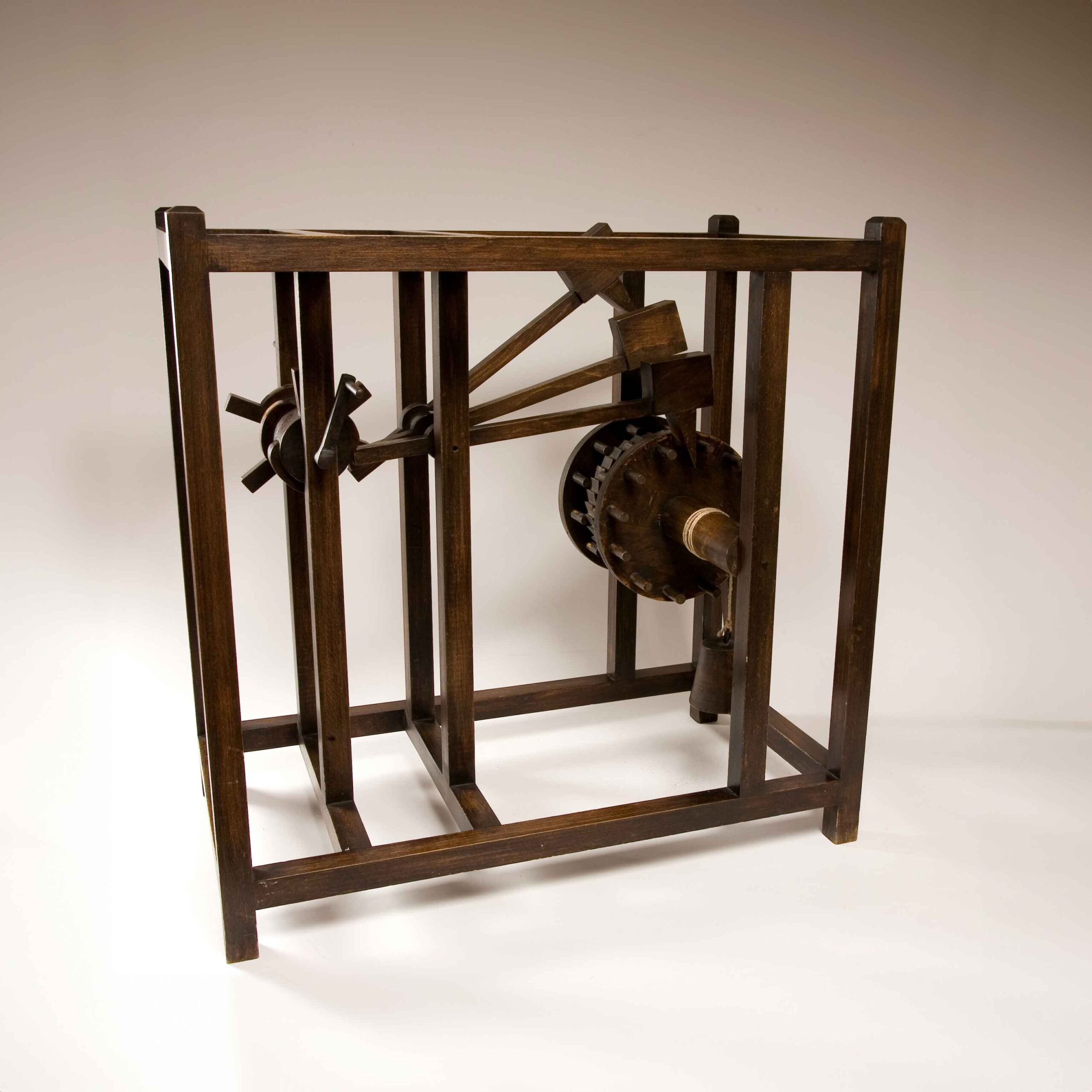
For the purpose of lifting weights, Leonardo conceived of a system of hammers that would provide force through the impact of blows.

To operate the device, two cranks are turned to set into motion a drum with radially protruding pegs, causing the individual hammers to rise and fall in alternating succession. Blow after blow, the hammers cause the wheel to turn, thereby also turning the drum to which the weight is attached.
In order to prevent the unwinding of the cable, and the consequent fall of the weight, Leonardo adopted an anti-return safety mechanism consisting of an oblique rod that fits perfectly into the wheel’s teeth.

Technical informations

Type of exhibit
Model
Material
Carved wood, metal, rope
Measures
Width: 67 cm; Length: 68 cm; Depth: 38 cm.
Storage location
Relationship with the original work
Source: Leonardo da Vinci, Madrid Codex I, f. 92 v
Inventory number
Record n. OA: 00000030
Location
Museo Leonardiano, Counts Guidi's castle, ground floor

Related exhibits

Last update: 11 November 2025, 12:10

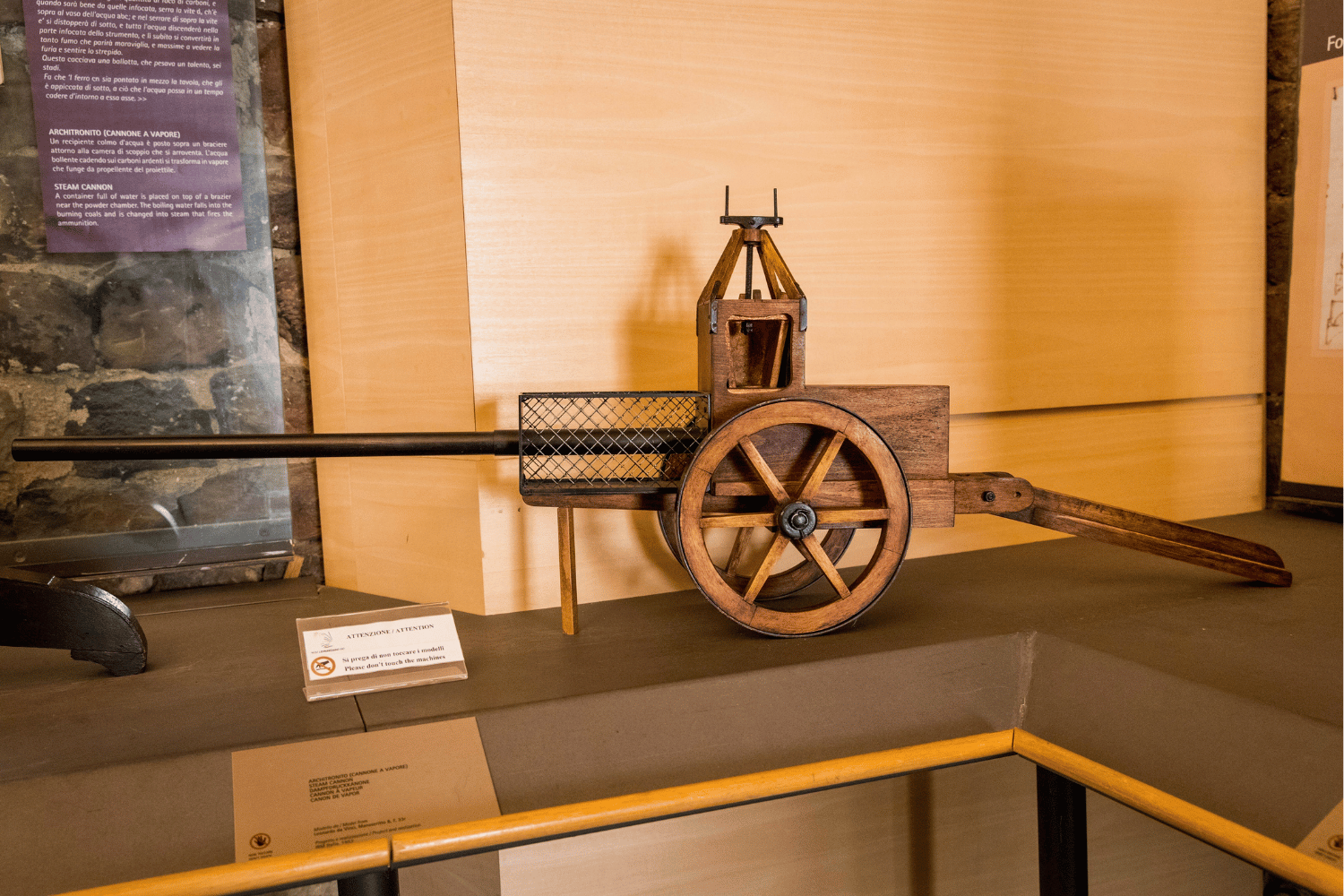
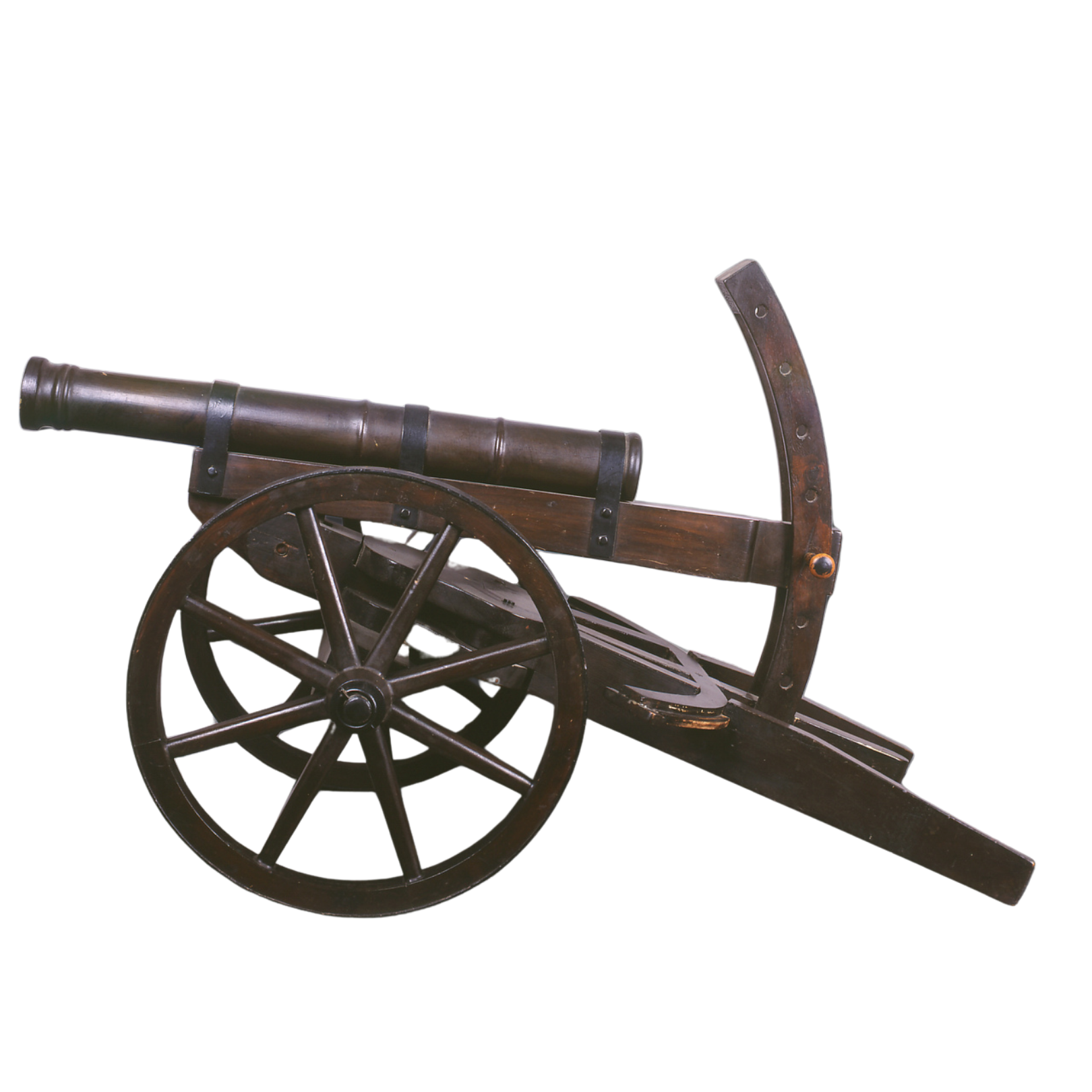
Architronito, or steam cannon

Made by
IBM Italia

1952

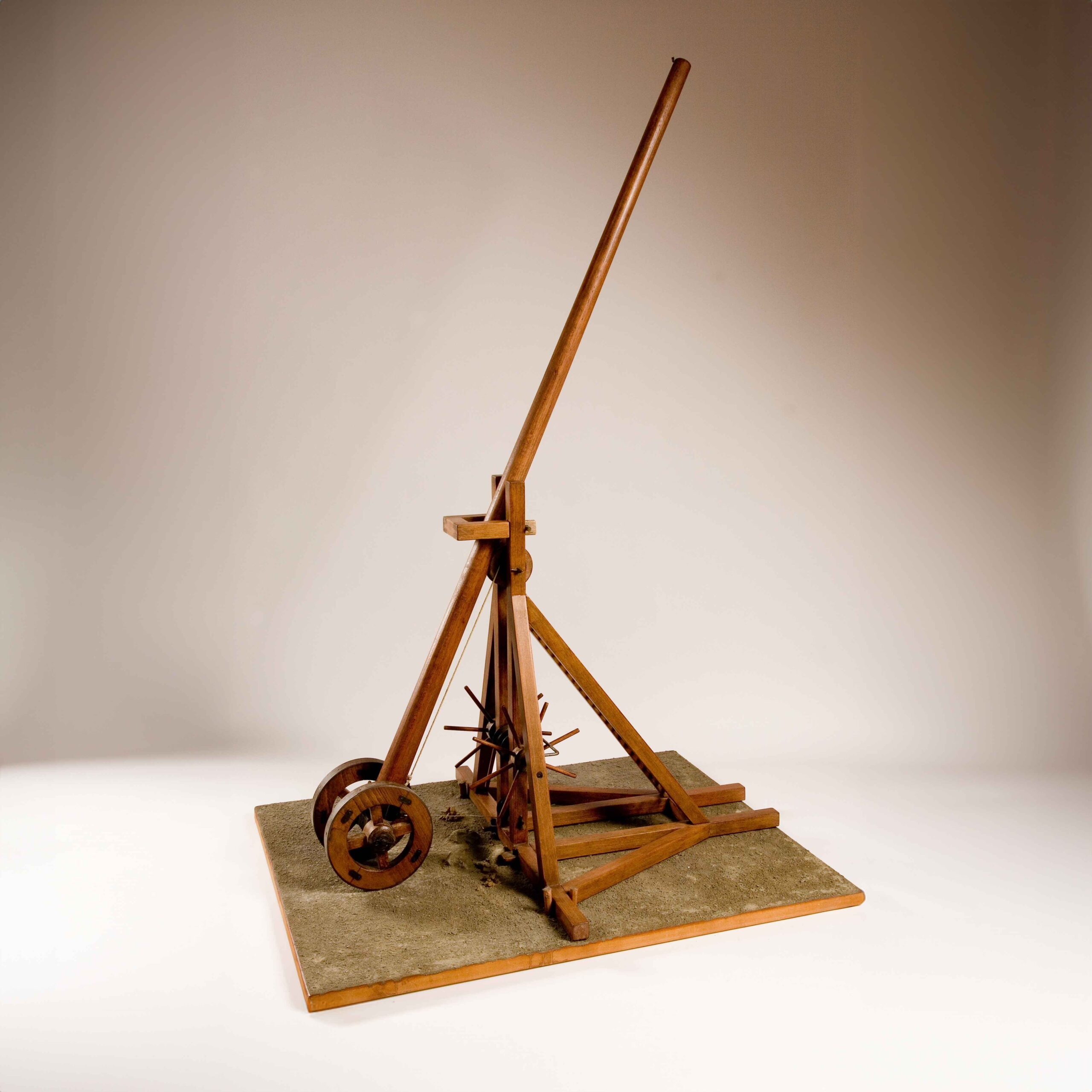
Developing an idea from Archimedes, Leonardo designed the Architronito, a cannon capable of shooting projectiles using steam as a propulsive force.

In the model, the breech of the cannon is positioned inside the metallic cage, which is filled with burning coal. Water contained in a quadrangular reservoir is made to flow to the chamber underneath, where it comes into contact the cannon’s red-hot barrel, then transforming into steam and so generating the pressure necessary to shoot the projectile. The Architronito is mounted on two wheels for easy movement on the battlefield. It is equipped with a beam at the back to limit recoil generated by the shot.

Technical informations

Type of exhibit
Model
Collection
Material
Carved/painted wood and iron
Measures
Width: 49 cm; Length: 135 cm; Depth: 27 cm.
Storage location
Relationship with the original work
Source: Leonardo da Vinci, Manuscript B (France), f. 33 r
Inventory number
Record n. OA: 00000010
Location
Museo Leonardiano, Counts Guidi's castle, ground floor

Related exhibits

Last update: 10 November 2025, 12:37

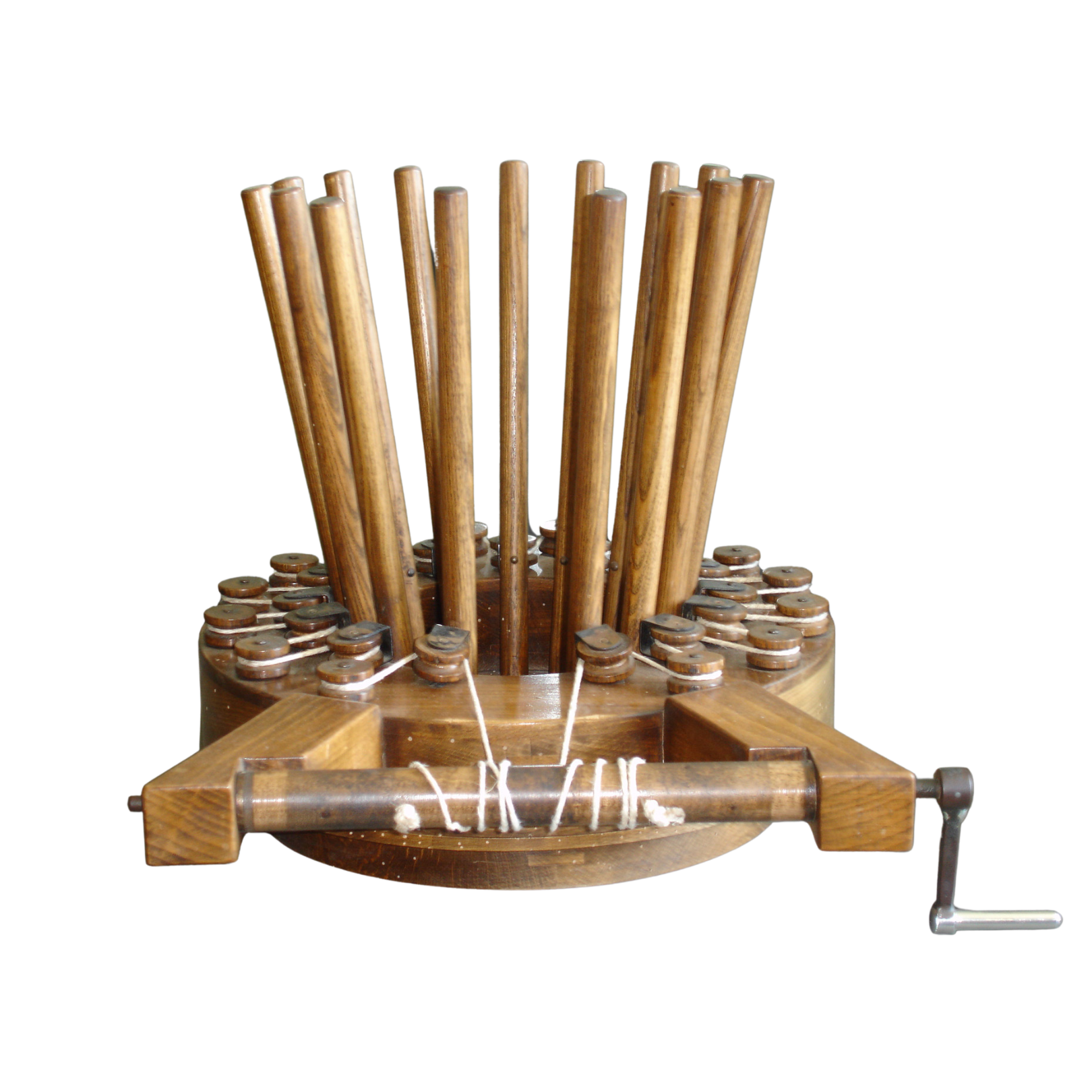
Apparatus for pulling

Luigi Boldetti

1971

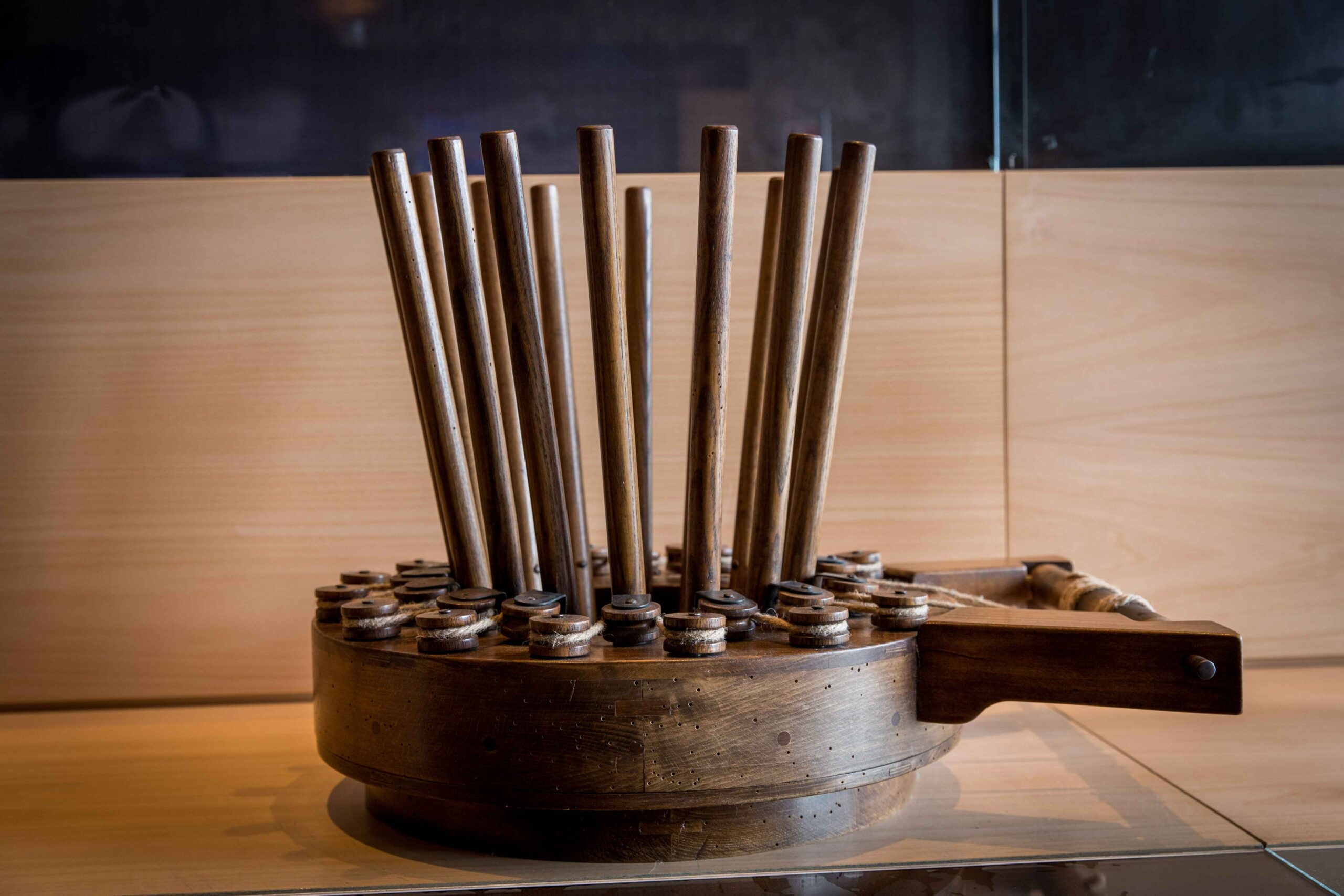
With precise and clean lines, Leonardo produced a finely detailed drawing of a curious device for moving or positioning rods or poles all at once.

The model consists of a circular platform, with a hole fashioned at the center, around which two orders of pulleys are arranged radially. The outer pulleys are fixed, while the inner ones are movable.
When the crank is turned, the cords passing inside the pulleys move the poles, causing them to straighten. It is likely that Leonardo was considering making use of this device in the field of textile manufacturing.

Technical informations

Type of exhibit
Model
Material
Carved wood, metal, rope
Measures
Width: 61 cm; Height: 48 cm; Depth: 63 cm.
Storage location
Relationship with the original work
Source: Leonardo da Vinci, Madrid Codex I, f. 44 v
Inventory number
Record n. OA: 00000046
Location
Museo Leonardiano, Counts Guidi's castle, ground floor

Related exhibits

Last update: 11 November 2025, 12:39

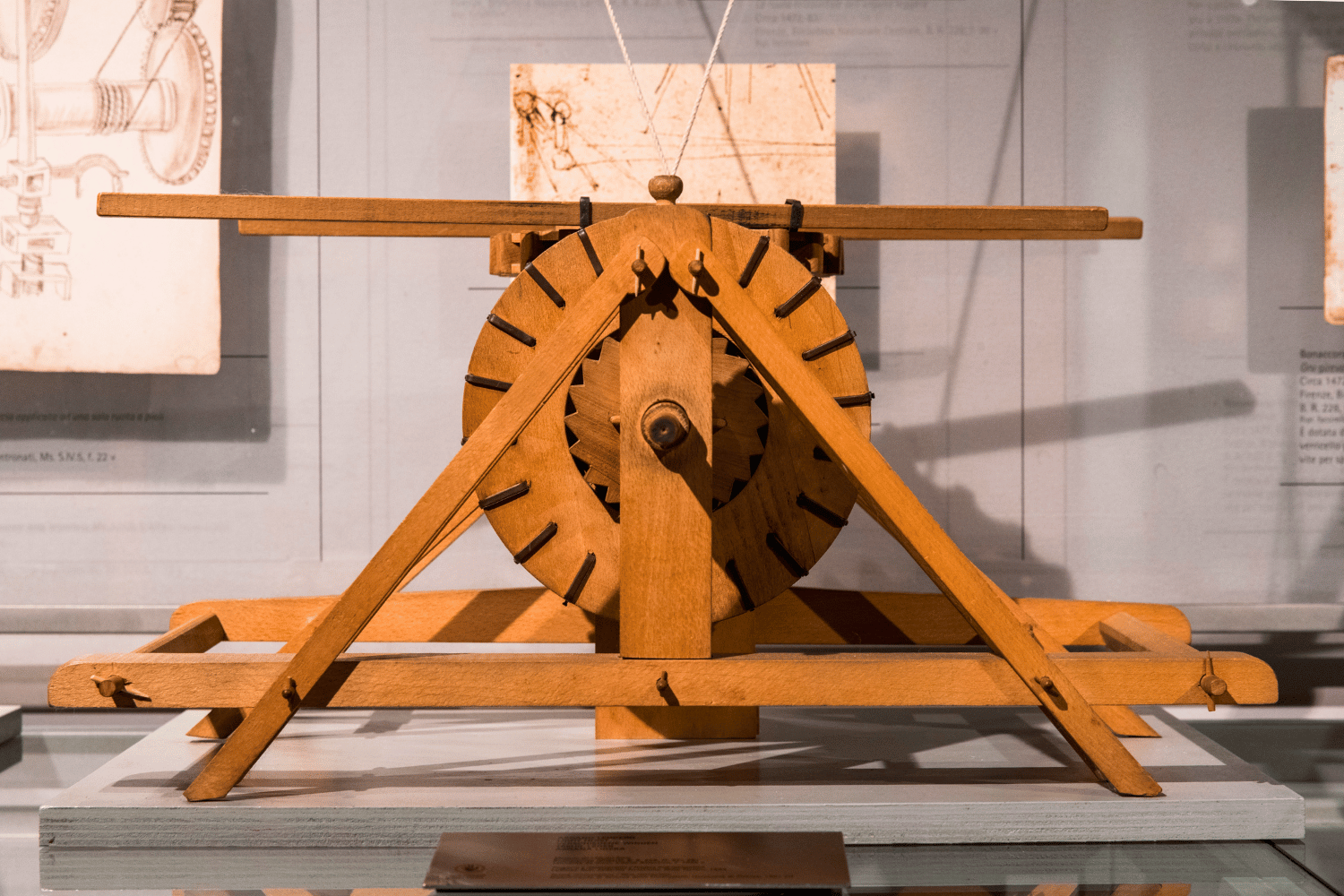
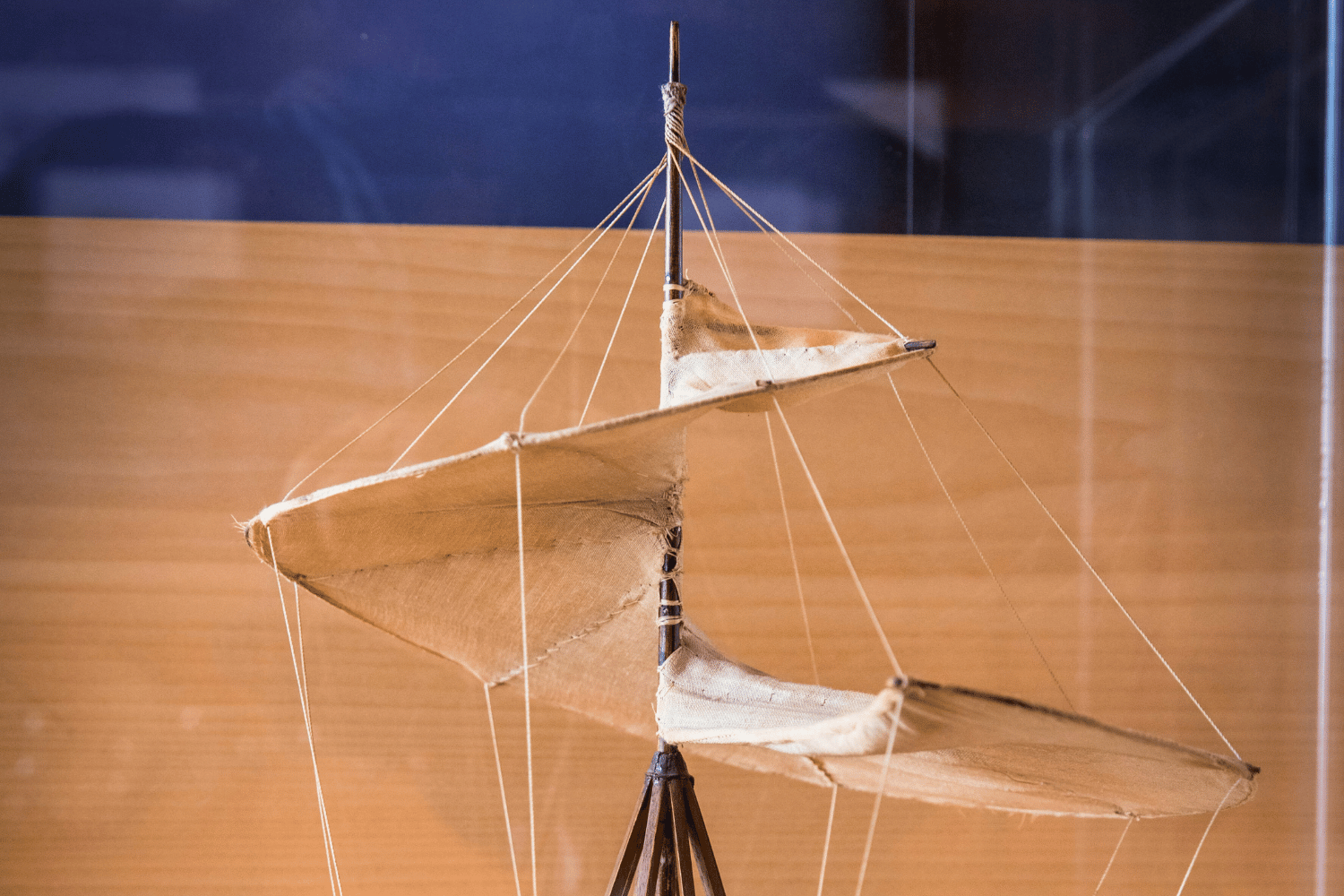
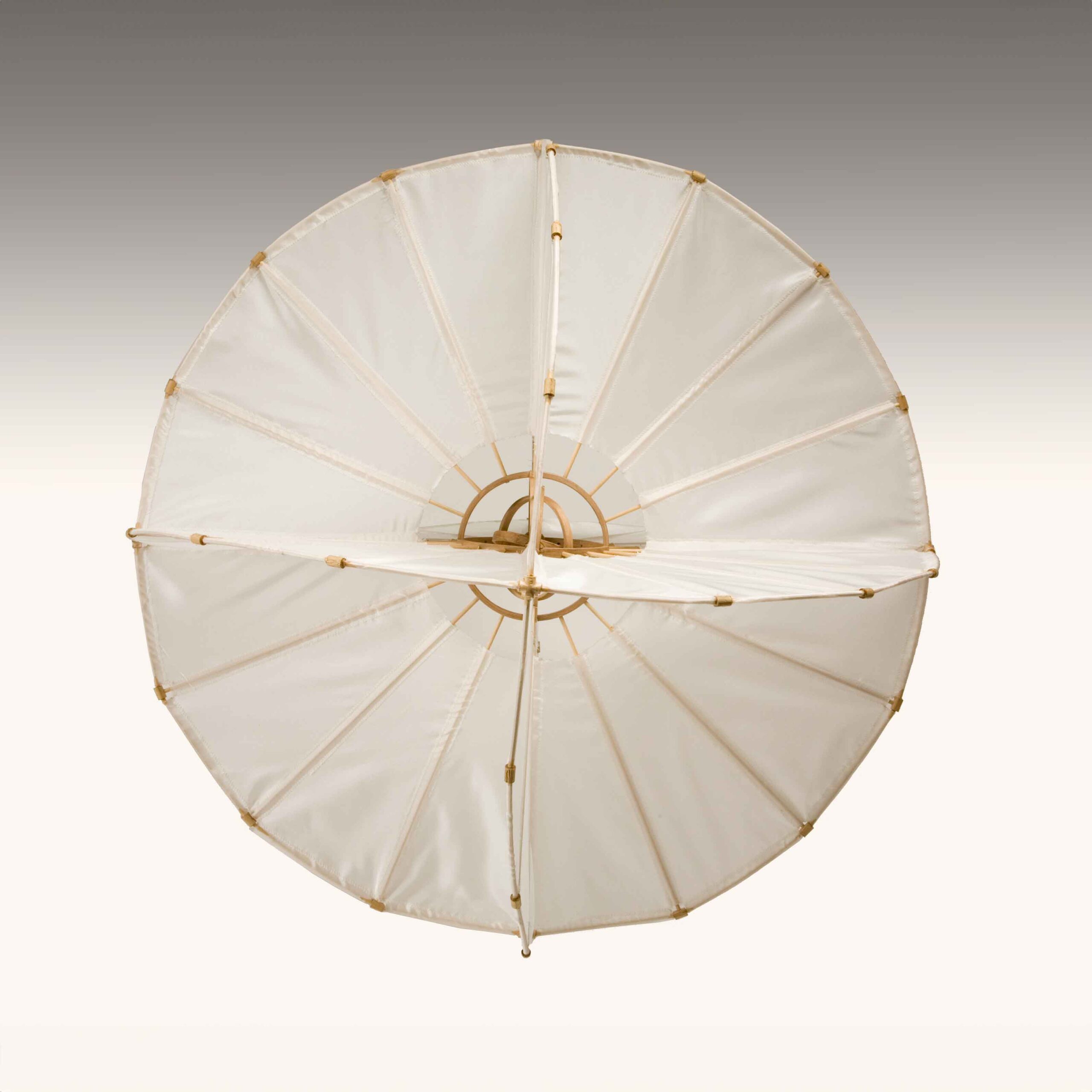
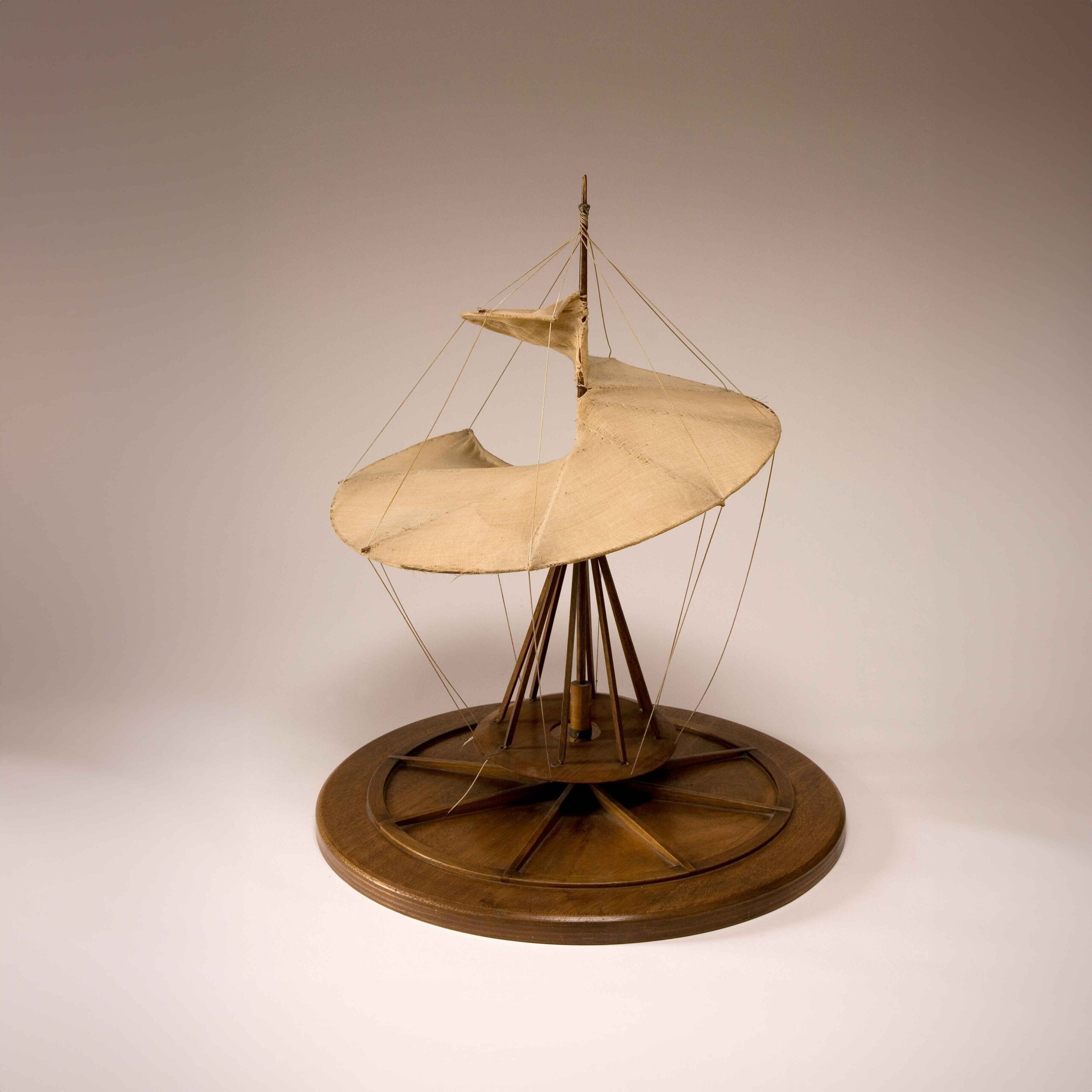
Made by the Scuola di Costruzioni ed Esperienze Aeronautiche at Guidonia and donated to the Museum in 1938, the aerial screw is one of Leonardo’s best known designs, long interpreted as the earliest anticipation of the modern helicopter.

The screw is made of a spiral-shaped linen canvas arranged around a vertical mast, inserted onto a circular platform. By running on the platform and pushing the horizontal bars connected to a central mast, a number of men can operate this screw.
This project is part of the study of the physical and chemical characteristics of air: Leonardo reached the conclusion that air can be compressed and that it has its own material thickness. He therefore retained that a screw-shaped device, if rapidly rotated, could rise in flight by screwing itself into the thickness of the air, in exactly the same manner a common screw can screw into another material.

Technical informations

Type of exhibit
Model
Collection
Material
Wood, iron
Measures
Width: 135 cm, Length: 49 cm, Depth: 27 cm.
Storage location
Relationship with the original work
Source: Leonardo da Vinci, Manuscript B (France), f. 83 v
Inventory number
Record n. OA: 00000006
Location
Museo Leonardiano, Counts Guidi's castle, ground floor

Related exhibits

Last update: 24 June 2025, 09:12

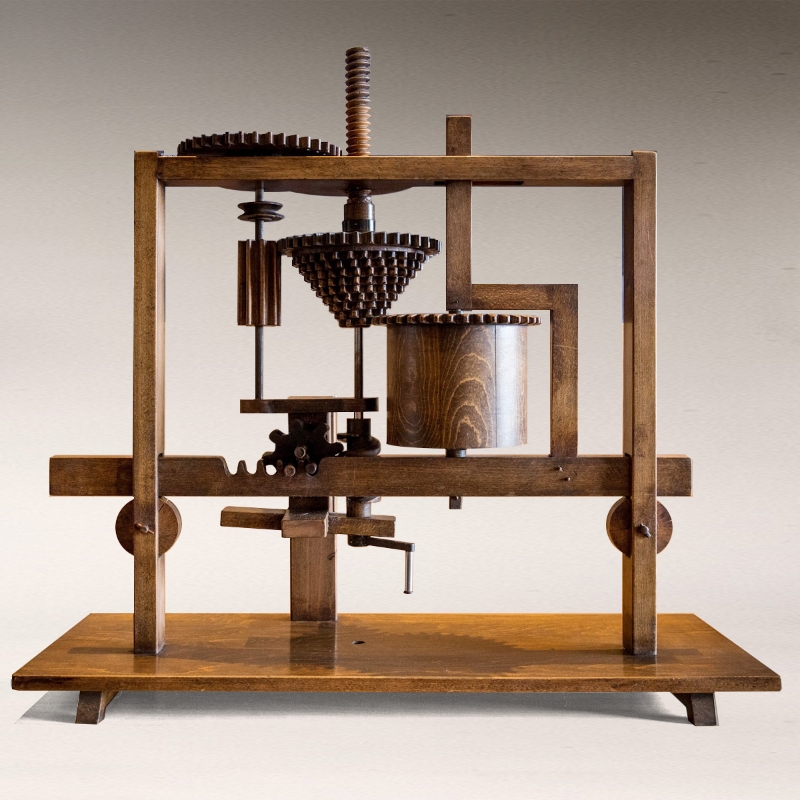
The Chiaravalle tower clock

Luigi Boldetti

1975

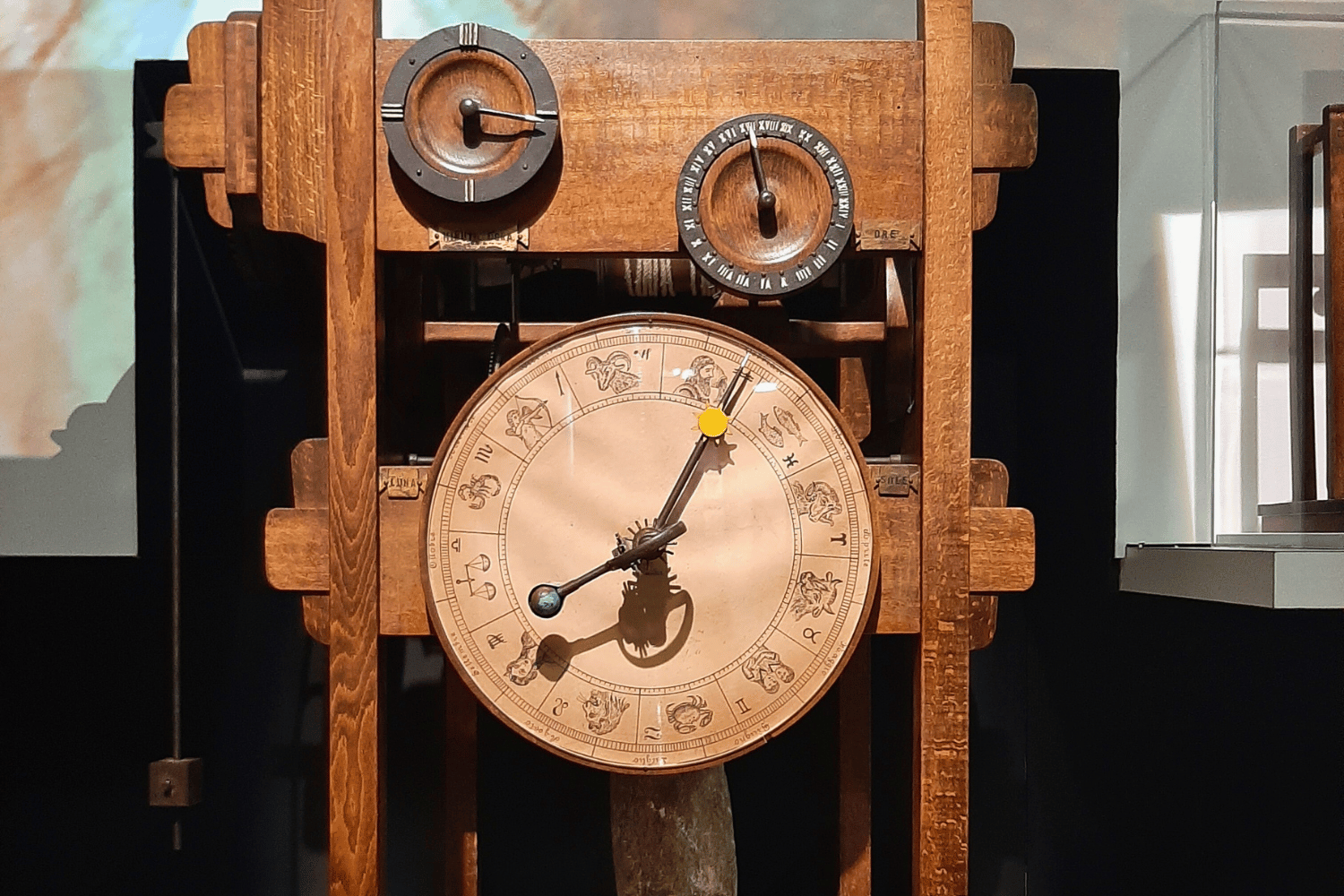
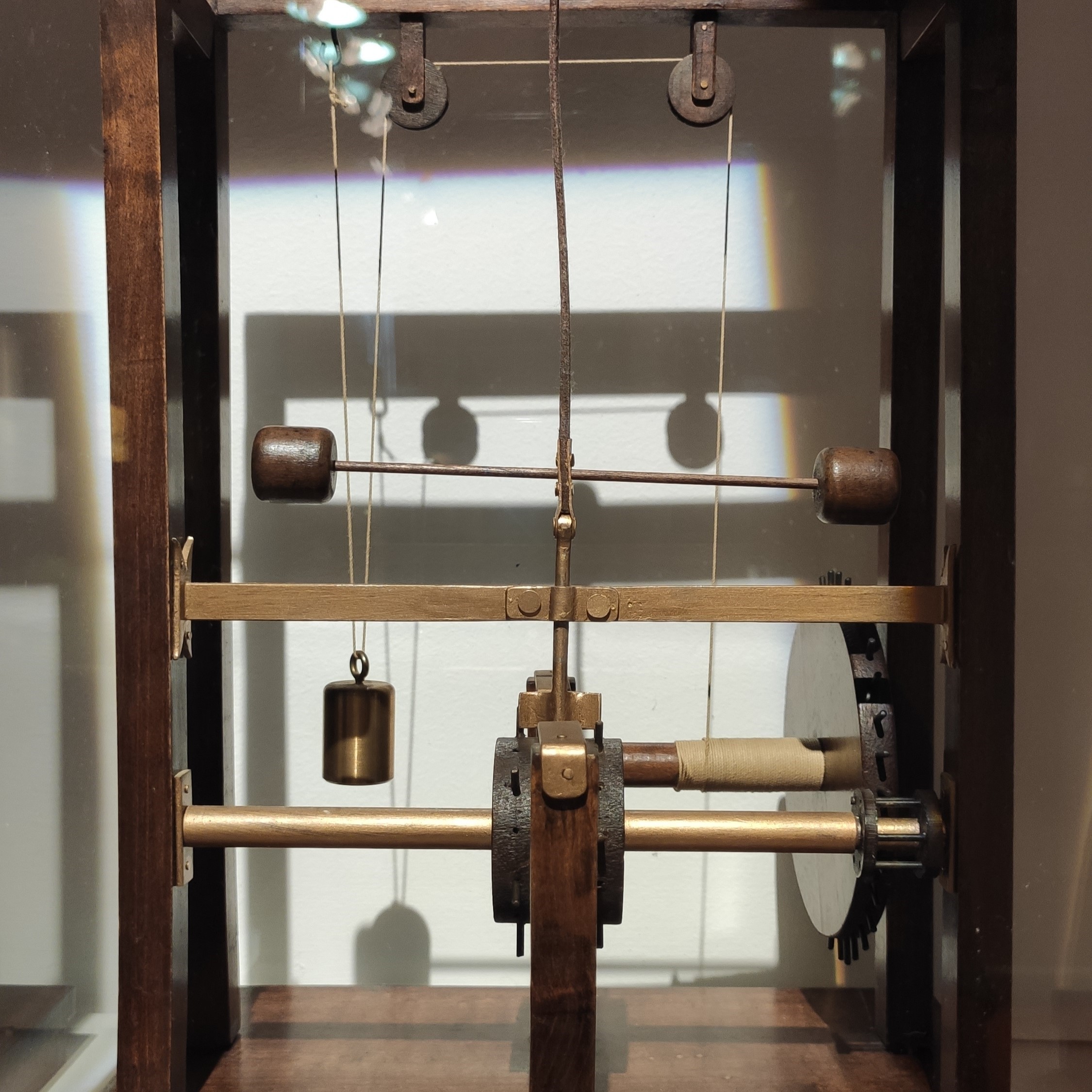
During his stay in Milan, Leonardo devoted many drawings to the study of sophisticated mechanisms for the planetary clock at the nearby abbey of Chiaravalle.

In this model, the moving organ is located inside a wooden structure, where a weight lowers, causing a drum to turn, setting into motion a series of shafts and toothed wheels that carry out ordered sequences of movements.
The internal mechanisms correspond to three clock faces on the outer structure: two smaller ones, for counting the minutes and hours; while on the largest, with its 12 zodiacal divisions for the year, dedicated moving hands show the positions of the sun and moon and the lunar phases, as well as other astrological and astronomical indications.

Technical informations

Type of exhibit
Model
Collection
Material
Wood carving, stone, iron, metal sheet
Measures
Width: 81.5 cm, Length: 75 cm; Depth: 52.7 cm.
Storage location
Relationship with the original work
Source: Leonardo da Vinci, Codex Atlanticus, f. 1111v
Inventory number
Record no. OA: 00000008
Location
Museo Leonardiano, Palazzina Uzielli, first floor

Related exhibits

Last update: 19 June 2025, 14:46

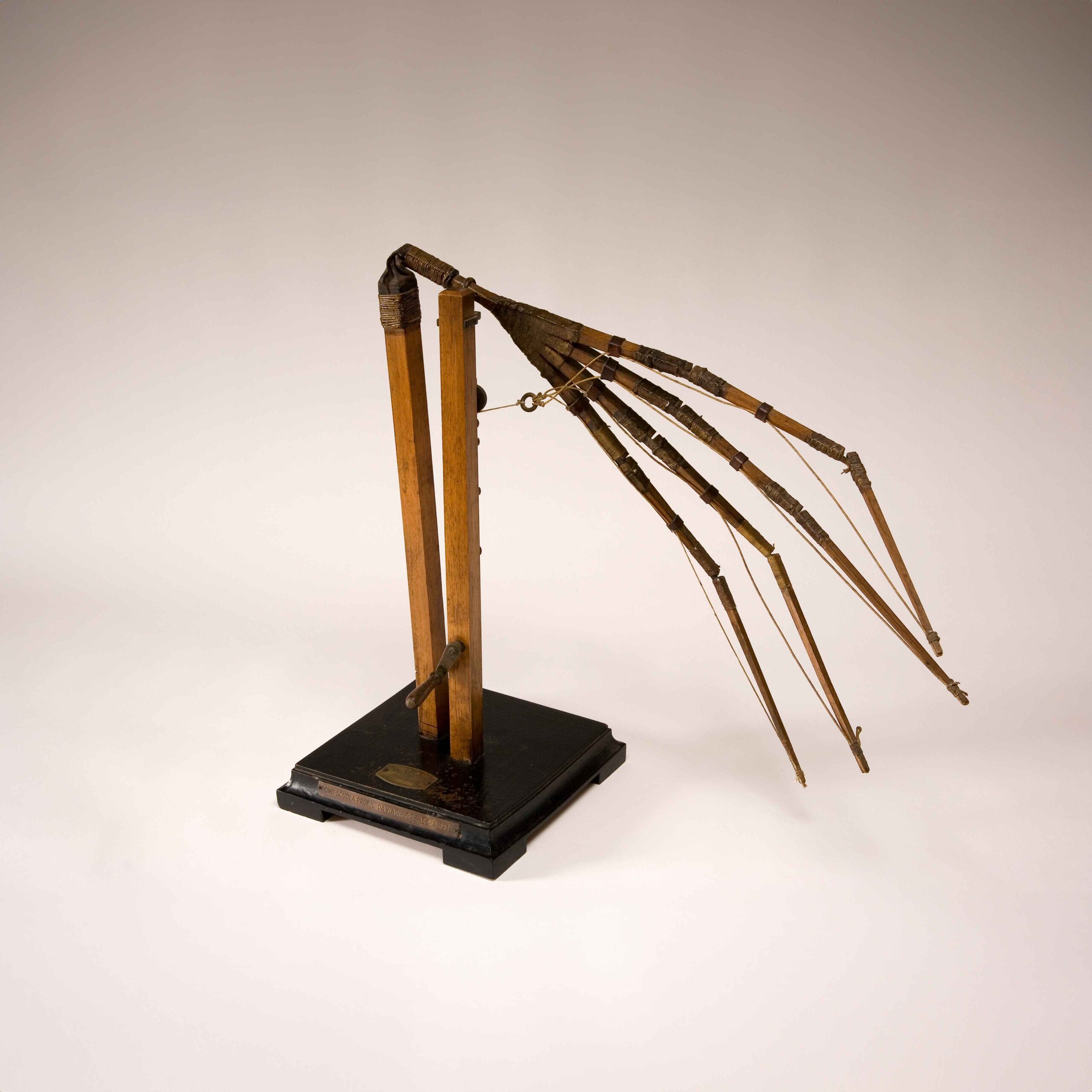
Large jointed wing

Fausto Colombo, Made by
IBM Italia, Giovanni Sacchi

1983

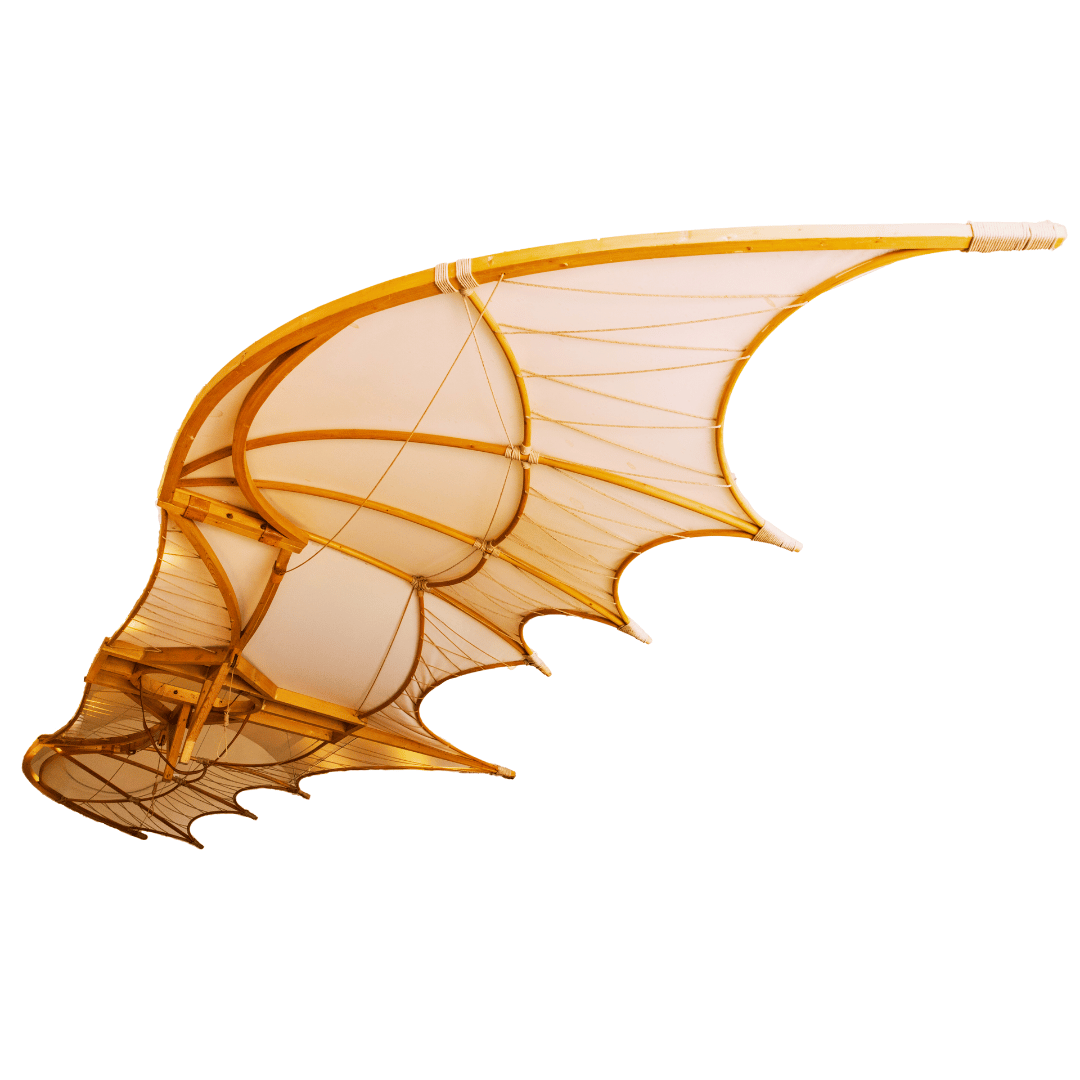
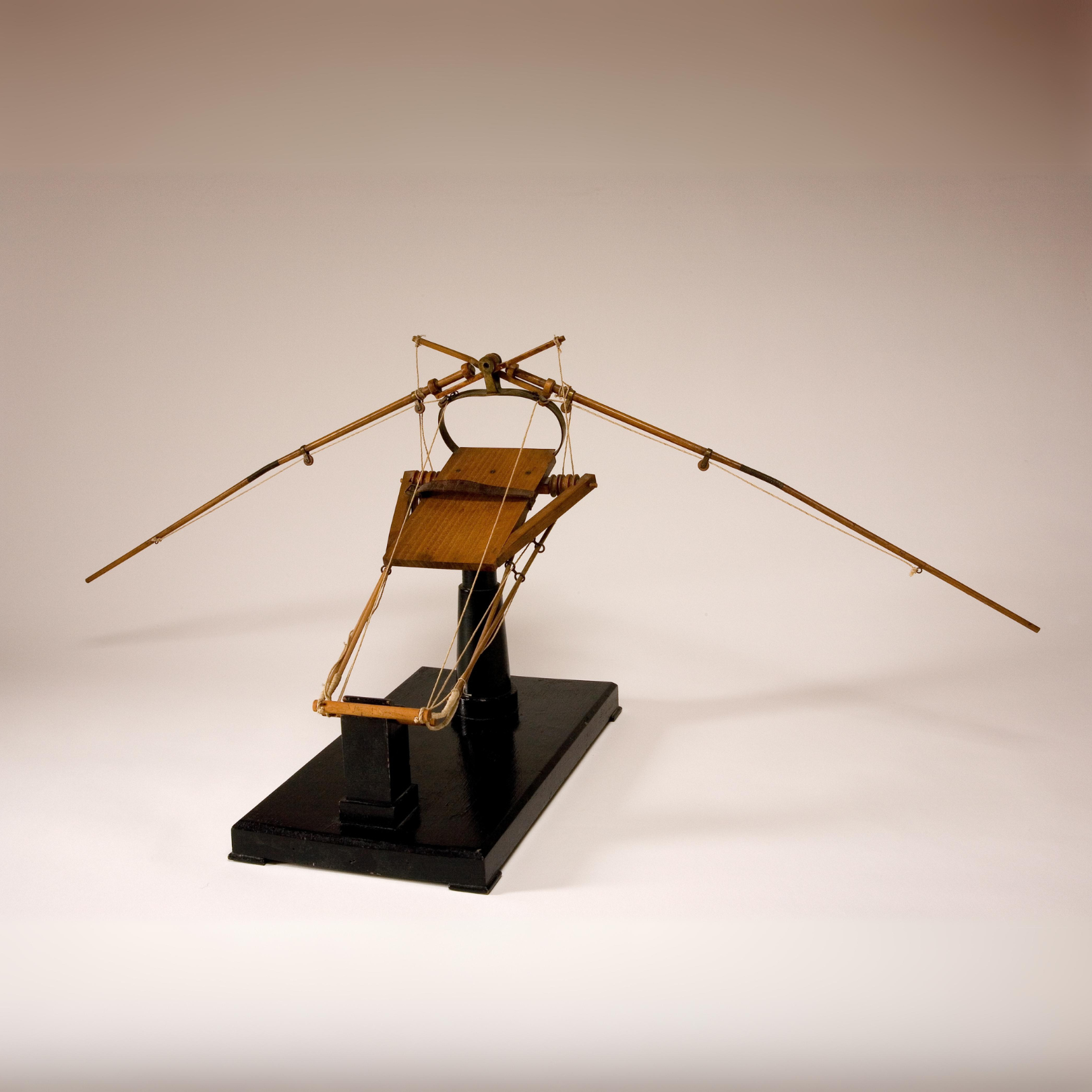
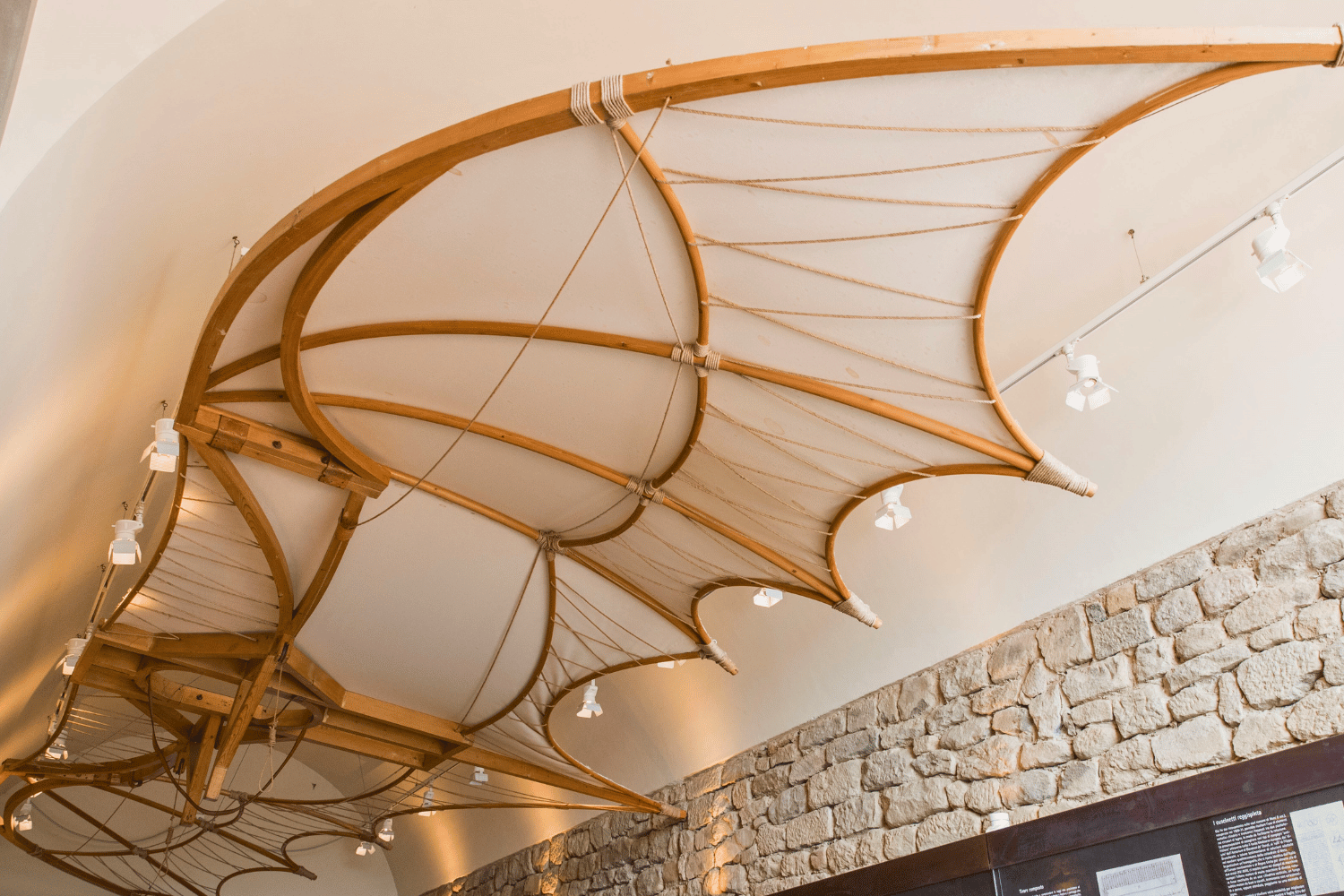
The huge jointed wing hanging in the center of the Museum gallery is taken from some drawings in the Codex Atlanticus, even though these drawings have not made possible a complete interpretation of the machine. This project bears witness to a phase of study when Leonardo was attempting to combine gliding flight with broad movable components controlled by human force using a system of control lines.

After having abandoned his studies for flight by means of beating wings, Leonardo began experimenting with gliding flight and designed a machine blending the two systems together, one that could exploit air currents, like a glider. The wings of the machine, similar in form to those of bats or large birds, are made up of thin ribbings of reeds, held together by cords.
In imitation of the anatomy of birds, the internal sectors of the wings are fixed and rigid, to support the weight, while those on the outside are movable and flexible, having the purpose of guiding the direction. The pilot is supported in vertical position at the center of the device by a harness, where he uses his weight to adjust the machine’s equilibrium. Through a simple system of control lines and pulleys the pilot can determine flight direction.

Technical informations

Type of exhibit
Model
Collection
Material
Carved wood, bamboo cane, hemp ropes, canvas, leather
Measures
Wingspan: 12 m x 3.60 m
Storage location
Relationship with the original work
Source: Leonardo da Vinci, Codex on the Flight of Birds, f. 15 v and 8 r
Inventory number
Record n. OA: 00000049
Location
Museo Leonardiano, Counts Guidi's castle, ground floor

Related exhibits

Last update: 24 June 2025, 09:06

Counterweighted swivel crane

Made by
Università di Firenze, Facoltà di Architettura

1987

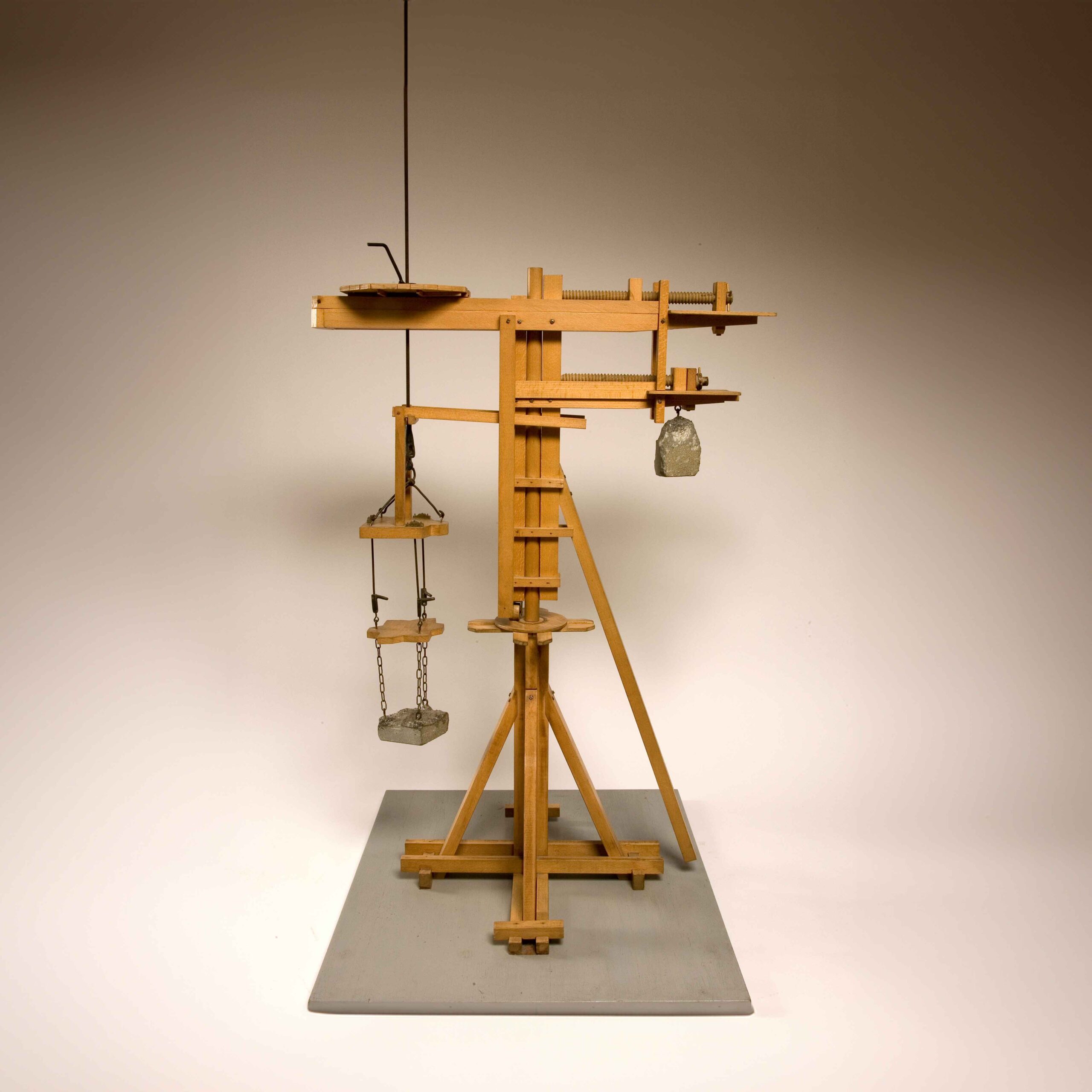
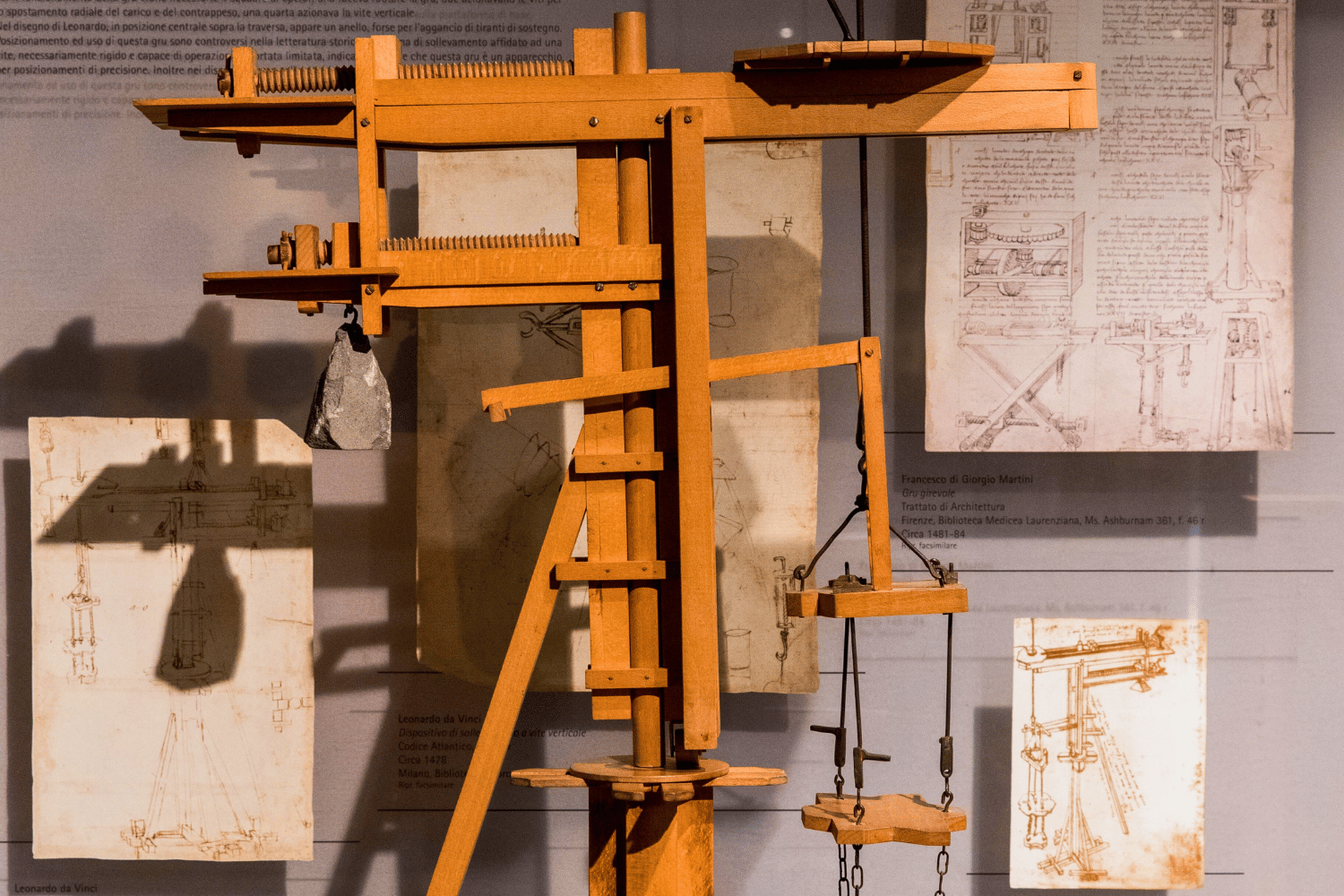
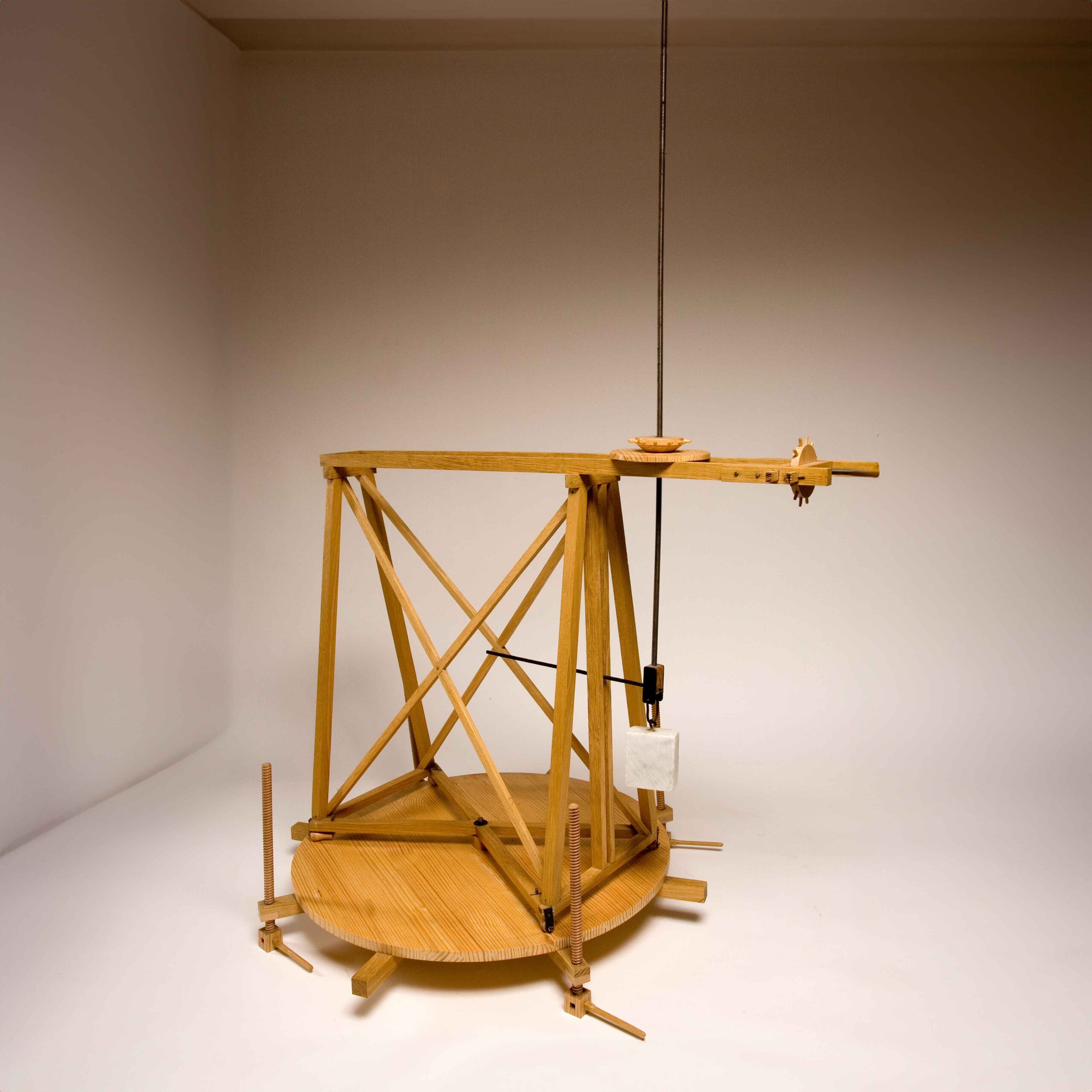
This machine designed by Filippo Brunelleschi represents an important evolution with respect to the medieval stella-type crane. It was used to accurately place heavy marble blocks destined for the construction of the lantern of the Florence Cathedral’s dome. At over 20 meters high, the crane was operated by no fewer than four teams of workers.

One team stood on the ground and was responsible for maneuvering a long oblique beam (rudder) to cause the crane to swivel, up to 360°. Two more teams powered the endless screws to cause the load and counterweight to move simultaneously in opposite directions, always keeping the machine in balance, while the last team lifted and lowered the load by turning a vertical screw.

Technical informations

Type of exhibit
Model
Material
Carved wood, iron, and pietra serena stone
Measures
Width: 103 cm, Length: 59 cm; Depth: 55 cm.
Storage location
Relationship with the original work
Source: Leonardo da Vinci, Codex Atlanticus, f. 965r
Inventory number
Object Record No: 00000026
Location
Museo Leonardiano, Palazzina Uzielli, first floor

Related exhibits

Last update: 19 September 2025, 11:53

How clear is the information on this page?

Thank you, your feedback will help us improve the service!

What were your favorite aspects?1/2

Dove hai incontrato le maggiori difficoltà?1/2

Do you want to add more details?2/2

Enter a maximum of 200 characters

This website is protected by reCAPTCHA. Google Privacy Policy and Terms of Use di applies.