

The guided tour fee does not include the admission ticket to the Leonardo Museum.
Each guide may accompany a maximum of 25 people, according to the following rules: up to 10 people without radio headsets; from 11 to 25 people, radio headsets are mandatory and must be provided by the same agency.
Guided Tour of the Leonardo Museum
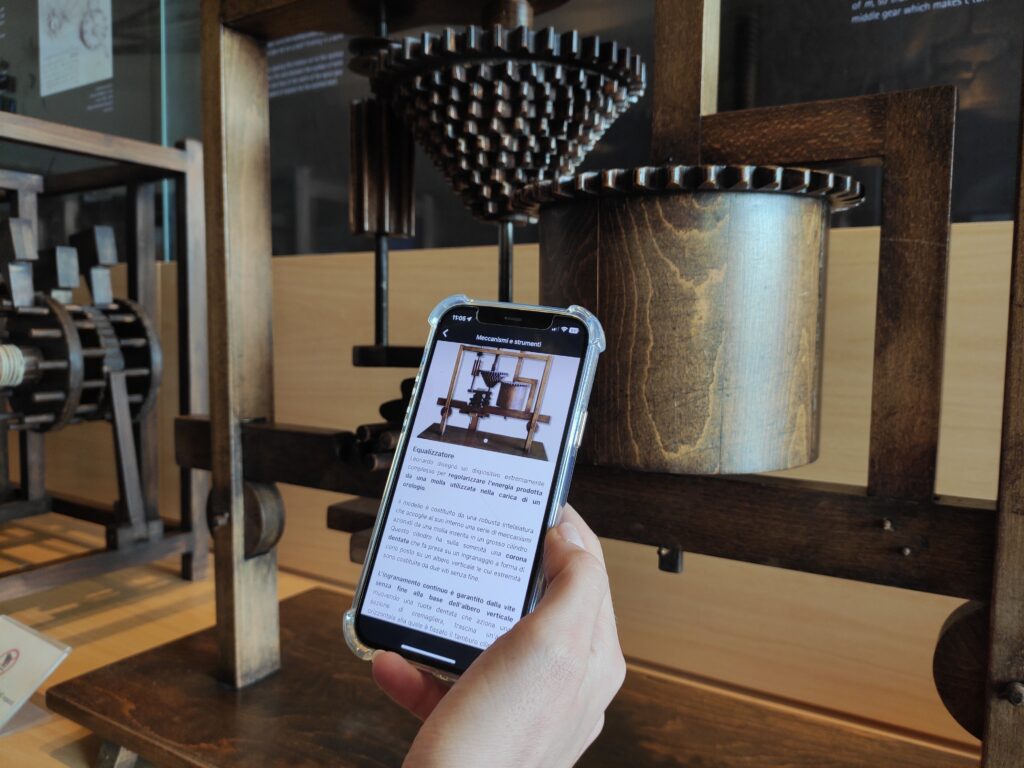
The tour begins at the Palazzina Uzielli, with rooms dedicated to construction machines, textile technologies, and mechanical clocks. It continues on the upper floor with sections focused on Leonardo’s anatomical studies and the mechanical elements he examined with a method similar to that used in his exploration of the human body.
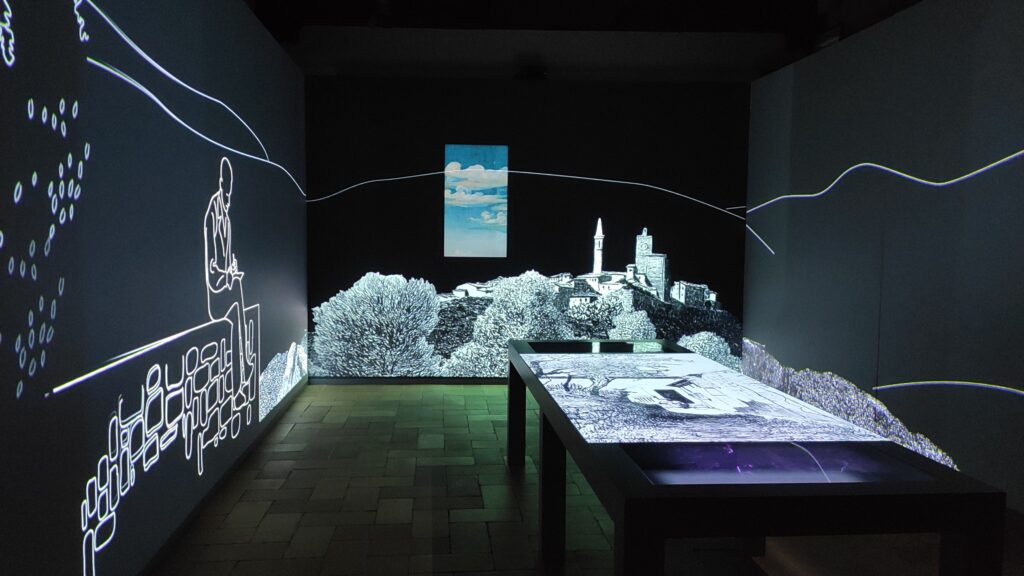
The models on display are accompanied by visual stories taken from period paintings and manuscripts, as well as animated digital reconstructions that help visitors better understand their functions.
The tour then continues inside the Conti Guidi Castle, where the ground floor houses sections on civil engineering and war machines. The large articulated wing model frames the gallery featuring the sections on flight, mechanisms, and tools.
On the upper floor, models, videos, and multimedia installations explore Leonardo’s hydraulic studies—especially those developed for his native land—and the biographical events of his childhood in Vinci.
The visit concludes with a spectacular view from the panoramic terrace atop the Conti Guidi Castle tower.
- Languages available: Italian, English, German, French, and Spanish
- Duration: 1 hour and 30 minutes
Guided Tour of the Leonardo Museum and the “Leonardo and Painting” Section
This guided tour offers a full immersion into the world of Leonardo da Vinci, exploring both his engineering genius and his extraordinary artistic production.
The itinerary begins at the Palazzina Uzielli, where construction machines, textile technologies, and mechanical clocks are on display. On the upper floor, attention shifts to Leonardo’s anatomical studies, highlighting his comparative approach between the human body and machines.
The visit continues to the Conti Guidi Castle, which hosts the sections on civil engineering, war machines, and flight. On the first floor, the tour delves into Leonardo’s hydraulic projects, especially those conceived for Vinci, and his early biographical connections to the town. From the panoramic terrace of the castle, visitors enjoy breathtaking views of the Tuscan hills—landscapes that inspired the Master himself.
The itinerary concludes in the educational and exhibition section Leonardo and Painting, located at Via Roma 23/A. Here, thanks to high-resolution, life-sized reproductions of Leonardo’s paintings, visitors can admire his masterpieces brought together in a single exhibition space. Educational installations and explanatory videos enrich the experience, offering insights and perspectives on Leonardo’s pictorial work.
- Languages available: Italian, English, German, French, and Spanish
- Duration: 2 hours and 30 minutes
Guided Tour of the “Leonardo and Painting” Section
This guided tour is entirely dedicated to exploring Leonardo da Vinci’s painting. It takes place in the exhibition space at Via Roma 23/A, in the heart of Vinci, and offers a unique opportunity to closely examine the masterpieces of the Genius through ultra-high-resolution, life-sized reproductions.
The itinerary winds through Leonardo’s most famous paintings—from the Virgin of the Rocks to the Mona Lisa, from The Last Supper to Saint Anne—giving visitors the chance to see details otherwise invisible. Meanwhile, the guide explains Leonardo’s creative processes and the technical innovations he introduced in rendering the human figure, landscapes, and light.
Multimedia supports, videos, and educational panels enhance the visit, making it particularly suitable for students, families, and art enthusiasts.
- Languages available: Italian, English, German, French, and Spanish
- Duration: 1 hour
Guided Tour of Vinci’s Historic Village
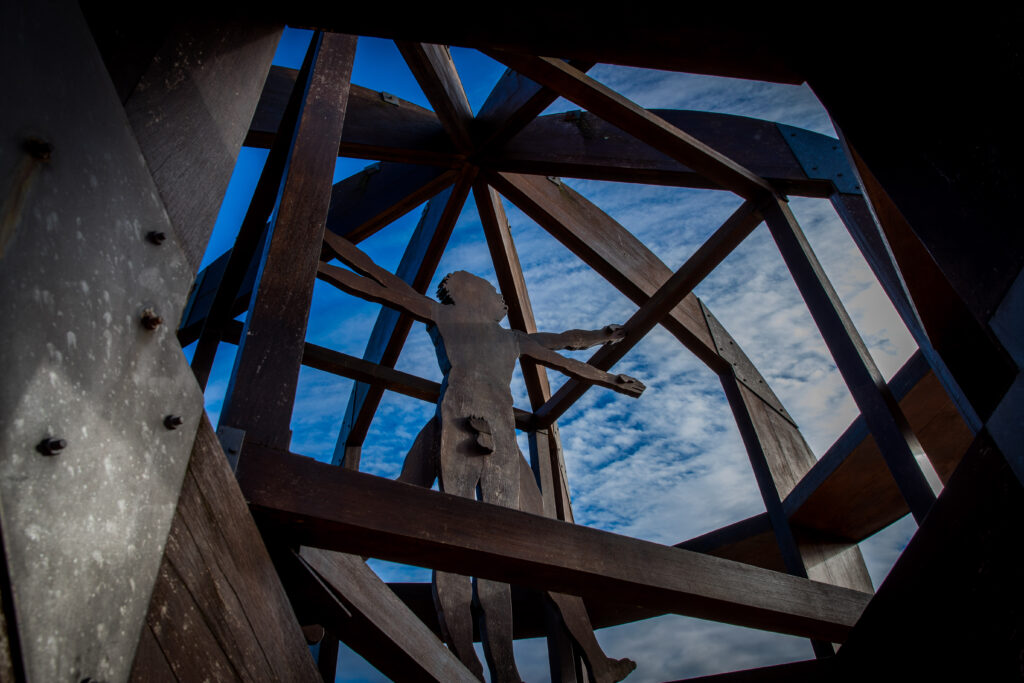
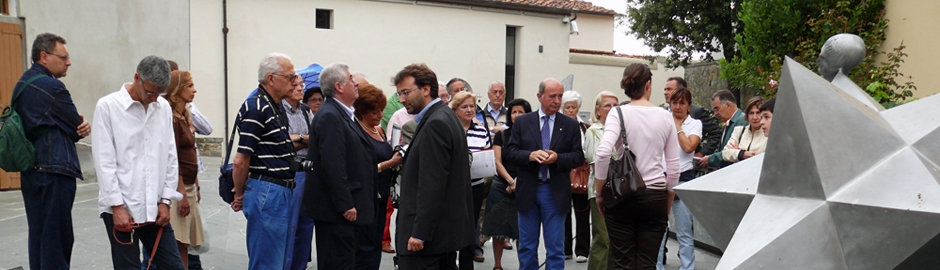
In the panoramic square behind the castle’s entrance stands Mario Ceroli’s large wooden sculpture (1987), a three-dimensional interpretation of Leonardo’s Vitruvian Man. Just a few steps away, on Piazza dei Guidi redesigned by Mimmo Paladino, is the entrance to the Leonardo Museum, housed in both the Palazzina Uzielli and the Conti Guidi Castle.
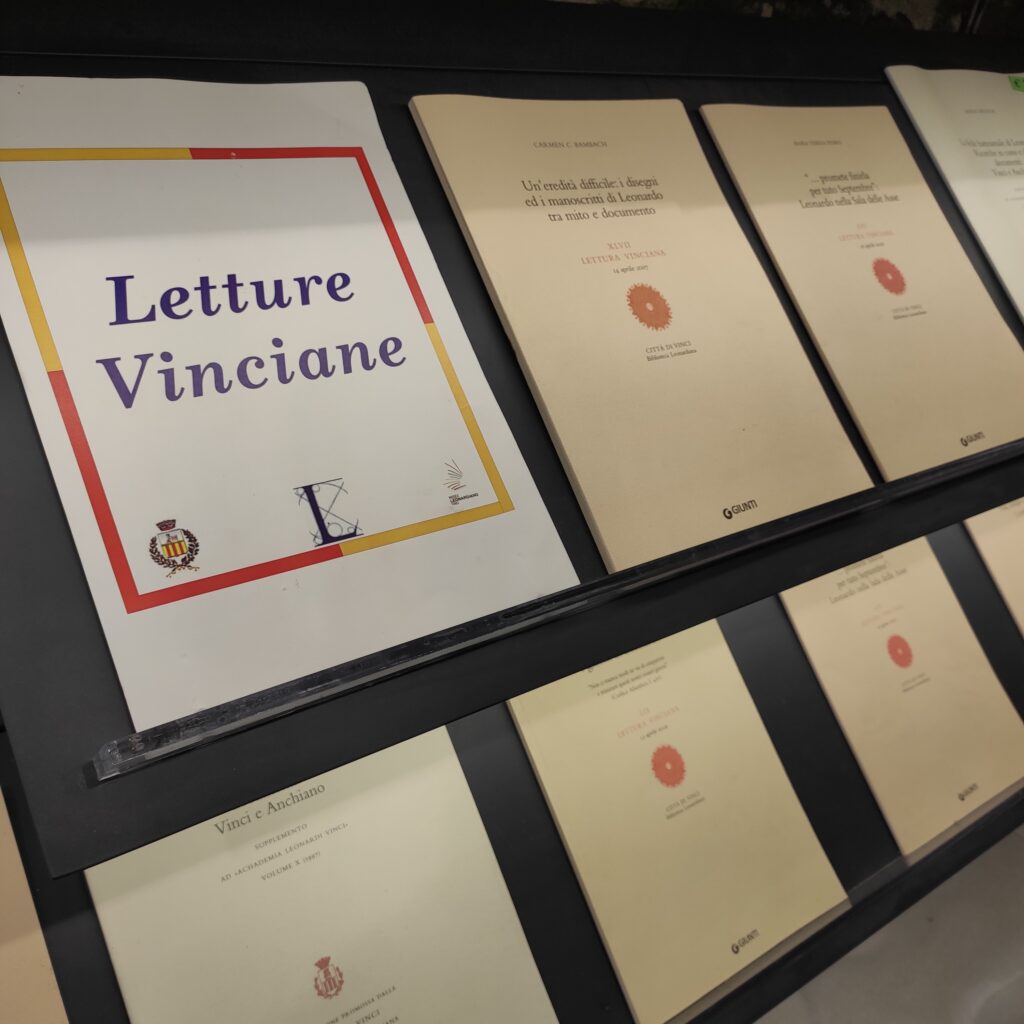
Within the historic walls of the village, the tour also includes the Church of Santa Croce—home to the ancient baptismal font believed to have been used for Leonardo’s baptism—and the Leonardian Library, a documentation center specializing in Leonardo’s works. The library holds facsimile reproductions of all his manuscripts and drawings, along with printed editions of his works.
The itinerary also touches on buildings linked to Leonardo’s family and concludes at the central Piazza della Libertà with the bronze equestrian monument (1997) by sculptor Nina Akamu.
- Languages available: Italian, English, German, French, and Spanish
- Duration: 1 hour
Visit to Leonardo’s Birthplace
Nestled among centuries-old olive trees on the Montalbano hills, in a landscape virtually unchanged over time, Leonardo’s birthplace in Anchiano is a symbolic site of his deep connection to his hometown. In this simple country home, just a few kilometers from Vinci, Leonardo was born on April 15, 1452.
The ancient complex, documented since 1427, was donated in modern times to the Municipality of Vinci by Count Giovanni Rasini of Castelcampo and was converted into a museum in 1952. The visit invites guests to rediscover the origins of the great Tuscan genius and his ties to his native land. Inside the building, digital animations and interactive applications present Leonardo’s artworks and biography. A life-sized hologram of an aged Leonardo, blending video, theater, and documentary, reflects from his final home in Amboise and looks back on his life, sharing his most intimate thoughts.
- Languages available: Italian, English, German, French, and Spanish
- Duration: 1 hour and 30 minutes
Visit to Leonardo’s Birthplace and Walk Along the “Strada Verde”
Stretching for about 2 km between Anchiano and Vinci, the ancient scenic route known as the “Strada Verde” (Green Path) winds through the beautiful Tuscan countryside, surrounded by terraced olive groves typical of the Montalbano hills. It can be walked in complete relaxation in about 30 minutes.
The path partially follows an old route between Vinci and Santa Lucia a Paterno, which included the Anchiano area. This route, likely used for agricultural purposes, is documented as far back as the late 1500s in records from the Captains of the Guelph Party preserved in the State Archives of Florence.
This walk immerses visitors in the unspoiled nature that inspired Leonardo’s early curiosity, love, and devotion. It ends with a visit to Leonardo’s birthplace in Anchiano, a typical 15th-century rural Tuscan house traditionally believed to be where Leonardo was born on April 15, 1452.
- Languages available: Italian, English, German, French, and Spanish
- Duration: 1 hour and 30 minutes
Contacts
Per prenotare visite guidate: