


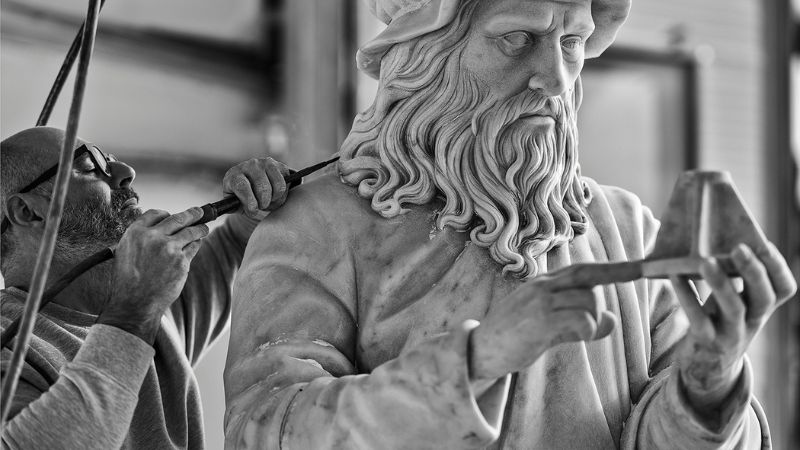
On April 15, 2026, on the anniversary of the birth of Leonardo da Vinci, a monument dedicated to the Renaissance genius will be inaugurated. The work has been conceived and created by the sculptor Filippo Tincolini.
It is a monumental sculpture in White Carrara marble, with a total weight of 5 tons, consisting of a statue depicting Leonardo, 220 cm tall, placed on a 120 cm-high base.
However, the “return” evoked by the title Leonardo Returns to Vinci does not concern the past. As Filippo Tincolini states: “This monument is not a celebration. It is a conversation.”
This is echoed by the Mayor of Vinci, Daniele Vanni:
“April 15 is the day on which our community renews its bond with the Universal Genius. The inauguration of the monument created by Filippo Tincolini represents a moment of great symbolic value for Vinci. It is not simply about welcoming a new work of art into the public space, but about giving form to a living and shared reflection on what Leonardo represents today for the world.
We have worked with conviction alongside the artist on a project capable of interpreting Leonardo not as a distant icon, but as a method, a continuous stimulus to curiosity, research, and dialogue between different fields of knowledge. In this sense, the work fits perfectly within the identity of our city, which does not wish to be merely a guardian of memory, but a contemporary laboratory of ideas.
The process that led to the creation of the sculpture is also particularly significant, as it combines technology and human labor in a virtuous way: an approach that directly recalls Leonardo’s spirit and looks toward the future without forgetting the depth of tradition.
I would like to thank the artist, all the professionals involved, and everyone who contributed to making this project possible. I invite citizens and visitors to experience this work as an opportunity for encounter and reflection, enhancing knowledge and culture as forms of collective growth.”
The monument opens a dialogue between the city, the artist, and all those who will engage with the work over time. It does not say “this is Leonardo,” but rather poses the question to everyone: “who is Leonardo for us today?” This is Leonardo’s lesson: curiosity as the driving force of knowledge, as a continuous impulse to question the world. Leonardo thus returns as a contemporary figure: not as an icon, but as a method, as a constant striving toward knowledge.
Without revealing what visitors will see from April 15 onward, we can instead describe the process from concept to finished work. The sculpture originates from a process that integrates robotic milling and manual finishing, in a continuous dialogue between machine and gesture. Filippo Tincolini is not only the artist who conceived and created the work, but also the one who designed the robot that made its realization possible.
This technology does not replace the artist’s work, but expands its possibilities, making the process itself an integral part of the artwork.
A profound connection is thus established with Leonardo’s legacy: Leonardo was among the first to conceive of the machine as a tool for knowledge because, in his way of working, the machine is never merely a means to do something, but a way to understand how things work.
As with Leonardo, in Filippo Tincolini’s work, art, technique, and research are not separate domains, but parts of a single cognitive process.
The photographic exhibition: Time and the Instant – Genesis of a Work
Laura Veschi followed Filippo Tincolini throughout the creation of the monument to Leonardo.
The photographs reveal the time of sculpture—a time that does not coincide with duration, but with responsibility. Every gesture in working marble is definitive. Every subtraction is irreversible. In this sense, the process is never neutral: it is always a stance, a choice that cannot be undone.
Laura Veschi’s photographs convey this tension with a respectful gaze, remaining close to the material, to the surfaces, to the thresholds where form begins to emerge but is not yet complete.
The use of black and white reinforces this approach: each photograph becomes an entry point into the genesis of the work, a fragment that reveals what normally remains invisible—not the artwork as a result, but the artwork in the process of becoming.
Filippo Tincolini
Filippo Tincolini is an Italian artist who works primarily in sculpture. Born in 1976 in Pontedera, in the province of Pisa, after gaining experience in various foundries and marble workshops in Pietrasanta, he enrolled in the School of Sculpture at the Academy of Fine Arts in Carrara. In 2001, after completing his studies, he opened his own studio in Fantiscritti, at the foot of the marble quarries, where he still creates his works today.
The Carrara region, where the artist lives and works, has had a strong impact on his sculptural research, which is mainly expressed through the use of white marble, a material he explores in an experimental way. Tincolini’s artistic approach has always aimed to harmoniously combine distant worlds such as craftsmanship and technology, tradition and visionary spirit, the canons of classical sculpture and pop influences, mythology and comics.
He is currently represented by private galleries and continues to exhibit in both public and private spaces.
Laura Veschi
After graduating from the University of Florence in Educational Sciences, she has dedicated herself to photography since 2016. She attended a corporate photography course at the Marangoni School in Florence and a masterclass organized by Spazi Fotografici in Sarzana. She collaborates with the London-based art gallery Avantarte.
Among her solo exhibitions: Anime Resistenti (2023, Santa Caterina dello Ionio), an anthropological project dedicated to the Calabrian town and its inhabitants; and HC Resonance (2025, Pietrasanta). For the Royal Museums of Turin, she documented the creation of the copy of the statue Allegory of Spring by Simone Martinez.
She has published Ritorno a casa, a book born from her encounter with the sculptor Fabio Viale; Sentire la forma, the catalogue of sculptor Beatrice Taponecco’s exhibition; and Human Connections, the catalogue of Filippo Tincolini’s exhibition. Her upcoming publication with 5 Continents is titled Everything Flow.